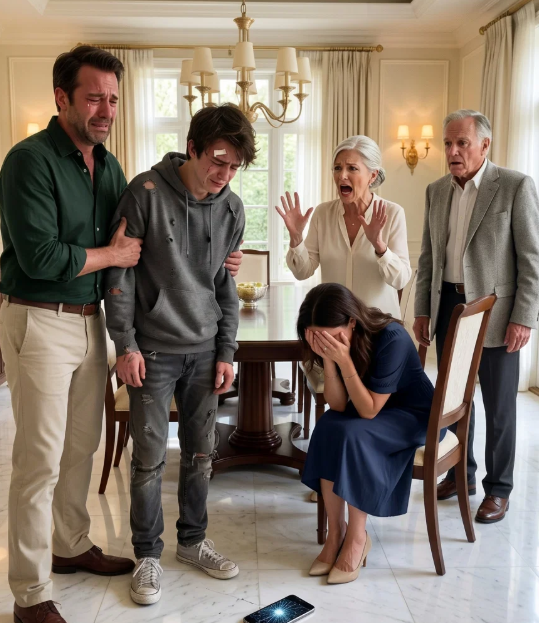
“Let him bleed. One less problem for this family.”
For several seconds, nobody moved.
Even Melissa stopped crying.
My mother seemed to realize what she had said, but she didn’t apologize.
I called 911 again and put the phone on speaker.
Dad’s face went pale when the dispatcher said officers were already coming.
A passing truck driver had seen the wreck from the highway and reported it.
Melissa suddenly grabbed my arm.
“Daniel, please. Tell them Dad was driving.”
I pulled away.
“No.”
Mom stepped closer.
“You don’t understand what this will do to your sister.”
I looked down at Evan.
His eyes were closing.
Then I noticed something beside the crushed passenger door.
A phone.
Evan’s phone.
The screen was cracked, but it was still recording.
A red timer kept counting.
My mother followed my gaze.
Her expression changed instantly.
She understood.
Everything she had just said was recorded.
And through the rain, blue lights appeared in the distance.
The first ambulance arrived less than three minutes later.
Two paramedics rushed to Evan while a sheriff’s deputy ordered everyone else away from the SUV.
I stayed beside my son until a paramedic gently pushed me back.
“We need room, sir.”
Evan had a fractured collarbone, two broken ribs, a deep cut above his ear, and signs of internal bleeding. The paramedics stabilized his neck and loaded him onto a stretcher.
I rode with him in the ambulance.
Behind us, I saw Melissa talking to Deputy Harris with my father close beside her.
Mom stared at Evan’s phone in my hand.
She looked terrified.
At the hospital, doctors rushed Evan into surgery.
A trauma surgeon told me his spleen had ruptured.
Another thirty minutes without treatment, he said, could have changed everything.
I sat alone in the waiting room, covered in my son’s blood.
At 11:06 p.m., Deputy Harris arrived.
He asked to speak privately.
I handed him Evan’s phone.
“There’s a recording on there.”
He listened silently.
The video had started moments before the crash because Evan was filming himself complaining about Melissa’s driving.
Her voice was clear.
“You’re such a baby. I’m barely over the limit.”
Then Evan said, “You don’t even have a license.”
Melissa replied, “Mom said nobody cares.”
Seconds later, the car swerved.
Screaming.
Impact.
The camera went dark.
But it kept recording.
For the next twenty-seven minutes, it captured every conversation near the wreck.
My father telling Melissa to move away from the driver’s side.
My mother telling Dad to wipe the steering wheel.
Melissa asking if Evan was going to die.
Dad saying, “He’ll be fine. We need to protect you first.”
And finally, Mom.
“Let him bleed. One less problem for this family.”
Deputy Harris stopped the video.
His expression had changed.
“Did you know they were trying to stage the scene?”
“No.”
He nodded slowly.
“Your father told the first responding officer he was driving.”
I laughed once, though nothing was funny.
The lie lasted less than an hour.
The truck driver who reported the crash had a dashboard camera.
His footage showed Melissa climbing from the driver’s door.
By 1:30 a.m., Melissa was arrested on suspicion of driving while revoked, reckless driving causing serious bodily injury, and leaving an injured person without reasonable assistance.
My father was questioned for making a false statement.
Mom refused to speak without a lawyer.
At 3:12 a.m., the surgeon finally came out.
Evan had survived.
He would recover.
But the doctor warned that emotional recovery might take much longer.
When I entered his room the next morning, Evan looked smaller than I had ever seen him.
He opened his eyes.
“Did Grandma really say that?”
My chest tightened.
He had heard everything.