For several seconds, nobody spoke.
Sergio’s smile disappeared first.
Then Rocío’s.
Her eyes moved from me to the officers, then to the boxes stacked beside the doorway.
Finally, they landed on my wedding ring.
“What the hell is this?” Sergio asked.
One of the officers stepped forward before I could answer.
“Señor Lozano?”
Sergio looked at him.
“Yes.”
“We need you to remain calm.”
“This is my home.”
“No,” I said.
Everybody looked at me.
My voice shook.
But only once.
“This is my apartment.”
Sergio turned slowly.
“You really want to do this?”
I looked at the medical report lying beneath my ring.
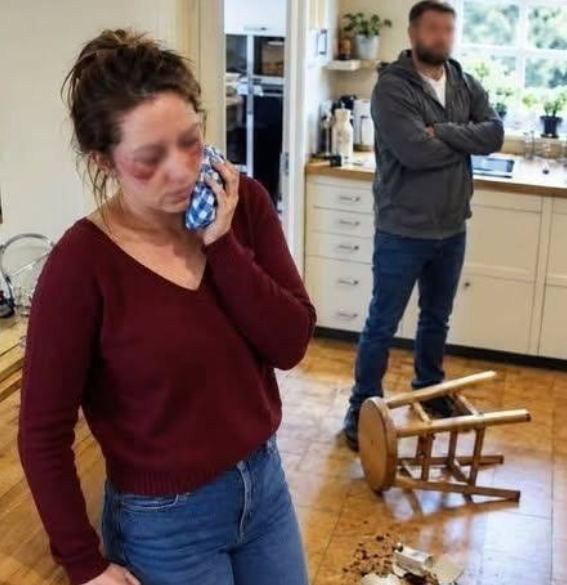
Then at the faint red swelling still visible along my cheek and neck despite the treatment.
“You already did it.”
Rocío crossed her arms.
“Oh, please. Sergio said you had an argument.”
One of the officers looked at her.
“This is not your conversation.”
She flushed.
“I’m his sister.”
“That changes nothing.”
For the first time in years, someone told Rocío that being Sergio’s sister did not grant her jurisdiction over the entire room.
I almost smiled.
Almost.
Sergio took one step toward me.
The officer moved between us immediately.
“Stay where you are.”
Sergio lifted both hands.
“I’m not doing anything.”
I stared at him.
That sentence.
How many times had I heard versions of it?
I’m not shouting.
I’m not threatening you.
I’m not controlling you.
I’m not forcing you.
You’re too sensitive.
You misunderstood.
It was just coffee.
Except it had never been just coffee.
The coffee was simply the first thing that left evidence on my skin.
Sergio pointed toward the boxes.
“She’s taking everything.”
“No,” I said.
“I am taking my belongings.”
“You can’t empty the apartment.”
“I’m not.”
I had been painfully careful about that.
I took my clothes.
My work equipment.
My personal documents.
Jewelry inherited from my mother.
Items I had owned before the marriage.
Several pieces I could clearly document as mine.
I left the sofa.
Television.
Dining table.
Most kitchen equipment.
His clothing.
His electronics.
Anything that might reasonably become disputed later.
Even the expensive espresso machine I had paid for remained on the counter because I did not want a fight over a coffee appliance to complicate a case involving coffee thrown into my face.
There are moments when winning the object is less important than protecting the record.
I was learning quickly.
Rocío walked toward the bedroom hallway.
“I’m going to see what she took.”
The second officer stepped sideways.
“No.”
She stared at him.
“I said I just want to see.”
“And I said no.”
“But some of those things are mine.”
That caught my attention.
“Which things?”
She hesitated.
“My coat.”
“What coat?”
“The beige one.”
I looked at her.
“That belonged to my mother.”
Rocío rolled her eyes.
“You gave it to me.”
“No.”
“You let me borrow it.”
“Exactly.”
“That was months ago.”
“Borrowing does not become ownership because enough time passes.”
She looked toward Sergio.
He started:
“Elena, don’t be ridiculous—”
The officer cut him off.
“Stop.”
The room went still again.
Rocío stared at me with pure hatred.
Not because she had lost a coat.
Because for the first time, I had used the word mine and nobody in the room had corrected me.
Sergio looked at the medical report.
Then at my face.
Something flickered across his expression.
Not remorse.
Calculation.
“Elena.”
I knew that tone.
Soft.
Controlled.
The one he used when witnesses appeared.
“You know I didn’t mean to hurt you.”
The officer beside me looked at him.
Sergio corrected himself immediately.
“It slipped.”
I almost laughed.
“You threw it.”
“No.”
“You picked up the mug.”
“Elena—”
“You looked directly at me.”
“Stop exaggerating.”
“And then you threw it.”
Rocío muttered:
“She makes everything dramatic.”
I turned toward her.
“I have photographs.”
Silence.
“The hospital has photographs.”
Sergio’s jaw tightened.
“The police have my statement.”
I touched the edge of the report.
“And I am finished arguing about what happened with people who were not there.”
Rocío’s mouth closed.
The officers did not arrest Sergio in the living room for theatrical effect.
They documented.
Asked questions.
Explained what would happen next.
There had already been an initial complaint and medical evidence.
Further decisions would be made through the proper legal process.
I did not control that process.
I did not need to.
What I controlled was whether I stayed.
I had already answered that.
Sergio stared at the half-empty room.
“Where are you going?”
I looked at him.
“That is no longer information you’re entitled to.”
His expression changed.
“Elena.”
“No.”
“You’re my wife.”
“Currently.”
Rocío gasped.
Sergio’s face hardened.
“You’re seriously talking about divorce over one argument?”
“No.”
“Over one cup of coffee?”
“No.”
“Then what?”
I looked at him.
“Over the part where you believed my body, my money, my home, and my belongings were yours to allocate.”
He said nothing.
I continued.
“The coffee only made it visible.”
That night, I stayed with my friend Lucía.
She did not ask me why I had waited so long.
I loved her for that.
She gave me clean sheets.
Tea.
Pain medication according to the hospital instructions.
Then sat outside the guest-room door while I cried in the dark.
Not because I missed Sergio.
That would come later in strange, humiliating waves.
I cried because leaving an abusive relationship does not instantly make your nervous system understand that the danger is over.
My body still expected footsteps.
A raised voice.
A slammed cabinet.
A demand disguised as a conversation.
At 2:30 in the morning, I woke because Lucía dropped a spoon in the kitchen.
I nearly screamed.
That was when I understood how frightened I had actually become.
The next day, I met with a lawyer named Marta Salcedo.
I brought everything.
Apartment purchase documents.
Marriage certificate.
Bank statements.
Medical report.
Photographs.
Messages.
Records of transfers to Rocío.
Screenshots of Sergio telling me things like:
Send her 300. Don’t make this difficult.
Give Rocío the blue dress. She needs it more than you.
Why do you always make me choose between my wife and my sister?
And my favorite:
If you loved me, you would stop counting what is yours and mine.
Marta read that one twice.
Then looked up.
“Did he feel the same way about his salary?”
I laughed for the first time in twenty-four hours.
“No.”
“Interesting.”
The apartment had been mine before the marriage.
That mattered.
It did not mean every question vanished automatically.
Marriage creates financial and occupancy issues more complicated than a sentence like:
I bought it first.
But ownership documentation gave me a strong starting point.
Marta’s advice was precise.
Do not change locks impulsively without confirming what you are legally permitted to do under the circumstances.
Do not throw Sergio’s property into the street.
Do not empty joint accounts.
Do not destroy anything.
Do not communicate by phone if written communication will do.
Preserve everything.
Follow any protective measures ordered by the authorities.
Separate immediate safety from long-term property questions.
It was not satisfying advice.
Which made me trust it.
The first temporary protective measures came quickly.
Not because judges automatically believe every complaint.
Because the medical documentation, my statement, and the surrounding facts were sufficient to justify immediate caution while the matter proceeded.
Sergio was required to respect distance and communication restrictions that applied under the order.
I returned to the apartment under controlled circumstances.
This time, I changed the locks only after confirming I was legally entitled to do so.
I stood in the hallway holding the new key and cried.
Not dramatically.
Quietly.
Because keys become emotional objects when someone has spent years convincing you that ownership is selfish.
The apartment felt enormous without him.
Not physically.
Acoustically.
No television shouting from the living room.
No Sergio calling from another room:
“Elena?”
That tone that never meant:
I love you.
It meant:
Come perform a task.
I walked through every room.
Opened closets.
Closed them.
Moved nothing.
Then went into the kitchen.
His coffee mug was still there.
The one he had thrown had shattered during the incident.
But another from the same set remained in the cabinet.
I picked it up.
Held it.
Then put it in a box marked:
SERGIO — PERSONAL / HOUSEHOLD ITEMS
Not smashed.
Not burned.
Not thrown from a balcony.
Boxed.
Documented.
Boring.
Beautiful.
Rocío began calling from different numbers.
I blocked each one.
Then emails came.
The first was furious.
You destroyed my brother’s life.
The second:
You’ve always hated me.
The third:
At least give back the things Sergio bought you.
That one made me stop.
I forwarded it to Marta.
Then made a list.
Things Sergio had bought me during seven years together.
Perfume.
Shoes.
A bracelet.
Several dresses.
Household items.
Birthday gifts.
Anniversary gifts.
There were also things I bought him.
Watch.
Laptop.
Weekend trips.
Furniture.
Car repairs.
Marriage is not a retail return counter.
Marta told me not to start inventing debts out of ordinary gifts.
Good.
I was angry enough that I needed someone paid to keep anger boring.
Then came the money.
That was where the marriage looked different on paper.
Over three years, I had transferred money to Rocío forty-seven times.
Small amounts mostly.
€80.
€150.
€220.
€400.
Occasionally more.
Total:
€13,860.
I stared at the figure.
Not because it would ruin me.
It would not.
But because I remembered almost every transfer beginning with:
Just this once.
I searched Sergio’s transfers to Rocío during the same period.
€1,240.
I laughed.
Then I cried.
The generosity had always been mine.
The authority had always been his.
That was the arrangement.
The deeper financial review found something worse.
Not theft.
Not a secret emptied account.
Something subtler.
Sergio had been telling Rocío what I earned.
My savings.
My annual bonus.
The approximate balance in my personal account.
He knew because we were married and because I had once shared financial information in good faith.
Then he used that knowledge to decide what I could “afford” to give his sister.
Messages between them later obtained through the legal process showed the pattern.
Rocío:
Ask her for 600. She has it.
Sergio:
She’ll complain.
Rocío:
Then make her.
Sergio:
Leave it to me.
Another:
Rocío:
I want the green handbag.
Sergio:
She never uses it.
Rocío:
Related Posts