
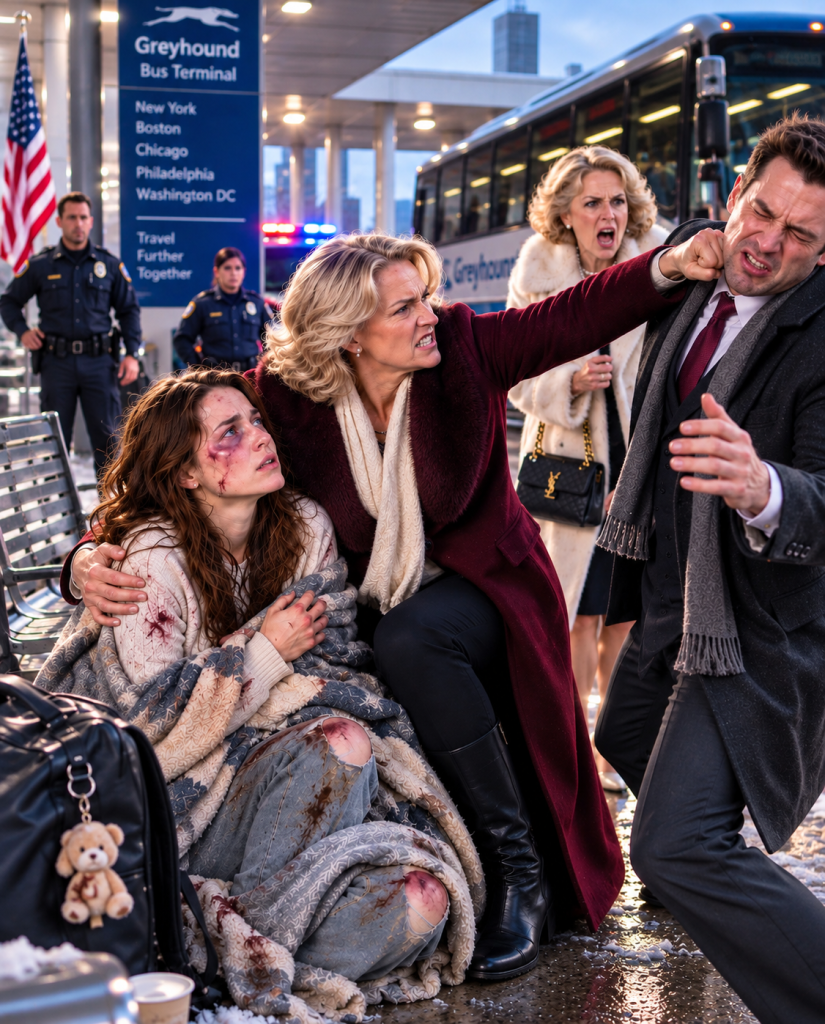
One of them, a woman named Denise, looked at me.
“You riding with us?”
“Yes.”
My phone rang as the rear doors closed.
Marcus.
I stared at his name until the screen went dark.
Then it rang again.
I turned the phone over.
At St. Matthew’s Hospital, Thanksgiving decorations hung from the nurses’ station—paper turkeys, orange leaves, a crooked banner made by someone’s grandchildren.
The ordinary cheerfulness of it made my chest ache.
A nurse took Chloe behind double doors while I stood alone beneath a television playing a morning parade.
For twenty-four years as a federal prosecutor, I had learned that waiting rooms revealed character better than courtrooms.
People under pressure did small things.
They checked doors.
They lied about time.
They rehearsed explanations.
They called the wrong person first.
Marcus had already called me nine times.
Sylvia twice.
At 6:31, a text arrived.
MARCUS: Eleanor, I think Chloe exaggerated what happened. She left voluntarily. Call me before you start making problems.
Three minutes later:
MARCUS: She was drinking.
Chloe barely drank wine.
At 6:39:
MARCUS: My mother is upset. Please do not ruin Thanksgiving over another one of Chloe’s episodes.
Another one.
I read that phrase twice.
Then I took a screenshot.
I did not answer.
At 7:08, Dr. Priya Patel came into the waiting room.
She was perhaps forty, wearing blue scrubs and the calm expression of someone accustomed to delivering information people desperately wanted but could not control.
“Mrs. Bennett?”
I stood.
“Your daughter is stable.”
The breath I had been holding left me so suddenly I had to grip the chair.
Dr. Patel continued.
“She’s significantly dehydrated and mildly hypothermic. She has some bruising that we’ll document, but nothing we’ve found suggests life-threatening injury. We’re also running blood work because she seems unusually weak and disoriented.”
“Can I see her?”
“In a few minutes.”
“Was she drinking?”
Dr. Patel gave me a careful look.
“Her blood alcohol level is effectively negligible.”
I nodded.
One lie gone.
But not forgotten.
“She mentioned she hadn’t eaten since yesterday afternoon,” the doctor added. “Do you know why?”
“No.”
Another small fact.
Facts were stones. One by one, they made a path.
When I finally entered Chloe’s room, she was awake.
A warmed blanket covered her to the chin. Her hair lay tangled against the pillow, and one eye was swollen enough that she kept it half closed.
When she saw me, her face changed.
Not dramatically.
It simply softened.
“Mom.”
I sat beside her.
For several minutes, neither of us said anything.
I held her hand.
She watched the IV drip.
Finally, she whispered, “I’m sorry.”
I almost laughed.
Not because anything was funny.
Because apology was so completely misplaced that I could not understand how she had arrived at it.
“For what?”
“Thanksgiving.”
I leaned closer.
“Chloe, look at me.”
She did.
“There is no dinner in the world important enough for you to apologize for this morning.”
Her lips trembled.
“I should have told you.”
“Told me what?”
She looked toward the door.
“About Marcus.”
I waited.
“He’s been different for almost a year.”
Different.
It was a word families used when the real words were still too painful.
“Different how?”
“Secretive. Controlling about money. Worried about appearances.” She swallowed. “He started saying my job embarrassed him because I earned more before his promotion. Then after he got promoted, he wanted me to quit.”
“Did you?”
“No.”
A tiny spark of the daughter I knew appeared.
“He told people I was thinking about it.”
“What people?”
“His mother. His boss. Friends.”
“And were you?”
“No.”
I squeezed her hand.
“Why didn’t you tell me?”
Her expression became almost apologetic again.
“Because every time I visited, you looked so peaceful.”
That answer hurt more than accusation would have.
Peaceful.
She had mistaken my quiet house for a fragile thing she needed to protect.
“I thought you’d already lost Dad,” she continued. “I thought I could handle my own marriage.”
“You never have to protect me from knowing your life.”
“I know that now.”
A nurse came in to adjust the IV. We stopped talking until she left.
Then Chloe said, “There’s more.”
I already knew there would be.
“There’s a woman named Vanessa Cole.”
“The mistress?”
Chloe flinched at the word.
“Maybe. I don’t know anymore.”
“What does that mean?”
“I found messages between them three months ago. They weren’t romantic exactly. At least not most of them. They were about work. Contracts. Client lists. Things Marcus shouldn’t have had at home.”
That shifted something inside me.
Not because it proved wrongdoing.
It didn’t.
But after decades of cases, I knew the difference between a family secret and a business secret.
“Where does Marcus work?”
“Halcyon Infrastructure.”
I knew the name.
Everyone in the state did.
Halcyon built municipal projects—bridges, transit centers, water systems.
Marcus had become a regional finance director six months earlier.
“Why would Vanessa be discussing contracts with him?”
“She works for one of Halcyon’s vendors.”
“Which one?”
“Fairmont Civic Solutions.”
I did not recognize it.
Chloe continued.
“I thought they were having an affair because the messages were hidden. Then I saw spreadsheets.”
“What spreadsheets?”
She shut her eyes, thinking.
“Bids. Pricing estimates. Internal numbers. Some documents had Halcyon logos. Others had Fairmont’s.”
“Did you copy anything?”
“Yes.”
That was the first moment that morning when my old instincts rose fully awake.
“Where?”
“A flash drive.”
“Where is it?”
“In the house.”
Of course it was.
I kept my voice calm.
“Where in the house?”
“The sewing box Grandma gave me.”
My mother’s old walnut sewing box.
Marcus hated it.
He called it junk.
I had given it to Chloe after my mother died because Chloe loved the tiny carved flowers on its lid.
“It has a false bottom,” Chloe said. “You showed me when I was little.”
I remembered.
I had hidden birthday money there for her when she was eight.
“You put the drive there?”
“Yes.”
“And Marcus knows?”
“I don’t think so.”
My phone vibrated again.
This time it was a number I didn’t recognize.
I stepped into the hall before answering.
“Mrs. Bennett?”
“Yes.”
“This is Officer Daniel Ruiz. I responded to the terminal call. I’m following up regarding your daughter.”
His voice was direct but not hurried.
I appreciated that.
I gave him the basic information Chloe had authorized me to share and told him she was stable.
Then I asked, “Did the terminal have video?”
“Yes. We’ve requested preservation. The security office says cameras cover the passenger drop-off lane and Bay 6.”
“Good.”
“There’s something else.”
I waited.
“A bus employee remembers a dark SUV stopping around 3:40 this morning. Female passenger got out. Driver remained inside.”
“Could he identify the driver?”
“Not confidently.”
“Did anyone else get out?”
“He thinks an older woman opened the passenger-side door from inside. He couldn’t see clearly.”
Sylvia.
Perhaps.
But assumptions were not evidence.
“Thank you, Officer.”
“One more thing,” he said. “Your daughter left something under the bench.”
“What?”
“A canvas tote bag. Security found it after EMS left.”
My heart sped slightly.
“What’s inside?”
“We haven’t searched it beyond checking for identification.”
“Please keep it secured until Chloe can advise you.”
“That was my plan.”
Good officer.
When I returned to the room, Chloe was staring at the ceiling.
“Was that police?”
“Yes.”
“Are they going to arrest Marcus?”
“I don’t know.”
She turned toward me.
“But you do know how this works.”
“I know how part of it works.”
“You could make calls.”
“Yes.”
“And?”
“And I won’t use old friendships to decide what should happen.”
She seemed surprised.
I pulled my chair closer.
“Chloe, I spent most of my career telling juries that power becomes dangerous when people use it because they can. I’m not going to become a different person because you’re my daughter.”