My Daughter-in-Law Threw Me Out After Twelve Years—Then Learned the House Was Never Hers to Inherit
The moment my daughter-in-law announced that she no longer needed me, she accidentally destroyed the future she thought she had already secured.
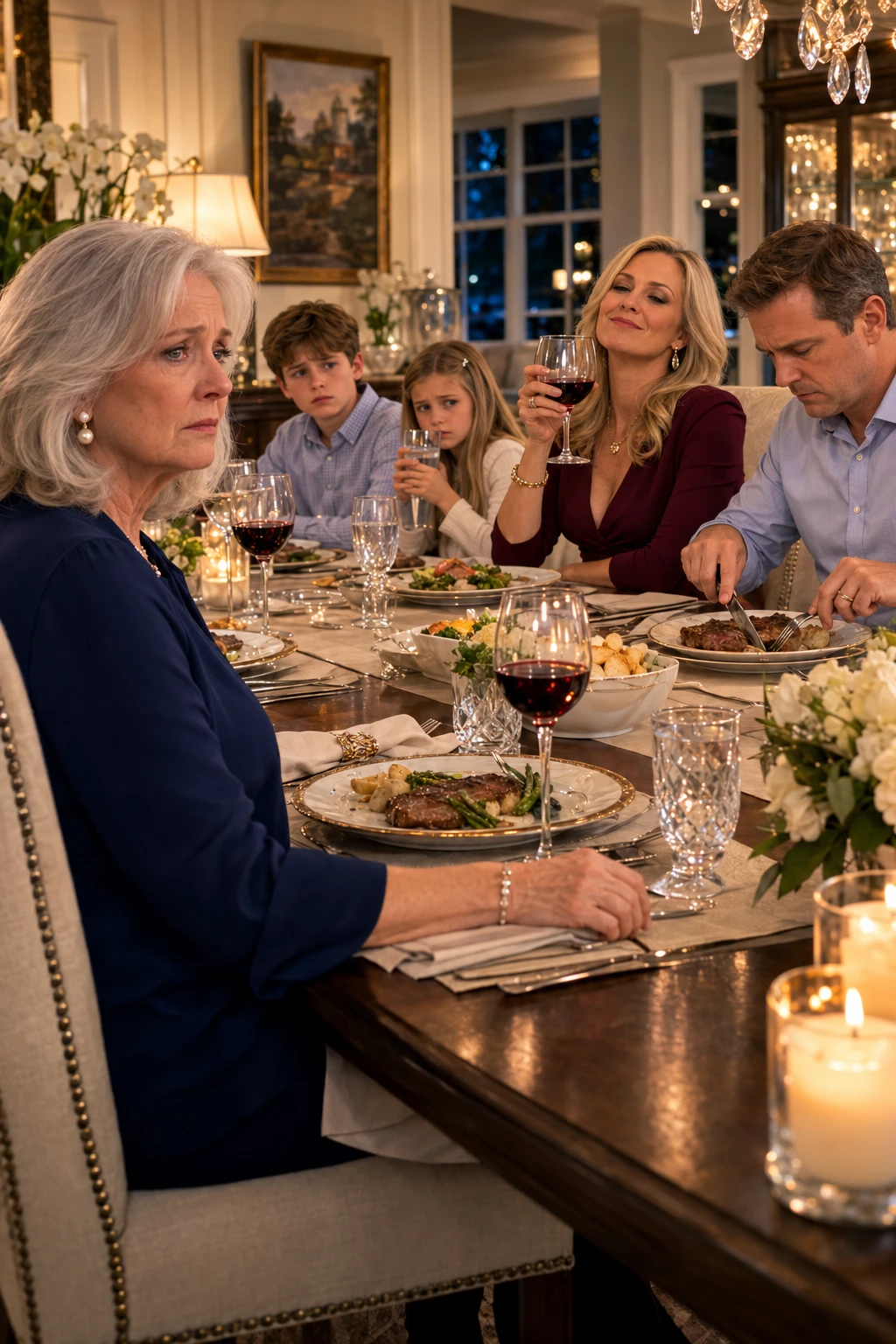
She raised her wine glass.
She smiled.
She celebrated.
And she had absolutely no idea that the life she was congratulating herself for building was about to collapse before dessert was finished.
“We finally bought our own house, Mom.”
The room filled with polite smiles.
Congratulations.
Compliments.
Admiration.
Everyone assumed it was a happy announcement.
Then came the second part.
The part she had been waiting to say.
“So now you can finally start learning how to live alone.”
The words landed exactly the way she intended.
Cruelly.
Publicly.
Deliberately.
My son sat beside her.
Silent.
Of course he did.
By then, Connor’s silence had become its own language.
A language I understood all too well.
It meant:
Don’t make this difficult.
Don’t embarrass us.
Just accept it.
Then Melinda laughed softly and delivered the final blow.
“And thank you for staying here all these years without paying a thing. But now that we have our own place, we really don’t need you here anymore.”
The dining room fell silent.
Even the children stopped moving.
My grandson Jackson froze with his fork suspended halfway to his mouth.
Lily stared down at her plate.
Children may not understand mortgages, inheritance, or adult resentment.
But they understand humiliation.
And they understood someone they loved had just been hurt.
I looked around the table.
At the dinner I had paid for.
At the house I had maintained.
At the family I had spent twelve years protecting.
And for the first time in a very long time, I felt something unexpected.
Relief.
Not sadness.
Not anger.
Relief.
Because after twelve years of waiting, the moment had finally arrived.
The moment I no longer had to pretend.
For more than a decade, I had watched Melinda slowly claim pieces of my life.
First it was a cabinet.
Then a room.
Then the kitchen.
Then traditions.
Then decisions.
Eventually she behaved less like a guest and more like a queen who had inherited a kingdom.
And I let it happen.
Not because I was weak.
Because I loved my son.
Because I adored my grandchildren.
Because every compromise seemed easier than a family war.
Until one day you wake up and realize compromise has become surrender.
And surrender has become expectation.
Melinda expected tears.
She expected pleading.
She expected panic.
What she did not expect was a smile.
A calm one.
A peaceful one.
The kind people wear when a burden is finally lifted.
May you like
I carefully folded my napkin.
Lifted my eyes.
And smiled.
“That’s wonderful, Melinda.”
The confidence vanished from her face for a fraction of a second.
Just long enough for me to notice.
“I’m glad you’ve finally decided to start a life of your own.”
Connor looked up.
His knife paused above his plate.
Melinda slowly lowered her wine glass.
Because suddenly she wasn’t certain where this conversation was going.
“Because,” I continued gently, “I have some news of my own.”
The knife slipped from her fingers.
It struck the china with a sharp metallic sound.
Nobody moved.
Nobody spoke.
The room seemed to hold its breath.
“What news?” she asked.
Her voice sounded different now.
Less confident.
Less certain.
Fear has a way of doing that.
I looked first at my grandchildren.
Then at Connor.
Then at Melinda.
For twelve years, they had believed a version of the truth that made life comfortable.
A version I had allowed.
A version I had protected.
But the truth has a strange habit.
It always arrives eventually.
And when it does, it rarely asks permission.
“News,” I said quietly, “that matters more to the two of you than anyone else in this room.”
Connor frowned.
Melinda’s fingers tightened around her glass.
I continued.
“Twelve years ago, when you moved in after Connor lost his job, I made a decision.”
Neither of them spoke.
“I decided that keeping my family together was more important than correcting certain assumptions.”
Connor exchanged a glance with his wife.
“What assumptions?”
I smiled.
“The assumption that this house would someday belong to you.”
The room became perfectly still.
Melinda blinked.
Once.
Twice.
Then laughed nervously.
“What are you talking about?”
I ignored the question.
“For twelve years, I’ve listened to conversations about renovations. Future plans. Property values. School districts.”
I looked directly at her.
“I’ve listened while you discussed what would happen to this house after I was gone.”
The color slowly drained from her face.
Connor straightened in his chair.
“Mom—”
“No.”
For once, my son fell silent.
“Tonight, before dinner, I signed the final paperwork.”
Nobody moved.
“Ninety minutes before you arrived, my attorney submitted the documents.”
Melinda’s expression hardened.
“What documents?”
I folded my hands together.
“The documents transferring ownership of this property.”
Jackson looked confused.
Lily looked frightened.
Connor looked alarmed.
And Melinda looked terrified.
Because suddenly she understood.
The future she had been counting on might no longer exist.
“Transferred to who?” Connor asked.
I smiled.
Not triumphantly.
Not cruelly.
Simply honestly.
“To a trust.”
Nobody spoke.
“The house, the land, the investment accounts attached to it, and every asset connected to this property now belong to the Whitmore Family Trust.”
Melinda stared at me.
“What does that mean?”
“It means neither of you own this house.”
Connor swallowed.
“Mom—”
“It means neither of you will inherit it.”
Silence.
“It means neither of you can sell it.”
The silence deepened.
“And most importantly…”
I looked toward Jackson.
Then Lily.
“The beneficiaries are my grandchildren.”
For the first time all evening, Melinda looked genuinely frightened.
Because she finally understood what her little speech had cost her.
Not a room.
Not an argument.
Not a dinner.
An entire future.
And suddenly the new house she had been celebrating didn’t feel nearly as impressive anymore.
Melinda stared at me as though she were waiting for the punch line.
None came.
Her gaze moved from my face to Connor’s, then back again.
Finally, she laughed.
It was a brittle sound.
Forced.
Almost breathless.
“Well,” she said, “that’s fine.”
No one answered.
She lifted her wine glass again, though her hand was no longer steady.
“It’s still going to the children. That was always the plan.”
“No,” I said.
Her smile tightened.
“What do you mean, no?”
“The trust does not give you control over the property simply because you are their mother.”
Connor’s forehead creased.
“Who is the trustee?”
“My attorney is the independent trustee until Jackson turns thirty.”
Melinda’s glass stopped halfway to her lips.
“And Lily?”
“She will receive equal protection under the trust.”
“Protection from what?” she demanded.
I looked directly at her.
“From anyone who might try to use their inheritance for personal debts, business ventures, or lifestyle expenses.”
The words landed harder than I expected.
Connor looked down.
Melinda did not.
She leaned forward.
“You’re implying we would steal from our own children?”
“I’m stating that you will not have access to the principal.”
Her cheeks flushed.
“I’m their mother.”
“And Connor is their father.”
“Exactly.”
“Neither role makes you the owner of their inheritance.”
My sister Elaine, who had been sitting near the end of the table, slowly put down her fork.
She was the first guest to understand that this was not merely an argument about hurt feelings.
The structure I had created was deliberate.
Legal.
Final.
Melinda turned to Connor.
“Say something.”
He looked at me.
“Mom, why didn’t you discuss this with us?”
The question almost made me laugh.
“Did you discuss your announcement with me?”
“That’s different.”
“Why?”
He opened his mouth.
Nothing came out.
I continued.
“You and Melinda purchased a home, planned your departure, and decided I would live alone. You announced it publicly and spoke as though you were evicting me from a property you believed belonged to you.”
Connor’s face reddened.
“That’s not what she meant.”
Melinda turned sharply.
“Yes, it was.”
Everyone looked at her.
Even she seemed surprised by her own honesty.
But panic had loosened her control.
She set down her glass.
“You’ve lived here for twelve years,” she said. “We’ve taken care of everything. We’ve raised our children here. We’ve improved this property.”
“You replaced the kitchen curtains.”
“We renovated the basement.”
“With money from my account.”
Connor looked up.
Melinda’s eyes flashed.
“You agreed to that.”
“Yes.”
“And we maintained the yard.”
“I paid the landscaping company.”
“We covered utilities.”
“You contributed toward electricity for nineteen months. Then you stopped when Connor changed jobs.”
My son looked uncomfortable.
The other guests began staring at their plates.
For years, Melinda had repeated the same version of our arrangement.
She and Connor had generously allowed me to remain in my own home while they handled the responsibilities.
The truth was far less flattering.
I had paid the mortgage.
The taxes.
The insurance.
The repairs.
The groceries.
Most of the vacations.
The children’s school fees.
And, for seven of those twelve years, Connor and Melinda had paid nothing at all.
I had never corrected the story publicly.
Until now.
Melinda’s voice rose.
“You’re keeping records of what we cost you?”
“No.”
I reached beside my chair and lifted a slim blue folder from the floor.
“My accountant keeps records.”
Connor stared at it.
“What is that?”
“A summary of household expenses.”
The confidence finally disappeared from his face.
He knew me well enough to understand that I would not bring a folder unless I intended to use it.
I placed it on the table.
“Twelve years ago, I offered you six months without rent while Connor found work.”
Melinda crossed her arms.
“We were family.”
“Yes. And six months became twelve years.”
“We helped you.”
“You lived here.”
“That isn’t the same thing.”
“No,” I said. “It isn’t.”
I opened the folder.
The first page contained a simple figure.
Total housing support provided to Connor and Melinda Whitmore:
$418,760.
The figure included fair-market rent, utilities, childcare, insurance contributions, vehicle payments, private-school tuition, vacations, and emergency loans that were never repaid.
Connor stared at the number.
Melinda went pale.
“That’s ridiculous.”
“It is documented.”
“You can’t charge us retroactively.”
“I’m not.”
I closed the folder.
“This is not an invoice. It is a reminder.”
“Of what?”
“That the person you accused of living here without paying has paid for nearly every comfort you have enjoyed.”
The room became silent again.
Jackson lowered his eyes.
I regretted that the children were present.
But Melinda had chosen the audience.
She had chosen dinner.
She had chosen humiliation.
I would not lie to protect her from the consequences of her own stage.
Connor rubbed one hand over his face.
“Mom, can we talk privately?”
“No.”
His eyes lifted.
“We should not be doing this in front of everyone.”
“I agree.”
I turned toward Melinda.
“But your wife began it in front of everyone.”
My daughter-in-law’s mouth hardened.
“Fine. You want honesty?”
“I have wanted it for twelve years.”
“We stayed because you needed us.”
A soft sound came from the end of the table.
Grandma Elise, my late husband’s older sister, had been quiet all evening.
Now she gave a disbelieving laugh.
Melinda looked at her.
“What?”
Elise leaned back.
“Margaret lived alone for nine years before you moved in.”
Melinda’s face tightened.
“She was grieving.”
“She was functioning.”
“We gave her family.”
Elise’s expression cooled.
“She gave you shelter.”
Connor’s voice sharpened.
“Aunt Elise, stay out of this.”
“No,” I said.
Everyone turned toward me.
“No one needs to stay out of it now. Your wife invited the room into the conversation when she raised her glass.”
Melinda pushed back from the table.
The legs of her chair scraped loudly across the floor.
“So what exactly do you want?”
The question revealed more than she intended.
She assumed every act required a demand.
A payment.
A concession.
She could not imagine that I had made my decision without needing anything from her.
“I want you to move into the house you purchased.”
Her eyes narrowed.
“We already said we were.”
“Good.”
“And you’ll stay here?”
“Yes.”
“Alone?”
“That is none of your concern.”
She gave a humorless laugh.
“Then why are you acting like this changes anything?”
“Because you do not understand what you purchased.”
Connor’s head lifted.
“What does that mean?”
I waited.
I had not intended to reveal everything at dinner.
The trust had been enough.
But Melinda had made one final mistake.
She had announced the purchase before closing.
Before recording.
Before confirming the terms of the loan Connor had signed.
The call from my attorney ninety minutes earlier had not concerned only the trust.
It had concerned the property they were celebrating.
“Your new house,” I said. “The one on Hawthorne Ridge.”
Melinda glanced at Connor.
“Yes.”
“Four bedrooms. Three bathrooms. Stone fireplace. Corner lot.”
Her suspicion deepened.
“How do you know the details?”
“Because the property belonged to Whitmore Residential Holdings.”
Connor stopped breathing for a second.
Melinda looked between us.
“What is Whitmore Residential Holdings?”
“A company your father-in-law created thirty-two years ago.”
My late husband, James, had spent decades investing quietly.
He never drove expensive cars.
Never wore designer clothing.
Never discussed money at dinner.
He purchased modest rental properties, repaired them carefully, and held them through a small family company.
When he died, the company passed to me.
Connor knew his father had owned several rentals.
He did not know the full portfolio.
Melinda knew almost nothing.
She had never been interested in James’s work while he was alive.
Only in what might someday be inherited.
Connor’s face lost its color.
“Mom.”
“Yes.”
“Hawthorne Ridge was one of Dad’s properties?”
“It still is.”
Melinda shook her head.
“No. We bought it from a private investment company.”
“That company is controlled by the trust.”
The room seemed to tilt around her.
“But we signed a purchase agreement.”
“You signed a lease-to-own agreement.”
Connor turned toward her.
“What?”
Melinda stared at him.
“You read the contract.”
“I read the summary you gave me.”
Her face changed.
There it was.
A secret inside the secret.
Connor had not understood what he signed.
Melinda had handled the transaction.
She had found the property through a broker she knew socially.
She had told everyone they had purchased it below market value because of her negotiating skills.
In reality, the financing documents had been rejected by two banks.
Their debt-to-income ratio was too high.
Their down payment had come partly from a loan against Connor’s retirement account.
The only agreement they qualified for was a five-year lease with an option to purchase.
And even that arrangement had required approval from the property owner.
Me.
Melinda gripped the table.
“You approved the lease.”
“I did.”
“Why?”
“Because Jackson and Lily deserve a stable home.”
Relief flickered in her eyes.
Then I continued.
“But the purchase option belongs to the trust.”
The relief disappeared.
Connor looked confused.
“What does that mean?”
“It means the property can eventually be purchased for the children’s benefit, provided the conditions are met.”
“What conditions?” Melinda asked.
“Consistent payments. No unauthorized refinancing. No liens. No attempts to assign the option. And no use of trust assets as collateral.”
Her breathing became shallow.
Connor slowly turned toward her.
“What did you do?”
She did not answer.
His voice changed.
“Melinda.”
“I didn’t do anything.”
I reached for a second folder.
This one was gray.
Her eyes locked onto it immediately.
The confidence, the mockery, the practiced composure—all of it vanished.
My attorney had called me that afternoon because the title company had received an unusual inquiry.
Someone had attempted to use the projected equity in the Hawthorne Ridge property as collateral for a private business loan.
The applicant had claimed that full ownership would transfer within sixty days.
That was impossible under the actual agreement.
Unless someone believed I would soon die.
Or surrender control.
I opened the folder.
“Three weeks ago, an application was submitted to secure a two-hundred-and-eighty-thousand-dollar commercial loan.”
Connor stared at me.
“What commercial loan?”
Melinda’s face had gone completely white.
The answer came from Tyler, her brother, sitting halfway down the table.
He stood so quickly that his chair nearly overturned.
“This is not the place.”
I looked at him.
“No. But apparently it was the place to announce my eviction.”
Tyler grabbed his coat from the back of his chair.
Melinda snapped, “Sit down.”
He ignored her.
Connor looked between them.
“What loan?”
No one answered.
Then Jackson spoke.
His small voice cut through the room.
“Is it for Uncle Tyler’s restaurant?”
Melinda closed her eyes.
Children hear more than adults realize.
Connor turned toward his son.
“What restaurant?”
Jackson looked frightened.
“The one Mom said we were buying.”
Melinda stood.
“Jackson, go upstairs.”
“No,” Connor said.
The force in his voice startled everyone.
He rarely contradicted her.
“Sit down, Melinda.”
She stared at him.
For twelve years, Connor had chosen silence because silence was easier than conflict.
But silence becomes impossible when the truth starts using your children’s voices.
“What restaurant?” he asked again.
Melinda drew a slow breath.
“It was an investment.”
“With what money?”
“Our money.”
“We don’t have two hundred and eighty thousand dollars.”
“We would after the house closed.”
“The house isn’t closing.”
Her eyes moved toward me.
“It was supposed to.”
I understood then.
The announcement had never been only about removing me from my home.
Melinda believed that once she and Connor moved out, I would feel lonely.
Afraid.
Dependent.
She expected me to sell this house within months and distribute part of the proceeds to them.
Or allow them to borrow against the inheritance they assumed was guaranteed.
The Hawthorne Ridge transaction had been structured around money they did not possess.
Money she expected from me.
“You planned to use my house,” I said.
Melinda’s mouth trembled.
“We planned to use Connor’s inheritance.”
“An inheritance he does not have.”
“He’s your only son.”
“That is not a financial instrument.”
Connor looked sick.
“You told the lender Dad’s company would guarantee the loan?”
Melinda said nothing.
I slid a photocopy across the table.
His signature appeared on the bottom.
Connor picked it up.
“I didn’t sign this.”
“I know,” I said.
Melinda stepped backward.
Everyone looked at her.
Connor studied the page again.
The signature resembled his.
But he knew his own handwriting.
His own name.
His own hand.
“You forged this?”
“It wasn’t final.”
“You forged my signature?”
“I was trying to build something for us.”
“For your brother.”
“For all of us.”
Tyler reached the doorway.
Connor looked at him.
“You knew?”
Tyler’s silence answered.
The dinner had begun as a celebration.
Now it had become an exposure.
My attorney had already reported the document to the lender.
No funds had been released.
No property had been transferred.
But attempted fraud did not disappear simply because the plan failed.
Melinda looked at me.
“You did this.”
“No.”
“You set us up.”
“I approved a lawful lease so my grandchildren would have a home.”
“You knew I would try to finance the restaurant.”
“I knew nothing about the restaurant until the title company contacted my attorney.”
“You could have warned me.”
“About forging my son’s name?”
Her expression twisted.
“You wanted this.”
“No.”
I looked toward Jackson and Lily.
“I wanted dinner.”
The simplicity of it silenced the room.
I had wanted one evening.
A family meal.
A chance to hear about the children’s schoolwork.
A chance to celebrate a new beginning.
Instead, Melinda had raised a glass and announced that she no longer needed me.
And in doing so, she had forced every hidden arrangement into the light.
Connor stood.
He seemed unsteady.
“Jackson. Lily. Get your coats.”
Melinda stared at him.
“What are you doing?”
“Taking the children home.”
“To our new house?”
“No.”
The word came quietly.
But it carried twelve years of accumulated silence.
“Connor,” she warned.
He looked at her.
“You forged my signature.”
“I can explain.”
“You borrowed against my retirement account.”
His eyes widened as another realization struck.
“The down payment.”
She looked away.
“You said the withdrawal was for closing costs.”
“It was temporary.”
“How much did you give Tyler?”
“Connor—”
“How much?”
“Seventy-five thousand.”
He gripped the back of his chair.
My grandson began crying.
I stood immediately.
“Jackson, sweetheart, come with me.”
He ran into my arms.
Lily followed.
I guided both children into the living room, away from the table.
Behind us, Connor and Melinda began arguing.
Not loudly at first.
Then louder.
I closed the doors.
Jackson pressed his face against my shoulder.
“Are we losing our house?”
“No.”
“Is Mom going to jail?”
“I don’t know.”
“Did she steal?”
I knelt so I could look at both children.
“The adults made serious mistakes. None of this is your fault.”
Lily’s lower lip trembled.
“Do you still love us?”
The question broke something inside me.
I pulled them close.
“Nothing your parents do could ever change that.”
The dining-room door opened twenty minutes later.
Connor stood alone.
He looked older than he had at the beginning of dinner.
“Can the kids stay with you tonight?”
“Yes.”
Melinda appeared behind him.
“No.”
He turned.
“They’re staying.”
“You don’t get to decide that by yourself.”
“You decided everything else by yourself.”
Her expression hardened.
“You’re choosing her over your wife.”
“No,” he said. “I’m choosing our children over chaos.”
For the first time, I saw Melinda understand that she had lost control of the room.
Not because I had overpowered her.
Because the people she relied on had begun thinking for themselves.
Tyler had left.
Several relatives were quietly collecting their coats.
Elaine hugged me before leaving.
Elise kissed Jackson and Lily goodbye.
The celebration dissolved without dessert.
Connor drove away with Melinda forty minutes later.
Not to Hawthorne Ridge.
To an attorney’s office recommended by one of his colleagues.
The children slept in my guest room.
The room Melinda had once planned to convert into a dressing room after my death.
I sat between their beds until both were asleep.
At midnight, Connor called.
His voice sounded hollow.
“I filed a police report.”
I closed my eyes.
“About the signature?”
“Yes.”
“Are you safe?”
“I’m at a hotel.”
“And Melinda?”
“I don’t know.”
He was quiet for a long time.
Then he said, “I’m sorry.”
I had imagined those words for years.
In my imagination, they felt satisfying.
In reality, they felt heavy.
“For what?” I asked.
“All of it.”
“That is too much for one apology.”
“I know.”
“You let her speak to me as though I were a burden.”
“I know.”
“You watched her take over my home.”
“I know.”
“You accepted my money while telling people you supported me.”
His breathing changed.
“I know.”
“And tonight, you sat beside her while she told me I was no longer needed.”
He began crying.
My son was forty-two years old.
I had not heard him cry since his father died.
“I was ashamed,” he said.
“Of me?”
“Of myself.”
The answer surprised me.
“I knew what she was saying was wrong. But if I defended you, I would have to admit how much of our life depended on you.”
I sat at the edge of the guest-room doorway, watching my grandchildren sleep.
“Dependence is not shameful, Connor.”
“Pretending it was yours instead of ours was.”
That was the first honest thing he had said in years.
The months that followed were painful.
Melinda was charged with forgery and attempted financial fraud.
Because no money had been released and because she had no prior criminal record, she avoided prison.
She received probation, restitution obligations, mandatory financial counseling, and hundreds of hours of community service.
Tyler’s restaurant never opened.
The seventy-five thousand dollars was mostly gone.
Connor filed for divorce.
Not immediately.
He spent several weeks trying to determine whether the marriage could be repaired.
But the forged signature was not the only deception.
Investigators uncovered hidden credit cards.
Private loans.
Unpaid taxes.
A second attempt to borrow against his retirement plan.
The marriage had been built on appearances Connor funded with silence.
Once the finances were exposed, there was almost nothing left underneath.
Connor and the children moved into a modest apartment.
He did not ask to return to my home.
That mattered.
Instead, he sold his expensive car, withdrew the children from private school, and began repaying part of what he had taken from his retirement account.
He also started therapy.
At first, he spoke about Melinda.
Then, slowly, he began speaking about himself.
About avoidance.
Entitlement.
Fear.
The belief that being a good husband meant never confronting his wife, even when her behavior harmed everyone around them.
I attended one session with him.
The therapist asked what I needed from my son.
Connor looked at me with red-rimmed eyes.
I answered carefully.
“I need him to stop mistaking silence for kindness.”
He lowered his head.
“And I need him to understand that love without respect becomes exploitation.”
He nodded.
It was not reconciliation.
But it was the beginning of responsibility.
The Whitmore Family Trust remained unchanged.
Jackson and Lily were still the beneficiaries.
Connor never asked me to revise it.
Six months after the dinner, he brought the children to visit.
They ran through the front door with backpacks and soccer cleats.
Connor stopped on the porch.
“May I come in?”
For twelve years, he had entered without knocking.
The question was small.
The meaning was not.
“Yes,” I said.
He stepped inside.
The house looked different by then.
I had reclaimed the upstairs sitting room.
Removed the furniture Melinda had chosen.
Repainted the kitchen.
Converted the basement into a family room for the grandchildren.
Not because they owned the house.
Because I wanted them there.
Choice changed everything.
Connor stood beside the fireplace.
“I don’t remember the house looking like this.”
“It didn’t.”
“It feels like you.”
For years, every room had reflected someone else’s taste.
Neutral walls.
Designer furniture.
Decorations selected to impress visitors.
Now there were photographs.
Books.
My husband’s old wooden clock.
A bright yellow chair Jackson loved.
Lily’s drawings framed in the hallway.
Evidence of people rather than appearances.
“I should have noticed you disappeared inside your own home,” Connor said.
“Yes.”
He flinched slightly.
I did not soften the truth.
Not anymore.
He looked toward the backyard where the children were playing.
“I thought because you never complained, you were fine.”
“I did complain.”
His eyes returned to mine.
“You asked me not to make things difficult.”
He closed his eyes.
“I remember.”
That sentence became part of our repair.
I remember.
Not denial.
Not reinterpretation.
Not excuses.
Memory.
Acknowledgment.
Consequences.
A year after the dinner, the lease on Hawthorne Ridge was terminated.
The property had remained vacant throughout the investigation.
I could have sold it.
Instead, the trustee and I created a protected housing program for families with children undergoing long-term medical treatment at the county hospital.
My late husband had spent his final months receiving treatment there.
The house Melinda had planned to use as leverage became a temporary home for families who truly needed one.
The first family moved in during early spring.
A father.
A mother.
Two children.
Their youngest daughter was receiving chemotherapy.
When I handed them the keys, the mother began crying.
“We’ll take care of it,” she promised.
“I know.”
“This is incredibly generous.”
I smiled.
“It is something my husband would have wanted.”
The trust covered the mortgage, utilities, maintenance, and taxes.
No family paid rent.
No one was humiliated.
No one was expected to surrender their dignity in exchange for shelter.
Melinda heard about the program through mutual friends.
A week later, she sent me a letter.
I left it unopened for several days.
When I finally read it, I expected blame.
Instead, she wrote:
I spent twelve years believing everything around me would eventually become mine.
Your house.
Connor’s inheritance.
The children’s future.
Even your silence.
I mistook your patience for surrender.
I thought because you loved us, you would never say no.
I understand now that I never thanked you because gratitude would have required me to admit how much you gave.
I am sorry for humiliating you.
I am sorry for teaching Jackson and Lily that disrespect was acceptable.
I am sorry I treated your home like a possession waiting for its owner to disappear.
I do not expect forgiveness.
For once, I am writing without asking for anything.
I folded the letter and placed it in my desk.
I did not call her.
Some apologies deserve acknowledgment.
They do not automatically deserve access.
Melinda saw the children through supervised visits at first.
Over time, as she complied with the court’s requirements, those visits became less restricted.
She found work in an insurance office.
She rented a small apartment.
She paid restitution monthly.
Her life became quieter.
Smaller.
More honest.
The children still loved her.
That was their right.
I never asked them to choose.
Children should not carry the punishment for adult failures.
Two years after the dinner, Jackson turned thirteen.
He asked to celebrate at my house.
We filled the backyard with lights.
Connor grilled hamburgers.
Lily decorated a cake that leaned noticeably to one side.
Melinda attended.
It was the first time she had entered my home since the night of her announcement.
She stopped on the porch.
The expression on her face was impossible to read.
Then she looked at me.
“May I come in?”
The same question Connor had asked a year earlier.
I stepped aside.
“For Jackson.”
She nodded.
“For Jackson.”
There were no speeches.
No confrontation.
No dramatic reunion.
She helped arrange plates.
Connor kept a respectful distance.
The children moved between them naturally.
At one point, Melinda stood in the dining room where she had once raised her wine glass.
Her eyes rested on the table.
“I think about that night often,” she said.
“So do I.”
“I really believed you would beg us to stay.”
“I know.”
“I believed being needed made me powerful.”
I looked toward the backyard.
“Being loved is not the same as being needed.”
She nodded.
“I understand that now.”
Perhaps she did.
Perhaps she was still learning.
So was I.
When the party ended, everyone helped clean.
Melinda carried a stack of plates toward the kitchen.
Then she stopped.
“Where do these go?”
For twelve years, she had rearranged my cabinets without asking.
Now she waited.
I pointed to the cupboard beside the sink.
She placed them carefully inside.
It was such a small act that no one else noticed.
I did.
Before leaving, she handed me an envelope.
Inside was a check.
Not large.
Three hundred dollars.
The memo line read:
First repayment toward household support.
I walked onto the porch after her.
“You do not owe me four hundred thousand dollars.”
She gave a sad smile.
“Maybe not legally.”
“I do not want repayment.”
“I know.”
“Then why?”
“Because I spent years pretending your generosity cost nothing.”
I looked down at the check.
“This won’t repair what happened.”
“No.”
She met my eyes.
“But I need to become someone who pays what she owes.”
I accepted it.
Not because I needed the money.
Because she needed the responsibility.
The next morning, I deposited the check into the trust’s education fund for Jackson and Lily.
Every payment she later sent went to the same place.
She never knew.
Or perhaps she eventually guessed.
Three years after the dinner, Connor completed repayment of the retirement loan.
He called me that evening.
“It’s done.”
“I’m glad.”
“I’ve been thinking about Dad.”
My husband had been gone for fourteen years.
“What about him?”
“He would be ashamed of me.”
“Probably.”
Connor laughed softly.
It was the first time I had heard him laugh at an uncomfortable truth rather than defend himself against it.
“But he would also expect you to do better.”
“I’m trying.”
“I know.”
That was forgiveness beginning.
Not erasure.
Not pretending.
Recognition of effort.
The trust remained in place.
Jackson and Lily would inherit protection, not instant control.
Education expenses would be covered.
First homes could be supported.
Medical emergencies would be funded.
But no beneficiary could use the assets to support gambling, reckless investments, or someone else’s vanity.
My grandchildren would receive opportunity.
Not entitlement.
On my seventieth birthday, Connor organized dinner.
At my house.
With my permission.
He arrived early to cook.
Melinda brought dessert.
The children decorated the dining room with photographs from years of family gatherings.
Some painful.
Some joyful.
All honest.
Before dinner, Jackson stood and tapped his spoon against a glass.
The sound carried me back to that other evening.
For one moment, the room seemed to freeze.
Then he smiled.
“Grandma, I want to say something.”
I nodded.
“When I was younger, I thought this was our house.”
He looked around the room.
“Then I learned it was yours.”
Everyone became quiet.
“But now I think it’s where our family learned how to be better.”
My throat tightened.
Lily raised her glass of sparkling cider.
“To Grandma.”
The others joined her.
Even Melinda.
There was no cruelty in the gesture.
No hidden announcement.
No claim.
Just gratitude.
After dinner, while everyone carried dishes into the kitchen, I remained at the table for a moment.
The house was filled with voices.
Jackson laughing.
Lily arguing with Connor about the correct way to load a dishwasher.
Melinda asking before opening a cabinet.
The sounds were ordinary.
That made them precious.
For years, I believed keeping the family together required me to endure anything.
To stay quiet.
To make room.
To pay.
To forgive before anyone apologized.
I had been wrong.
A family held together by one person’s surrender is not truly together.
It is simply balanced on the back of the person least willing to let it fall.
The night Melinda announced she no longer needed me, she believed she was taking control of her future.
Instead, she revealed how much of that future depended on my silence.
When I finally spoke, her plans collapsed.
But something else began.
Connor learned that peace without courage was cowardice.
Melinda learned that generosity was not ownership.
My grandchildren learned that inheritance was not the same as entitlement.
And I learned that love did not require me to disappear.
Later that night, after everyone left, I walked through the quiet dining room.
A wine glass remained near Melinda’s old seat.
I picked it up.
For a moment, I remembered her smile.
The announcement.
The silence.
The certainty that I would crumble.
Then I carried the glass into the kitchen and placed it in the cupboard.
Not as a trophy.
Not as a reminder of revenge.
Simply as another object returned to its proper place.
That was all I had ever wanted.
For the house to belong where it belonged.
For decisions to be made by the person who had the right to make them.
For love to exist without possession.
The Whitmore Family Trust protected the future.
But the papers had never been the most important part.
The most important change happened at the table.
The moment I stopped asking permission to exist in my own life.
Melinda had raised her glass to celebrate a future built on my absence.
Years later, my family raised theirs to celebrate my presence.
And this time, when the room filled with voices, I did not feel like a guest.
I did not feel like a burden.
I did not feel tolerated.
I sat at the head of my table.
Inside my home.
Surrounded by people who had finally learned the difference between what they were given and what they were owed.
And when I lifted my glass, nobody mistook my kindness for surrender again.