

My Mother-in-Law Handed Me a $150,000 Bill—Then the Manager Revealed Who Had Already Lost Everything
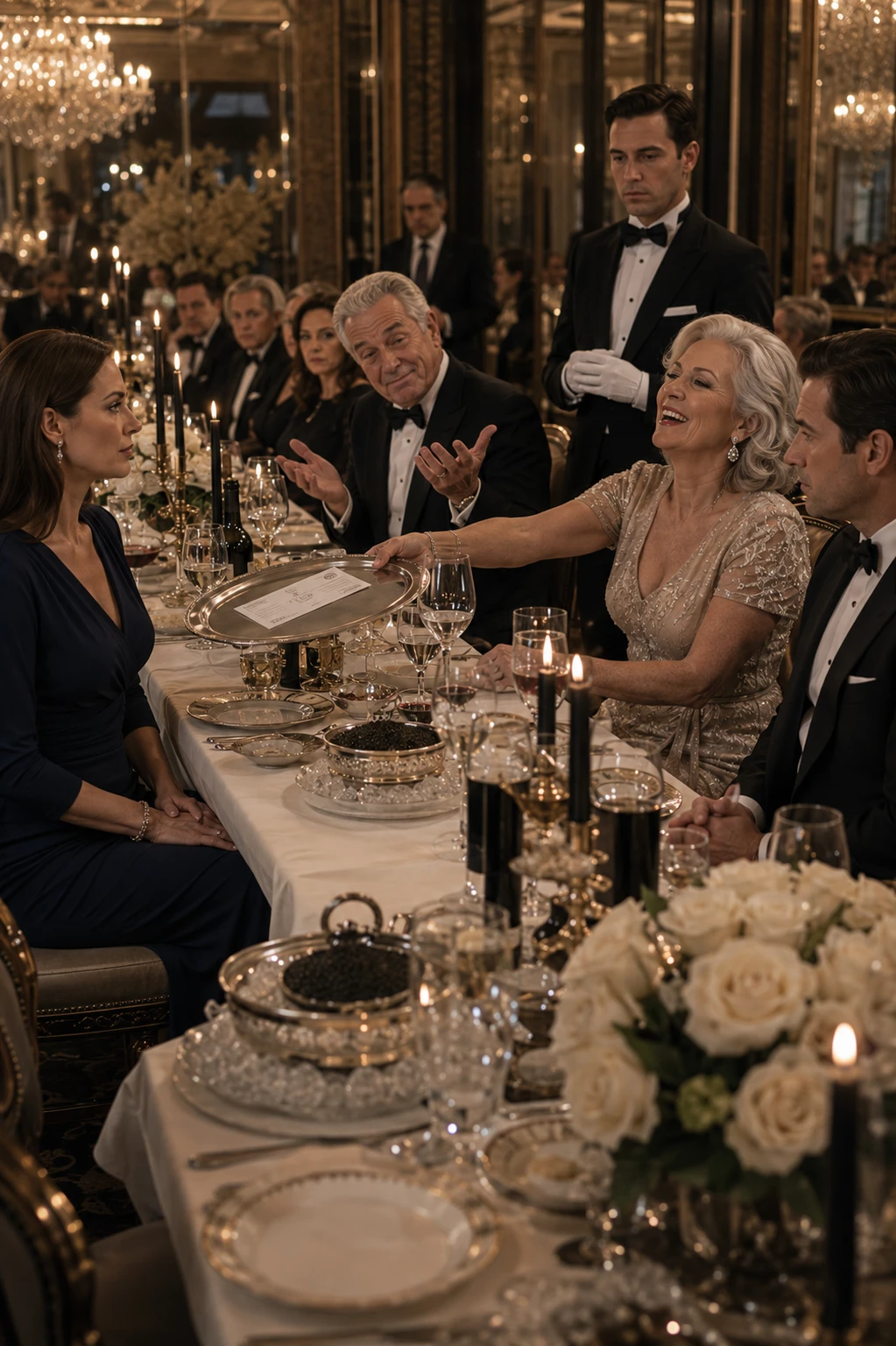
The $150,000 bill arrived on a silver tray.
My mother-in-law laughed before the waiter even set it down.
Then she pushed it toward me in front of Manhattan’s most powerful guests and said, “My daughter-in-law will pay.”
She expected embarrassment.
She expected obedience.
What she did not know was that I had stopped paying for their disrespect long before dessert was served.
The waiter appeared just after the final course, moving through the private dining room at Le Clair with the polished grace of someone trained to make even disaster look elegant.
White gloves.
Straight posture.
A silver tray balanced perfectly in both hands.
On it rested the check.
For one brief moment, no one moved.
Then Margaret Ashford laughed.
Not a startled laugh.
Not an embarrassed one.
A rehearsed laugh.
She raised her champagne glass, her diamond bracelet flashing beneath the golden chandelier light, and looked at the bill as though it were a prop she had been waiting all evening to reveal.
Victor Ashford, her husband of forty years, leaned closer and inspected the total.
His eyebrows rose theatrically.
Then he patted the inside pocket of his tuxedo.
Once.
Twice.
Nothing.
“Oh dear,” Margaret said, turning toward me with a smile so sweet it made my skin tighten. “Daughter-in-law, it appears we left our wallets behind.”
A few guests chuckled.
Victor joined them.
Then their daughter.
The laughter spread slowly around the table, cautious at first, then warmer once everyone understood that I was supposed to be the joke.
I sat beside Daniel, my husband, wearing the fitted navy dress Margaret had described as “simple” the moment I arrived.
Simple.
That was her favorite word for me.
Simple clothes.
Simple upbringing.
Simple ambitions.
Simple enough, apparently, to use whenever the family needed someone to pay.
The room was breathtaking in a cold, carefully controlled way.
Tall windows overlooked Manhattan, as though the city had been invited merely to admire the Ashfords from below.
White roses spilled from crystal vases.
Black candles flickered against ivory linen.
A string trio had played near the entrance while guests dined on imported caviar, rare vintages, and custom desserts plated like works of art.
It was supposed to be Margaret and Victor’s fortieth wedding anniversary.
But from the moment I entered, it had felt less like a celebration and more like a performance.
And somehow, I had been assigned the role of the outsider who should feel grateful just to stand near the stage.
Margaret corrected the way I greeted guests.
Victor joked that Daniel had “married discipline” because I declined a second glass of wine.
Their daughter asked, loudly enough for several people to hear, whether I still handled “little office things” or had finally found “something meaningful.”
Daniel heard every word.
He always did.
And, as always, he said nothing.
Now the bill sat between us.
$150,000.
I looked at the total once.
Premium wine.
Imported caviar.
Live musicians.
Custom décor.
A complete private booking.
Every excessive detail had been chosen by them.
Not by me.
Not with my approval.
Not even with my knowledge.
Margaret leaned back in her chair, her smile widening when she noticed I had not reached for my purse.
“Well?” she asked softly.
The single word traveled across the table like a blade drawn slowly over glass.
A man seated near Victor lowered his wineglass and watched with open curiosity.
Another guest tilted her head, unwilling to miss whatever humiliation came next.
Daniel shifted beside me.
His knee brushed mine beneath the table.
It was not comfort.
It was a warning.
Margaret’s daughter crossed her arms, satisfaction curling at the edge of her mouth.
The waiter stood perfectly still, gaze lowered, pretending not to understand the cruelty unfolding only inches away.
“Aren’t you going to take care of this?” Margaret asked.
There it was.
No request.
No apology.
No shame.
Only expectation.
Daniel leaned closer.
“Just handle it,” he whispered. “We’ll figure it out later.”
I turned toward him slowly.
For a moment, the rest of the room blurred.
The candles.
The flowers.
The watching faces.
The silver tray.
The impossible number printed at the bottom of the bill.
Only Daniel remained clear.
My husband.
The man who had promised to stand beside me.
The man who had perfected the art of abandoning me without ever leaving his chair.
“We’ll figure it out later.”
That sentence had lived inside our marriage for years.
We’ll talk to my mother later.
We’ll set boundaries later.
We’ll fix this later.
We’ll deal with it later.
Later had become the place where every promise went to disappear.
It was where my dignity was stored until nobody remembered it existed.
And now, in front of everyone who had spent years mistaking my restraint for weakness, Daniel was offering them my humiliation one more time.
I looked away from him.
Margaret was still smiling.
Victor watched me over the rim of his glass.
Their daughter looked almost eager.
Everyone around the table waited for me to perform the role they had written.
The useful wife.
The obedient outsider.
The woman who would absorb the insult because making a scene would supposedly be worse than being destroyed by one.
I reached for my napkin.
The room quieted slightly.
I folded it carefully.
Edge to edge.
Daniel exhaled beside me, mistaking my calm for surrender.
Margaret’s smile sharpened.
I placed the napkin beside my plate.
Then I looked directly at her.
“Then I suppose,” I said calmly, “this is where your smiles disappear.”
The laughter stopped so abruptly it felt as though someone had cut the power.
Margaret blinked.
Victor’s hand froze around his glass.
Daniel went rigid.
For the first time that evening, no one interrupted me.
Even the waiter lifted his eyes.
Margaret recovered first.
But not completely.
Her smile returned in fragments.
“What an odd thing to say,” she replied lightly, though the warmth had vanished from her voice. “We’re family. Surely you aren’t going to embarrass us over a bill.”
I nearly laughed.
Family.
That word always appeared when Margaret wanted something.
Never when I needed kindness.
I rested both hands on the table.
“I did not arrange this dinner,” I said.
Margaret’s eyes narrowed.
“I did not choose the wine. I did not hire the musicians. I did not approve the caviar, the flowers, the private room, the decorations, or the guest list.”
Victor cleared his throat.
Daniel whispered my name.
Not in support.
In panic.
I ignored him.
Margaret leaned forward.
“Careful.”
There it was again.
Not concern.
A command.
A warning from a woman who believed the world still rearranged itself whenever she lifted one finger.
I held her gaze.
“I have been careful for years.”
The words landed harder than I expected.
Something changed around the table.
A few guests looked away, suddenly uncomfortable with the spectacle they had been enjoying only moments earlier.
Margaret’s daughter gave a nervous laugh.
“This is ridiculous,” she said. “It’s only one dinner.”
“One dinner?” I repeated quietly.
The waiter tightened his grip on the tray.
Daniel’s hand moved beneath the table, reaching for mine.
I pulled away before he could touch me.
That small movement exposed him more clearly than any accusation could have.
His expression changed.
For the first time that night, Daniel looked less embarrassed by me and more frightened of what I might say.
Margaret noticed too.
Her jaw tightened.
“Daniel,” she said without looking at him, “tell your wife to stop.”
My wife.
Not my name.
Never my name when control was involved.
Daniel swallowed.
I turned toward him.
The entire room watched.
His mouth opened.
For one painful second, I wondered whether he might finally choose me.
Then he said, “Please don’t make this worse.”
Something inside me became completely still.
Not shattered.
Finished.
I looked back at Margaret.
“You’re right,” I said. “I should not make this worse.”
Her shoulders relaxed.
Too soon.
“So I won’t.”
I picked up the check.
Looked once more at the total.
Then placed it back on the silver tray.
The sound was soft.
Almost delicate.
Margaret still flinched.
I turned toward the waiter.
“Please bring the manager.”
Victor’s face hardened.
“Now, hold on.”
Margaret’s voice dropped.
“What are you doing?”
I did not answer.
The waiter hesitated, glancing between me and the Ashfords.
Then he nodded and disappeared through the private dining-room door.
Silence followed him.
Not peaceful silence.
Fearful silence.
The kind that appears when people realize the person they mocked may not be standing where they thought she was.
Margaret tapped one finger against her champagne flute.
“Do you understand how this looks?” she asked.
“Yes,” I said.
Her eyes sharpened.
“I finally do.”
Daniel turned fully toward me.
“What does that mean?”
I looked at him, and every disappointment I had buried rose close enough to touch.
It was not about the money.
It had never been only about money.
It was every dinner where Margaret corrected me.
Every holiday where Victor dismissed me.
Every insult Daniel heard and allowed.
Every promise of later.
Every time I had paid—not with a credit card, but with some part of myself.
Before I could answer, the door opened.
The manager entered quickly, composed but cautious.
The waiter followed behind him.
Margaret immediately straightened, returning to the elegant posture of a woman accustomed to being believed before anyone else spoke.
“There has been a misunderstanding,” she said.
The manager looked at her.
Then Victor.
Then the untouched bill resting on the tray.
Finally, he turned toward me.
Something in his expression changed.
Recognition.
Subtle.
Professional.
But unmistakable.
Margaret saw it.
So did Daniel.
The entire room seemed to stop breathing.
The manager stepped closer, lowered his voice, and addressed me with careful respect.
“Mrs. Ashford,” he said, “would you like me to proceed?”
The color drained from Margaret’s face.
Because he had not been speaking to her.
He had been speaking to me.
And that was the moment everything began to unravel.
I held the manager’s gaze.
“Yes, Mr. Bell,” I said. “Proceed.”
His chin dipped once.
The movement was restrained, but final.
Daniel stared at me.
“Proceed with what?”
I did not answer him.
Mr. Bell reached inside the slim leather folder beneath his arm and removed three sheets of paper.
He placed the first beside the silver tray.
Not in front of Margaret.
In front of Victor.
“Mr. Ashford,” he said, “the card provided to secure tonight’s reservation was declined at six forty-two this evening.”
Victor’s hand tightened around his glass.
“That is impossible.”
“The issuer confirmed the account was closed.”
Margaret’s daughter sat forward.
“Closed?”
Victor looked toward me.
Only for a fraction of a second.
But that glance told me he already understood more than he wanted the room to know.
Margaret did not notice.
She was still trying to preserve the appearance of control.
“Then charge the family account,” she said.
Mr. Bell placed down the second page.
“The family account was suspended this morning.”
The chandelier light caught the diamonds at Margaret’s throat as she turned toward Victor.
“You said it had been handled.”
“It was,” he replied too quickly.
“Apparently not.”
Victor’s jaw hardened.
“This is a private banking issue. We will resolve it tomorrow.”
Mr. Bell remained unmoved.
“The restaurant requires payment tonight.”
Victor looked around the table.
The men he had spent the evening impressing now watched him with careful stillness.
Some were investors.
Some were board members.
Some had done business with him for twenty years.
None looked amused anymore.
Victor lowered his voice.
“Put it on Daniel’s account.”
Mr. Bell did not turn toward Daniel.
“The Ashford Holdings executive account was also frozen this afternoon.”
A faint sound passed through the room.
Not quite a gasp.
More like twelve people inhaling at once.
Daniel’s face emptied.
“What?”
Margaret looked at him sharply.
“You didn’t know?”
He shook his head.
Then turned toward me.
“What did you do?”
There was accusation in his voice.
Not yet understanding.
Not yet regret.
Only panic over something he had assumed belonged to him.
I looked at the man I had married.
“I stopped authorizing expenses I never approved.”
Margaret laughed again.
This time, no one joined her.
“You cannot freeze Ashford accounts.”
“I can freeze the accounts attached to my signature.”
Victor placed his glass down.
Too hard.
Champagne spilled across the linen.
“Enough.”
The single word carried the old authority he used in boardrooms, clubs, and family dinners.
Mr. Bell glanced toward me.
I nodded.
He placed the third page on the table.
A copy of the reservation authorization.
At the bottom was my electronic signature.
Or something designed to resemble it.
Daniel saw it first.
His breathing changed.
Margaret’s daughter leaned across the table.
“What is that?”
Mr. Bell answered.
“The event guarantee submitted six weeks ago.”
Margaret frowned.
“I authorized this dinner.”
“You selected the arrangements,” he said. “The guarantee was submitted through an account belonging to Mrs. Claire Ashford.”
My name moved across the room like a match being struck.
Claire.
For the first time all evening, someone had used it.
Margaret’s eyes moved to the signature.
Then to me.
“I assumed Daniel had taken care of that.”
Daniel did not answer.
He was staring at the authorization line.
I watched the truth reach him.
Not all at once.
First recognition.
Then fear.
Then the desperate calculation of a man deciding which lie might still survive.
“Daniel?” I asked.
His lips parted.
Margaret turned toward him.
“Tell her.”
He still said nothing.
I looked at Mr. Bell.
“Show them the time stamp.”
Mr. Bell pointed to a line in the lower corner.
The document had been signed at 11:47 p.m. on October third.
I remembered that night.
I had been in Boston.
Alone.
Attending the funeral of my former mentor.
Daniel had promised to come.
Then Margaret called and said Victor needed him at a donor reception.
“We’ll go to Boston together later,” he had told me.
Later.
Always later.
I returned home two days after the funeral and found Daniel asleep with his laptop open beside him.
He had closed it too quickly when I entered the room.
At the time, I told myself it was work.
Now his silence confirmed what the time stamp already proved.
“You used my authorization key,” I said.
Daniel looked at me.
“Claire, I can explain.”
Margaret’s face tightened.
“You told me she agreed.”
“I said she would handle it.”
“That is not what I asked.”
Victor turned on his son.
“You guaranteed the booking without confirming the funds?”
Daniel’s humiliation was suddenly more important to them than what he had done to me.
I watched that realization strike him too.
No one asked whether forging my approval had hurt me.
They asked why he had failed to do it successfully.
“I intended to tell her,” Daniel said.
“When?” I asked.
He looked away.
“After the anniversary.”
“After I paid?”
His jaw worked.
“You could afford it.”
There it was.
The belief beneath the betrayal.
Not that I had agreed.
Not that it was fair.
That I could afford it.
As though capacity erased consent.
Margaret straightened.
“This entire scene is unnecessary. Claire has always managed certain family expenses.”
Certain family expenses.
The phrase sounded so small.
So harmless.
It concealed years.
The mortgage payment Victor missed after a failed development deal.
The legal retainer for Margaret’s daughter after a reckless accident.
Daniel’s first business loan.
Margaret’s charity gala when sponsors withdrew.
The repairs to their Hamptons house.
The medical treatment Victor insisted remain private.
Every time, I had paid quietly.
Not because they were entitled.
Because Daniel asked.
Because he called it temporary.
Because helping family once becomes an expectation surprisingly quickly when gratitude is absent.
Mr. Bell waited.
The guests waited.
Daniel waited for me to save him.
I did not.
Margaret lifted her chin.
“Pay the bill, Claire. Whatever grievance you have with Daniel can be discussed at home.”
“No.”
The word landed cleanly.
Her fingers tightened around the stem of her glass.
“What did you say?”
“I said no.”
“You would humiliate us over one hundred and fifty thousand dollars?”
I looked around the room.
At people who had laughed when she pushed the bill toward me.
At the silver tray.
At Daniel’s hand lying uselessly beside mine.
“You humiliated yourselves before the bill arrived.”
A woman near the end of the table lowered her eyes.
Victor pushed back his chair.
“This has gone far enough.”
“Not yet,” I said.
His face hardened.
I reached into my evening bag and removed a sealed envelope.
Daniel went still.
He recognized it.
He had seen the same cream stationery in our home office three nights earlier.
He had asked what it was.
I had told him he would know when the time came.
The time had come.
I placed the envelope beside the false authorization.
Margaret stared at it.
“What now?”
I looked at Daniel.
“Tell them.”
His face blanched.
“Claire.”
“You were very willing to speak for me ten minutes ago.”
His eyes filled with warning.
Or pleading.
It no longer mattered.
Victor struck the table with two fingers.
“Tell us what?”
Daniel’s mouth opened.
Nothing emerged.
I broke the seal.
Inside were copies of bank resolutions, corporate notices, and one letter bearing the name of Ashford Holdings.
Margaret laughed under her breath.
“You think a stack of paper frightens us?”
“No,” I said. “Your own numbers should.”
I slid the first document toward Victor.
His expression changed before he finished the opening paragraph.
The room noticed.
His shoulders lowered by an inch.
The color beneath his skin dulled.
“What is it?” Margaret demanded.
He did not answer.
She pulled the page from his hand.
Ashford Holdings had violated the liquidity covenant attached to the emergency credit facility issued eighteen months earlier.
A facility guaranteed by Mercer Capital Partners.
My firm.
Not Daniel’s.
Not Victor’s.
Mine.
Margaret read the name twice.
Then looked at me.
“You work for Mercer.”
“I founded it.”
The silence became enormous.
Someone near the windows whispered my name.
Not Claire Ashford.
Claire Mercer.
The name I had used professionally for twenty years.
The name Margaret dismissed as part of my “little office things.”
The name printed discreetly in financial journals Victor rarely read unless his own photograph was included.
Daniel’s sister stared at me.
“You’re Claire Mercer?”
I held her gaze.
“Yes.”
She looked toward her father.
Victor had known.
That became clear immediately.
Not everything.
But enough.
His refusal to meet Margaret’s eyes exposed him.
She turned toward him slowly.
“You knew who she was?”
Victor’s lips compressed.
“I knew she had resources.”
“Resources?”
Her voice sharpened.
“You told me her consulting work was modest.”
“I told you her finances were private.”
“You let me speak to her like—”
She stopped.
Not from remorse.
From the horror of realizing she had humiliated someone she now considered important.
That distinction was visible.
And uglier than the insult itself.
I looked at Daniel.
“He knew everything.”
Margaret turned toward her son.
Daniel rubbed his palm against his trouser leg.
An old nervous habit.
“He asked me not to discuss it,” I continued. “He said his family would treat me differently if they knew.”
Margaret’s face softened toward him.
As though secrecy had protected her.
Then I finished.
“He was right.”
The softness vanished.
A few guests shifted in their chairs.
One of Victor’s longtime investors, Charles Whitman, leaned forward.
“Mercer Capital guaranteed the bridge facility?”
Victor closed his eyes briefly.
Charles understood before the others.
If Mercer withdrew support, Ashford Holdings did not merely lose a generous daughter-in-law.
It lost the financial structure keeping it alive.
I placed a second document on the table.
“Effective at five o’clock this afternoon, Mercer Capital declined to renew the guarantee.”
Victor’s glass slipped.
It fell sideways onto the tablecloth, spilling champagne between the candles.
Margaret stared at him.
“What does that mean?”
No one answered immediately.
Charles did.
“It means the lender can call the facility.”
Margaret’s daughter looked confused.
“Call it?”
“Demand repayment.”
“How much?”
Victor remained silent.
Charles looked toward him.
“How much, Victor?”
The answer came so quietly that the string quartet beyond the closed doors could be heard finishing a slow final chord.
“Eighty-two million.”
Margaret’s face emptied.
Her daughter gripped the table.
Daniel whispered, “Dad.”
Victor looked at me with naked anger.
“You gave your word.”
“I guaranteed a loan based on financial disclosures you certified as accurate.”
“They were accurate.”
I removed another page.
This one was not from my attorneys.
It was from Ashford Holdings’ internal accounting system.
A report Daniel had tried to delete.
Cash transfers.
Personal expenses disguised as corporate development costs.
The Hamptons renovations.
Margaret’s jewelry purchases.
Private flights.
Tonight’s dinner deposit.
All drawn from accounts backed by money my firm had guaranteed.
Victor’s anger flickered.
Then faltered.
The guests closest to him could see the figures.
Charles removed his glasses.
“My God.”
Margaret looked at Victor.
“You said the company paid for those things because they were promotional.”
Victor’s voice became cold.
“This is not the place.”
I almost smiled.
The same words Daniel had used for years whenever truth threatened comfort.
Not the place.
Not the time.
Later.
Mr. Bell stood quietly beside me.
The waiter still held the silver tray.
The bill remained unpaid.
The entire room had become the place.
Charles looked toward two other men at the table.
Both served on the Ashford board.
One reached for the report.
Victor placed his hand over it.
“No.”
The board member stared at him.
“Remove your hand.”
Victor did not move.
Charles spoke next.
“Victor.”
For decades, people had obeyed him when he used that tone.
Now someone used it on him.
His fingers lifted.
The report passed down the table.
Page by page.
Guest by guest.
The truth moved publicly through the room Victor had filled with powerful people to admire him.
Each face changed.
Disbelief.
Recognition.
Disgust.
Calculation.
Loyalty withdrawing in real time.
Margaret sat rigidly beside him.
The woman who had laughed first now could not seem to breathe.
Daniel turned toward me.
“You planned this.”
His voice held shock.
“I prepared for it.”
“You waited until tonight?”
“No. I ended the guarantee this afternoon.”
“Why today?”
I looked at the false signature.
“Because three nights ago, I found the reservation authorization in our printer history.”
His face collapsed.
“I was going to tell you.”
“You had six weeks.”
“I knew you would say no.”
The admission came before he could stop it.
The room heard.
I felt the last thread between us break without sound.
“You knew I would refuse,” I said, “so you used my name anyway.”
“I thought once you were here—”
“I would be too embarrassed to resist.”
He looked down.
That was the answer.
Margaret had planned a joke.
Daniel had planned a trap.
The bill was meant to arrive publicly because public pressure had always been their most reliable weapon against me.
They expected me to choose silence over dignity.
They had not imagined I might choose myself.
Victor rose.
The movement was abrupt enough to make his chair strike the wall behind him.
“This conversation is over.”
Charles remained seated.
“No, it isn’t.”
Victor stared at him.
Charles placed the report beside his plate.
“I am calling an emergency board meeting.”
“You do not have that authority.”
“I do with two additional directors.”
The two men beside him stood.
Not dramatically.
Simply together.
The visible alignment changed everything.
Victor looked from one to the next.
“You would do this at my anniversary dinner?”
Charles’s expression was grim.
“You brought us here while hiding an eighty-two-million-dollar exposure.”
“I built that company.”
“And then used it as your personal account.”
Margaret stood too.
Her hand reached for Victor’s sleeve.
He pulled away.
A tiny rejection.
But she felt it.
Everyone did.
Their celebrated forty-year marriage had been presented all evening as proof of loyalty, permanence, and elegance.
Now, beneath the chandelier, Victor looked at his wife as if her expenses were evidence against him.
“You wanted the gala,” he snapped.
Margaret recoiled.
“You approved every purchase.”
“You never asked what we could afford.”
“You told me we could afford anything.”
Their daughter pushed back her chair.
“Stop.”
Neither listened.
“You wanted people to envy us,” Victor said.
“You wanted them to fear you.”
“You spent money we did not have.”
“You lied about having it.”
The perfect anniversary fractured in front of the people invited to worship it.
Not because I exposed a healthy marriage.
Because pressure revealed the bargain underneath.
Status.
Secrecy.
Mutual blame.
Daniel rose between us.
“Can we please handle this privately?”
Charles looked at him.
“You submitted a fraudulent guarantee.”
Daniel stiffened.
“It was a family authorization.”
“It was not authorized.”
Daniel glanced toward me.
I did not rescue him.
One of the board members removed his phone.
“I’m notifying counsel.”
Daniel’s face turned gray.
Margaret looked from her son to me.
For the first time, genuine panic overtook pride.
“Claire, stop this.”
“I am not doing anything now.”
“Call your lawyers. Renew the guarantee. Tell them this was a misunderstanding.”
“It wasn’t.”
“We are family.”
The word sounded desperate now.
I stood.
The navy fabric of my dress caught the candlelight.
Simple, she had called it.
I had chosen it because Daniel once told me navy made my eyes look calm.
I no longer felt calm.
I felt clear.
“Family does not forge your name,” I said.
Margaret’s eyes filled, but I continued.
“Family does not arrange public humiliation to force payment.”
I looked at Victor.
“Family does not hide corporate theft behind loyalty.”
Then Daniel.
“And family does not ask you to endure betrayal now so it can be discussed later.”
His face crumpled.
“Claire.”
“I loved you.”
The words changed him more than anger would have.
He heard the tense.
Margaret heard it too.
Daniel stepped toward me.
“Please.”
I moved back.
Only one step.
It created a distance he could not cross.
“I kept thinking you were weak because you were afraid of them,” I said. “But tonight you used their cruelty because it benefited you.”
“I made a terrible mistake.”
“No. You made a plan.”
He closed his eyes.
The distinction landed.
A mistake happens in a moment.
A plan requires time.
He had located my authorization key.
Approved the guarantee.
Allowed the dinner.
Sat beside me as his mother pushed the bill forward.
Whispered that I should handle it.
Then warned me not to make things worse.
Every step required a choice.
The manager cleared his throat gently.
“The account still requires settlement.”
All eyes returned to the silver tray.
The $150,000 bill remained at the center of everything.
Margaret stared at it as though it had changed shape.
The joke had returned to its owner.
Mr. Bell placed four portable payment terminals on the table.
One before Margaret.
One before Victor.
One before Daniel.
One before Daniel’s sister.
Margaret stared at the machine.
“What is this?”
“The amount can be divided among the hosts.”
Her daughter shook her head immediately.
“I didn’t arrange this.”
Margaret turned toward her.
“You chose the flowers.”
“I did not agree to pay for them.”
Victor laughed once.
Harshly.
“Now everyone is concerned with authorization.”
The cruelty in the sentence was unmistakable.
Margaret looked at him as if seeing a stranger.
Perhaps she was finally seeing the husband beneath the performance.
Daniel’s sister reached for her handbag.
Her hands trembled.
“I can cover ten thousand.”
Margaret stared at her.
“That bracelet cost more than that.”
“It was a gift from you.”
“Sell it.”
Her daughter’s mouth fell open.
The loyalty in the room broke into pieces.
Victor tried three cards.
All declined.
Each electronic tone seemed louder than the last.
Margaret used one card.
Declined.
A second.
Declined.
The guests watched.
The humiliation they had intended for me returned without my lifting a finger.
Charles rose and buttoned his jacket.
“The board will meet at eight tomorrow morning.”
Victor pointed at him.
“If you walk out—”
“What?”
Charles waited.
Victor’s threat died before it formed.
He no longer controlled the money.
He no longer controlled the room.
He no longer controlled the men who had feared him.
Charles looked at me.
“I am sorry, Mrs. Mercer.”
Not Mrs. Ashford.
Mrs. Mercer.
My own name.
Then he left.
The other directors followed.
Several guests stood behind them.
No one wanted dessert anymore.
No one praised the roses.
No one congratulated Margaret and Victor on forty years.
One by one, Manhattan’s most powerful guests collected their coats and left the private room.
Some avoided my eyes.
Others offered brief apologies.
A woman who had laughed when Margaret first pushed the bill toward me stopped beside my chair.
“I should not have joined in.”
“No,” I said. “You shouldn’t have.”
She accepted the answer and walked away.
Within minutes, the long table looked enormous.
Abandoned glasses.
Melting candles.
Half-eaten desserts.
White roses leaning over empty chairs.
The performance had ended.
Only the family remained.
And Mr. Bell.
And the patient waiter holding the silver tray.
Margaret sank into her chair.
Her diamonds still glittered.
They looked almost absurd now.
Victor stood at the windows with his back to us, staring down at Manhattan.
Daniel remained beside me.
His shoulders were bowed.
His sister quietly transferred money from a personal account.
Twenty-two thousand dollars.
Victor found eleven thousand in a brokerage cash balance.
Margaret called a private banker who did not answer.
Then another.
Then a third.
Each unanswered call removed another layer of her composure.
At last, she looked at me.
Not sweetly.
Not arrogantly.
Simply terrified.
“The penthouse is mortgaged,” she whispered.
Victor turned.
“Margaret.”
She ignored him.
“The Hamptons house too?”
His silence answered.
Her face changed.
For forty years, she had believed wealth was the floor beneath her feet.
Now she understood it had been scenery.
Painted walls.
Borrowed jewelry.
A life balanced on signatures she never read.
“You told me everything was secure.”
Victor looked away.
The emotional consequence landed then.
Not when the cards declined.
Not when the directors walked out.
When Margaret realized the husband beside her had protected the image of their marriage more faithfully than the woman inside it.
Her hands lowered to her lap.
The diamond bracelet struck the table softly.
She looked suddenly older.
Not diminished.
Human.
It did not erase what she had done to me.
But it revealed what her cruelty had been serving.
Fear.
Status.
A lifetime spent confusing admiration with safety.
Daniel touched the back of the chair beside me.
“Come home with me.”
I looked at him.
He seemed to understand his mistake immediately.
Not our home.
His.
The place he assumed I would return to because wives returned.
Because I had always returned.
“I’m not going home with you.”
His fingers tightened on the chair.
“Claire, please don’t decide tonight.”
“I decided before dessert.”
His breath caught.
I reached into my bag and removed one final document.
A petition for legal separation.
Already signed.
His name appeared beneath mine, waiting.
Daniel stared at it.
Margaret covered her mouth.
Victor turned away again.
“You prepared this before tonight,” Daniel whispered.
“Yes.”
“Why come?”
I looked at the table.
“I wanted to know whether, given one final chance, you would stand beside me.”
His eyes filled.
“I failed.”
“Yes.”
No softened language.
No rescue.
The truth had carried me this far.
I would not abandon it now.
Mr. Bell returned quietly after arranging a temporary payment plan secured by Margaret’s jewelry and Victor’s remaining personal brokerage funds.
The restaurant would be paid.
Not by me.
Never again by me.
Margaret removed her bracelet.
Then the necklace.
Then the large emerald ring Victor had given her on their thirty-fifth anniversary.
She placed each piece into a velvet security envelope.
The woman who had expected to watch me reach into my purse now emptied herself of the symbols she had used to measure everyone else.
Her hands shook.
No one laughed.
Humiliation had stopped being entertaining.
That mattered too.
Justice did not require cruelty from me.
Only consequence.
I stepped away from the table.
Daniel followed.
“Claire.”
I stopped near the door.
He did not touch me.
At last, he had learned that much.
“I don’t expect forgiveness,” he said.
“Good.”
“But I need you to know I loved you.”
I looked at him.
“I believe you did.”
Hope flickered.
Then I finished.
“You just loved being protected from your family more.”
The hope disappeared.
He lowered his head.
Behind him, Margaret sat without jewelry beneath the dying candlelight.
Victor remained at the windows.
Their daughter cried quietly into one hand.
The Ashfords finally understood what they had lost.
Not merely financing.
Not merely reputation.
The one person who had repeatedly saved them while asking only to be treated with dignity.
I opened the door.
The string trio had packed away its instruments.
The main dining room was nearly empty.
Staff moved softly between tables, gathering glasses and smoothing linen.
The waiter who had carried the bill stood near the service station.
As I passed, he stepped closer.
“I’m sorry I didn’t say anything earlier.”
I looked at his young face.
The discomfort I had seen when he delivered the water and the check had not been indifference.
It had been fear.
“I understand,” I said.
He swallowed.
“But next time, trust what you know is wrong.”
He nodded.
“I will.”
Outside Le Clair, cold air struck my face.
Manhattan shone beneath a clear winter sky.
Yellow taxis moved through wet streets.
Steam rose from a grate near the curb.
For the first time all evening, I could hear the city again.
Alive.
Unimpressed.
Moving forward.
My driver opened the car door.
I did not get in immediately.
Behind the restaurant windows, the private room glowed high above the street.
From outside, it still looked beautiful.
That was the thing about appearances.
They could survive long after the truth inside them had collapsed.
The board removed Victor as chief executive the next morning.
The vote was unanimous.
An internal investigation confirmed years of personal expenses disguised as business costs, undisclosed liabilities, and altered reports provided to lenders.
The company entered restructuring under independent management.
Victor retained a minority interest but lost control permanently.
His name remained on the building for three months.
Then the new board removed it.
Margaret sold most of her jewelry to cover personal guarantees and tax obligations.
The penthouse went on the market.
The Hamptons house followed.
The woman who once measured people by invitations and labels moved into a smaller apartment on the Upper East Side, where no one knew the price of her former dining room flowers.
Daniel resigned from Ashford Holdings before the board could dismiss him.
The forged authorization was referred to counsel.
I declined to pursue criminal charges after he signed a full admission, repaid the restaurant guarantee from his personal assets, and waived every claim against Mercer Capital.
That was not forgiveness.
It was closure on terms I chose.
Our separation became a divorce seven months later.
He did not contest it.
He wrote me one letter.
Not ten.
Not fifty.
One.
For the first time in our marriage, he did not demand that I manage his regret.
He wrote that he had spent his life believing silence was neutrality.
He understood now that silence had always protected the cruelest person in the room.
I read the letter once.
Then placed it in a drawer.
Margaret called me nearly a year after the anniversary dinner.
I almost did not answer.
When I did, neither of us spoke at first.
Her breathing sounded thinner than I remembered.
“I saw the photograph,” she said.
“What photograph?”
“The one from Le Clair.”
A society columnist had published an image taken before dinner.
Margaret and Victor stood beneath the roses.
Daniel beside them.
I appeared at the edge of the frame, half turned away while Margaret’s daughter spoke to someone more important.
“It looks different now,” she continued.
“How?”
“I thought I looked powerful.”
I waited.
“I look frightened.”
The honesty surprised me.
She did not ask me to deny it.
She did not call us family.
She did not mention money.
“I was cruel to you,” she said.
“Yes.”
“I knew Daniel would not defend you.”
The words hurt even after all that time.
“I counted on it,” she added.
There was no excuse after the admission.
Only shame.
“I am sorry, Claire.”
It was the first time she had apologized using my name.
I looked out my office window at the river moving beyond lower Manhattan.
“I accept that you are sorry.”
She understood the boundary.
It was not absolution.
It was acknowledgment.
“Thank you for answering,” she whispered.
Then the call ended.
Healing did not bring Daniel back into my life.
It did not restore the years I had spent paying for peace.
But it changed the way I lived afterward.
I stopped hiding Mercer Capital behind my married name.
I stopped minimizing my work so others would feel larger.
I hired the young waiter from Le Clair six months after he finished business school.
His name was Adrian.
He joined our hospitality investment team and became known for noticing what powerful people ignored.
At his first board presentation, he placed a glass of water beside my folder before the meeting began.
Then he stopped.
His face reddened as the memory returned.
“I can bring something else.”
I smiled.
“Water is fine.”
He laughed softly.
This time, the glass was not an insult.
It was care.
That autumn, Le Clair opened a smaller dining room on its ground floor for a nonprofit program supporting women rebuilding careers after financial abuse and coercive relationships.
Mercer Capital funded the renovation.
Adrian suggested the name.
The Later Room.
I almost rejected it.
Then he explained.
“For all the promises people are told to wait for.”
The name stayed.
On opening night, twenty-four women sat beneath warm lights at simple wooden tables.
No chandeliers.
No white roses.
No one arranged by status.
Each guest received the same meal.
Each person had a place card bearing her own name.
Near the entrance stood the silver tray from the anniversary dinner.
Mr. Bell had saved it after Le Clair replaced its service collection.
A small brass plaque rested upon it.
Nothing important should be postponed until later.
Daniel attended quietly.
He did not ask to sit beside me.
He remained near the back and listened as women spoke about jobs regained, accounts reopened, homes reclaimed, and voices used after years of silence.
When the evening ended, he approached.
He looked older.
Softer.
More honest.
“I understand the name,” he said.
“I hoped you might.”
He nodded toward the silver tray.
“Did you know that night what this would become?”
“No.”
That was the beautiful truth.
The instrument of my humiliation had become a place where other women learned they were not obligated to pay for someone else’s cruelty.
Daniel looked toward a young mother laughing with her daughter near the doorway.
“I’m glad something good came from it.”
“So am I.”
He hesitated.
Then stepped aside rather than asking for anything more.
That small restraint was the first apology he had lived instead of spoken.
As I gathered my coat, Adrian approached carrying two dessert plates.
“One is left.”
He offered the second to Daniel.
Daniel looked at me before accepting it.
Not for permission.
Out of respect for the space between us.
We stood near the empty tables and ate quietly.
No reconciliation.
No false promise.
Only two people acknowledging what had happened and what could never return.
When Daniel finished, he carried both plates to the service cart.
He placed mine down carefully.
Then he filled a clean glass with water and set it beside me.
Not pushed across a table.
Not offered as all I deserved.
Simply placed within reach.
“Good night, Claire,” he said.
“Good night, Daniel.”
He walked out beneath the brass sign.
I remained inside as staff dimmed the lights one by one.
On the silver tray, the plaque caught the final glow from the room.
Beside it stood the clear glass of water.
Perfectly still.
And for the first time, completely mine.