Part 3 — Edith Calloway’s Thirty-Two-Year Wait
Edith Calloway had been waiting since 1994.
That was the year her family’s parcel, a half-acre section of land that had been in the Calloway name since 1923, was transferred to Richard’s father through a deed that the county recorder’s office flagged as irregular during routine processing.
The irregularity was specific. The transfer deed bore a signature attributed to Edith’s mother, Dorothy Calloway, authorizing the sale. But Dorothy Calloway had been in a care facility for three years at the time of the signature. She had been diagnosed with advanced dementia. She could not have signed a legal document with the understanding required for the signature to be valid.
Edith had challenged the transfer. She hired an attorney. The attorney filed a petition with the county. The county acknowledged the irregularity and placed a notation on the deed record.
Then nothing happened.
The notation sat in the county file. Edith’s attorney retired. The cost of pursuing the claim exceeded what Edith could afford. Richard’s father built a house on the combined parcel and the Calloway section was absorbed into the larger property as though it had always been there.
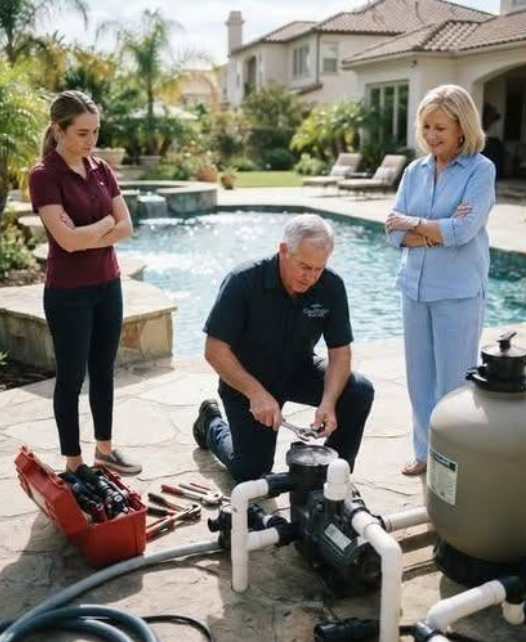
Edith told me later, sitting at my kitchen table with a cup of tea and the folder she had been carrying for three decades, that the hardest part was not losing the land. It was watching someone build on it. Watching the house go up. Watching the landscaping. Watching, twelve years ago, the construction crew pour concrete for an enormous pool over the exact area where her grandmother had built a well house in 1923.
The survey markers were part of that well house. Her grandmother had set them when the property boundary was first established. They were the physical proof that the Calloway parcel existed as a separate, defined piece of land.
And they had been buried under twelve inches of concrete and six inches of fill.
Edith told me she had assumed the markers were gone. Destroyed during construction. Removed by Richard’s father or the builders to eliminate any physical evidence of the boundary.
She was wrong. The markers were not removed. They were simply covered. Whether by negligence or intent, the construction crew had poured the pool deck directly over the Calloway boundary without excavating deep enough to encounter the granite.
Dad’s excavation for the drainage pipe went deeper than the original construction.
He found what they had buried.
Dad called Edith the evening Melissa refused to pay him. He had located her through the county recorder’s office, where the notation from 1994 still sat in the file, unresolved, beside a name and a last known address.
Edith answered the phone. She listened while Dad described what he had found. She asked him to describe the markers. He described the cut granite. The chiseled crosses. The position relative to the pool.
She told him those were her grandmother’s markers.
She told him she had been waiting thirty-two years for someone to find them.
She told him she would be there in the morning.