Part 5 — What the Markers Restored
The county’s review took four months.
The surveyor’s report confirmed that the Calloway parcel, as defined by the 1923 survey and the physical markers discovered during the pool repair, constituted a separate and distinct piece of land that had been transferred through a deed bearing a signature that could not have been validly executed.
The county’s legal office reviewed the 1994 notation, Edith’s original petition, the surveyor’s findings, and Dad’s photographic documentation. They determined that the transfer was invalid and that the Calloway parcel remained, legally, the property of the Calloway family.
The determination did not require a trial. The evidence was physical, documented, and consistent across three independent sources: the original 1923 survey, the 1994 notation, and the 2026 field discovery. Richard’s attorney reviewed the findings and advised his client that contesting the determination would require proving the validity of a signature executed by a woman with documented dementia, which was not a case any attorney would take to court with confidence.
Richard did not contest.
The Calloway parcel was restored to Edith’s name. The restoration included the land beneath and surrounding the pool, which meant Richard’s pool sat partially on land that was no longer his.
Richard’s options were limited. He could negotiate with Edith to purchase the parcel at fair market value. He could remove the portion of the pool that extended onto the Calloway land. Or he could reach a lease agreement that permitted the pool to remain in exchange for ongoing compensation.
Edith chose the negotiation. She was eighty years old. She did not want a pool. She did not want a protracted dispute. She wanted the land acknowledged as hers, the deed corrected, and a fair price paid for the portion Richard wished to retain.
Patricia Webb represented Edith in the negotiation. The fair market value of the Calloway parcel, given its location within a two-million-dollar property, was assessed at $185,000.
Richard paid it.
The check was drawn from the same household account Melissa had refused to write a $7,800 check from four months earlier.
Dad received his $7,800 as part of the settlement. Patricia had included the unpaid invoice as a condition of the agreement. Richard’s attorney objected briefly. Patricia told him the invoice was supported by signed authorizations, an itemized estimate, photographic evidence of completed work, and a recorded refusal to pay accompanied by an employment threat directed at the contractor’s daughter.
The objection was withdrawn.
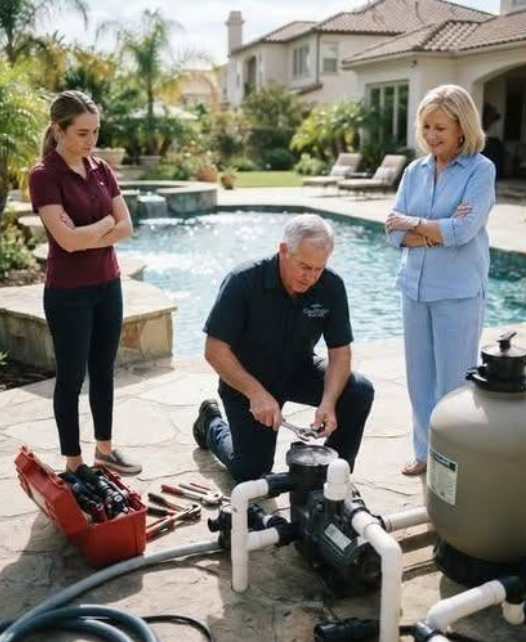
Dad deposited the check on a Tuesday afternoon. He did not celebrate. He went to his next job. A residential pool in a suburb twenty minutes south. Standard pump replacement. No granite markers. No county surveyors. No elderly women with thirty-two-year-old folders.
A normal job.
I asked Dad once, weeks after the settlement, whether he had known what the markers meant when he first found them.
He told me he had suspected. He told me a cut granite block with a chiseled cross, buried beneath a concrete pool deck, does not arrive there by accident. Someone placed it. Someone buried it. And the difference between those two actions is the difference between a boundary and a secret.
He told me he had gone to the county recorder’s office the same afternoon he found the first marker. He told me the notation from 1994 was in the file. He told me Edith’s name was in the file. He told me the entire history was sitting in a drawer in a government building, waiting for someone to connect it to the physical evidence buried under twelve inches of concrete.
He told me he had been doing this work for thirty years and that most of what he found under pools was broken pipes and tree roots. But occasionally, he found something that did not belong to the person who built the pool. And when that happened, the signed authorizations were the only thing standing between a legitimate discovery and an accusation.
He told me that was why he made people sign every page.
I asked him what he would have done if Melissa had paid the $7,800.
He looked at me.
He told me the same thing. The markers did not belong to Richard. The land did not belong to Richard. The payment dispute did not change the evidence.
He told me the only thing Melissa’s refusal had changed was the timeline. By threatening my job and refusing to pay, she had given Dad a reason to accelerate the process. If she had paid, he would have filed the documentation with the county the following week. Because she refused, he filed it the following morning.
She had not created the problem. She had rushed the consequence.
I thought about Melissa standing by the pool, smiling at me, telling my father that her husband controlled my paycheck. I thought about the confidence in her voice. The assumption that $7,800 was a small enough amount and my father was a small enough man that the threat would settle it.
She had looked at my father and seen a contractor. A man with a toolbox and a truck and a flat-rate estimate. A man who could be managed with a reminder of who held power in the relationship.
She did not see a man who had been documenting job sites for thirty years. A man who researched property records before every major project. A man who made clients sign every page because he understood that the signature was not paperwork. It was protection.
She did not see a man who found something under her pool that was worth more than her husband’s house.
On quiet evenings, Dad sat on his porch with a drink and the particular stillness of a man who has spent the day doing work he understands completely and is resting inside the satisfaction of competence.
I sat beside him sometimes. We did not talk about the pool often. It was a job. It was finished. The invoice was paid. The markers were documented. The land was restored. Edith had her parcel. Richard had his lesson. Melissa had a $185,000 reminder that threatening a contractor’s daughter was not a negotiation strategy.
Dad looked at the yard. He looked at his truck. He looked at the toolbox in the bed, organized the way it had been organized for thirty years, every wrench and fitting and adapter in its place, because a man who knows where his tools are is a man who can find what he needs when the moment requires it.
The porch was quiet. The truck was parked. The tools were in order.
And it was more than enough.