PART 2 — The Man Who Couldn’t Look Away
A few aisles over, near a display of organic juices no one ever really needed, a man stood pretending to read labels with unusual focus. His coat was plain gray, the kind designed not to attract attention, and nothing about him suggested the kind of wealth that could change a person’s life in a single decision. Beside him, a little girl held his hand with complete, unshaken trust, her small fingers wrapped around his like they belonged there.
Her name was Mia, and she was five years old—curious about everything, fearless in the quiet, natural way children are when they haven’t yet learned how complicated the world can be.
She leaned slightly closer to her father, her voice barely above a whisper. “Dad… why does that lady look so sad?”
The question landed harder than it should have.
The man’s jaw tightened—not in anger, but in something deeper, something that settled in his chest like a weight he hadn’t expected to carry. His name was Grant Whitaker, and while most people in the city recognized him from polished business profiles and charity events filled with cameras and applause, none of that mattered under the cold store lights. In that moment, he was simply a father being asked a question he didn’t know how to answer.
How do you explain to a child that sometimes people don’t have enough? That sometimes a parent has to choose between dignity and necessity? That a single item—a small blue can—can become something impossible to afford?
Grant gently brushed Mia’s hair back from her face, buying himself a second.
“She’s just having a really hard day,” he said quietly.
But even as he spoke, his eyes drifted back to Hannah, who was already walking toward the exit, her shoulders slightly pulled inward as if she were trying to take up less space in a room that had already made her feel too visible.
Grant had spent years sitting in rooms where numbers were so large they stopped feeling real. He had signed checks that made headlines. He had stood in front of audiences applauding generosity that was planned, structured, and carefully seen.
But this moment—this small, quiet moment—was something else entirely.
There were no cameras here.
No recognition.
No audience waiting to be impressed.
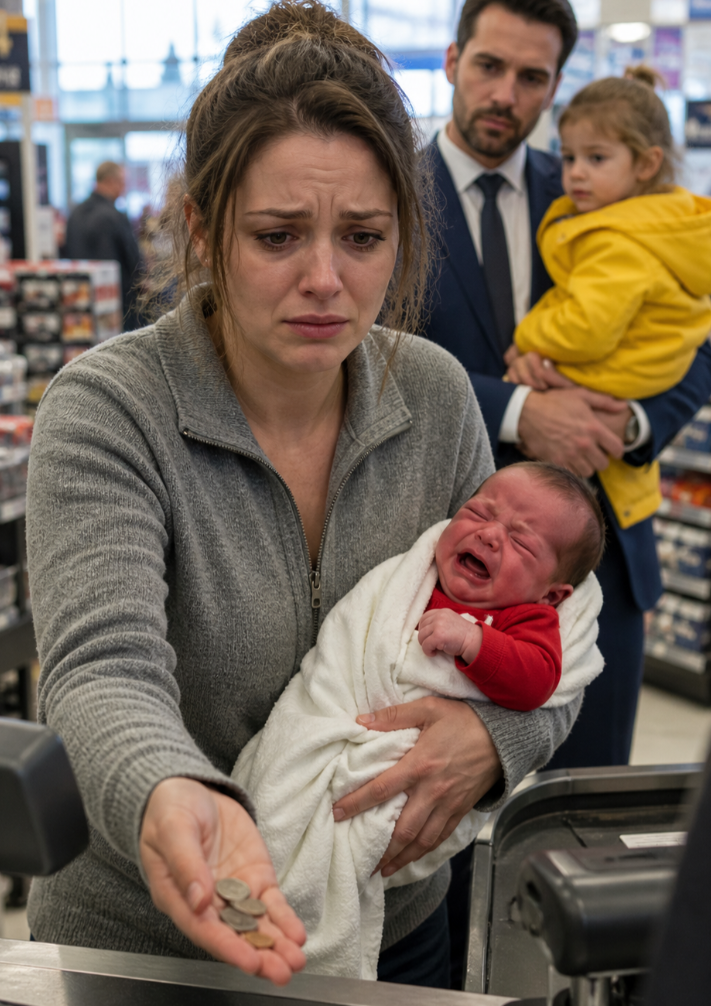
Just a young mother returning the one thing her child needed because she couldn’t afford it.
No drama. No spectacle. No voice raised.
And somehow, that made it heavier.
It broke through something in him—not loudly, not all at once, but with the slow, undeniable pressure of truth. Because this wasn’t a story told at a gala. It wasn’t a cause presented on a stage. It was real life happening in a place where no one expected to be seen.
Grant watched as Hannah pushed through the glass doors and stepped into the cold night air, clutching her small bag like it was the only thing holding her together.
Mia tugged gently on his sleeve.
“Can we help her?” she asked, her voice simple, certain.
Grant looked down at her, and for a moment, he didn’t answer. Not because he didn’t want to—but because he understood something in that second that he hadn’t fully admitted to himself before.
Helping someone quietly—without recognition, without performance—was different.
It required more than money.
It required attention.
Respect.
Choice.
He looked back toward the door where Hannah had disappeared.
And then—
He made a decision.
“Stay here for a minute,” he told Mia softly. “I’ll be right back.”
She nodded without hesitation, trusting him completely.
Grant turned and walked back toward the checkout lane, his steps steady, deliberate now—not rushed, not uncertain. The blue can still sat behind the counter, set aside like something unclaimed, something unimportant.
But he couldn’t unsee it.
He couldn’t forget the way her hands had trembled.
Or the way she had said, “I have to leave this one,” like it cost her more than money.
He picked it up and placed it back on the counter.
Then he added more.
Not extravagantly.
Not to impress anyone.
But because he remembered the thin plastic bag, the careful choices, the way necessity had shaped everything she bought.
A warm rotisserie chicken.
Fresh apples.
Better bread.
A small box of cookies—something a child might reach for without hesitation.
The cashier didn’t question him. The scanner began its quiet rhythm again.
Beep. Beep. Beep.
Each sound now felt different.
Not like a countdown.
But like something being undone.
When Grant gathered the bags and stepped back out into the cold, the night air hit him sharply—but it didn’t slow him down.
Across the parking lot, beneath the dim glow of a streetlight, Hannah sat at the bus stop.
Alone.
And she had no idea—
That the moment she thought had ended inside that store…
Was only just beginning.