PART 1 — The Sound of a Price She Couldn’t Pay
The store in Riverton, Ohio always sounded the same—carts rattling across polished floors, scanners chirping in quick, indifferent tones, babies fussing somewhere between aisles, and fluorescent lights humming overhead like a tired song that never ended. People moved quickly with their heads down, focused on lists and prices, carefully staying inside their own worlds. No one really looked at anyone else. But Hannah Mercer noticed everything.
She noticed the clock above the service counter, each minute slipping forward like it mattered too much. She noticed the thin fold of bills tucked into her wallet. She noticed the way her hands wouldn’t stop trembling, no matter how tightly she tried to steady them. At twenty-eight, she felt older than she should. The past months had worn her down quietly—through broken sleep, constant worry, and the kind of pressure that settles deep behind your ribs and never fully leaves.
Inside her cart was only what she could justify buying: a loaf of discounted bread, a small box of oatmeal, frozen vegetables she could stretch across several meals, and two jars of baby food. Resting on top of everything else, like it carried more importance than all of it combined, was a single blue can of hypoallergenic infant formula—the only kind her pediatrician had approved. The doctor’s words still echoed in her mind: if she changed brands, her baby might not tolerate it. There had been no hesitation in that warning, and Hannah had taken it seriously. When it came to her daughter, there was no room for risk.
Nora was almost one year old, with soft cheeks and bright, trusting eyes. She didn’t understand how heavy the world could be, and Hannah worked every day to make sure she didn’t have to. That trust—pure and unquestioning—made Hannah feel strong and terrified at the same time. Lately, though, the world had been asking for more than she could give, and the weight she carried for both of them had started to feel unbearable.
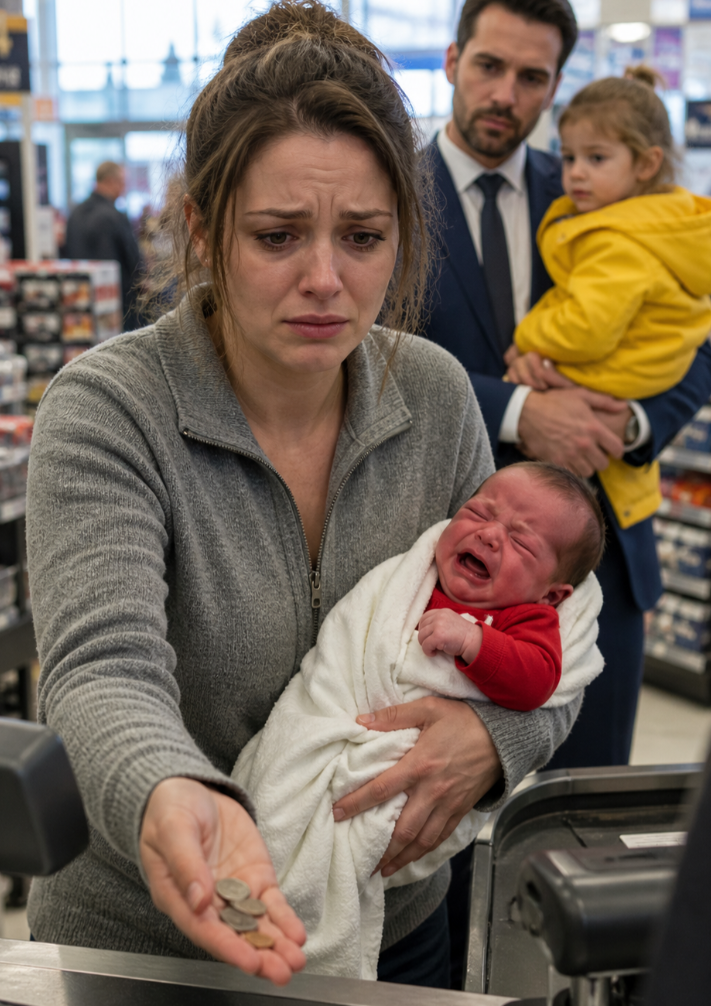
At the checkout, the cashier—barely older than a teenager, his name tag reading Evan—moved with mechanical efficiency. Bread. Beep. Oatmeal. Beep. Frozen vegetables. Beep. Each sound felt like a countdown, quiet but precise, leading to the moment Hannah had already rehearsed in her head several times while walking through the store. When Evan lifted the blue can of formula, her breathing slowed, then stopped. She knew the price. She had calculated it again and again, hoping numbers might somehow bend in her favor if she tried hard enough. But knowing something and facing it were never the same.
The scanner beeped, and the total appeared on the screen—higher than what she had. Not by a lot. Just enough to make it hurt. Evan glanced up briefly, not unkind, just tired, and asked if that was everything. Hannah nodded, her fingers already moving into her wallet. She counted once, then again, then a third time, as if the outcome might change under pressure. It didn’t. She was short.
Heat crept up her neck, and when she spoke, her voice came out smaller than she intended. She apologized softly and slid the formula back across the counter, pretending the motion was casual, as if it didn’t matter. But inside, it felt like giving something up with her entire body. The line behind her shifted—someone sighed, another person checked their phone—and Hannah suddenly felt like she had taken up too much space in a world that had no patience for hesitation.
She kept her eyes down, paid for what she could, and took the thin plastic bag. It felt heavier than it should have. Without looking at anyone, she walked toward the exit as quickly as possible, hoping movement alone might make her invisible. But she didn’t know that someone, just a few lanes away, had already been watching her the entire time.