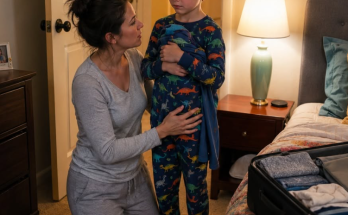
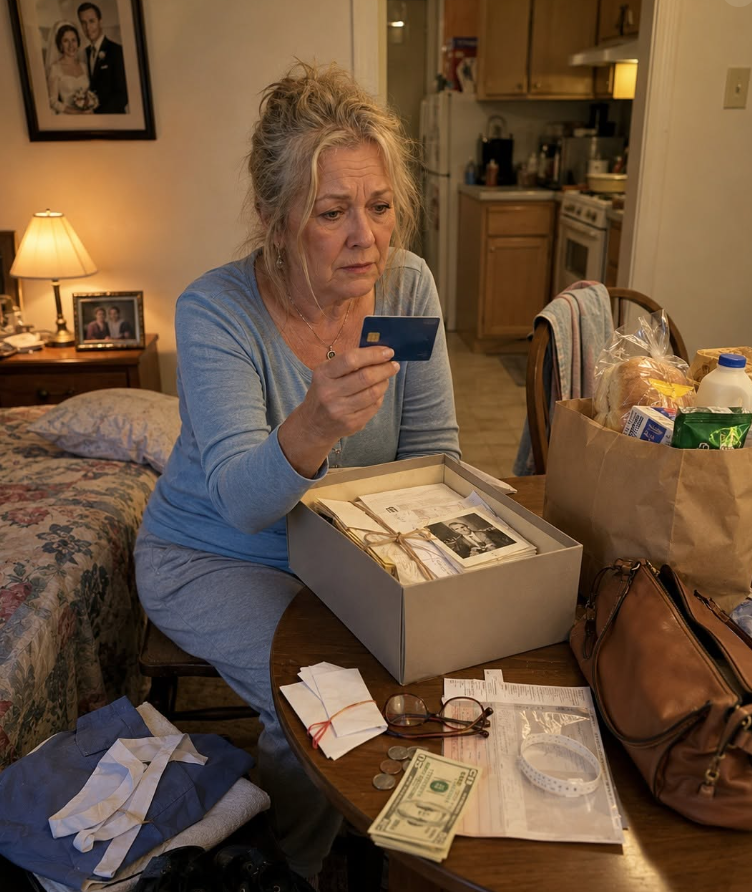
The debit card sat in a shoebox at the back of my closet for nearly four years.
Not because I forgot about it. You don’t forget a thing that was handed to you like a parting gift on the worst morning of your life. I knew exactly where it was. I knew the worn corner of the box where the cardboard had bent from being pushed behind a winter coat. I knew the way the card felt in my hand when I took it out in the middle of the night sometimes, when the apartment was quiet and I had counted coins for groceries and my back hurt in the low, persistent way that comes from cleaning other people’s floors for eight hours and sleeping on a mattress that was never quite right.
I would hold it. Look at it. Put it back.
It had a four-digit PIN written on a yellow sticky note folded into the box. I never used either of them. Not once, in four years, during which I worked every job I could find and rented a room above a garage and ate whatever was cheapest and told my children I was fine when they asked, which they did with the frequency of people who suspect the answer is a lie.
The card was not money to me. It was the last thing Bob ever gave me. And for a long time, using it would have felt like accepting something from him, and I was not ready to accept anything from the man who had sat across from me at our kitchen table six weeks after our thirty-seventh wedding anniversary and quietly asked for a divorce.
No one would have described our marriage as dramatic. We were not the kind of couple who made a story out of themselves. Bob Harper had been my high school sweetheart in the specific way of a thing that happens before you understand what sweetheart means and then turns out to have been exactly right anyway. We married young. We had two children, Chloe and then Jake, three years apart, and we raised them in a house in Seattle that needed work we could never quite afford to do all at once. We argued about bills and weather and whose turn it was to call the plumber. We celebrated birthdays with homemade cakes and too many candles. We survived bad years: a business that nearly collapsed, a pregnancy we lost between the children, a period in our early forties when we barely recognized each other and had to learn to be married again from something close to scratch. We had long stretches of ordinary days that, when I look back at them now, were the substance of everything.
Then, in November of what should have been an unremarkable year, Bob asked me to sit down and told me he wanted a divorce.
He did not say there was someone else. There wasn’t. He did not say I had done anything wrong. He offered no specific complaint, no accumulated grievance, no dramatic revelation. When I pressed him, which I did, repeatedly and at high volume, he said only that it was what he needed to do. That was the phrase he kept returning to. It is what I need to do. As if the marriage were a door he had been standing at for some time and had finally decided to walk through, and the reason was simply that the door existed.
Our daughter begged him to explain. Jake stopped returning his calls almost immediately, that particular silent withdrawal that is its own complete statement. Friends distributed themselves into camps, because people do that when a long marriage ends, and the silence between them becomes a territory they feel required to occupy. I moved through those weeks in the way you move through something you cannot believe is happening to you, half-present, performing the actions of someone whose life is being reorganized while the interior part of you has not yet accepted the reorganization.
I did not understand yet that Bob was sick.
Looking back, I can see it. He had lost weight over the months before the conversation at the kitchen table, not dramatically, but noticeably. His hands shook sometimes when he lifted his coffee cup. There were circles under his eyes that I attributed to poor sleep and the stress of whatever it was he was carrying that he would not name. I thought he was having some kind of late-life crisis, the kind that comes on men in their sixties and makes them do things that seem baffling from the outside. I was wrong about the cause and right about the crisis, just not in any way that would have been useful.
The divorce was finalized on a gray morning in November at a Seattle courthouse. We did not speak much. There is surprisingly little to say when the thing you are doing has already been decided and the only remaining task is to make it official. When the paperwork was complete and we were standing in the corridor outside the courtroom, Bob reached into his jacket and held out the debit card.
“Please keep this,” he said.
I looked at it without taking it.
“What is it?”
“A personal account. In case you ever need it.”
“I don’t want your charity.”
His expression changed in the way that expressions change when someone has heard a thing they knew was coming and still find it difficult. For a moment, I thought he was going to say something real. Something that would explain the past several months, or at least give me something to work with.
Instead he said, “Use it if you ever need to.”
Then he turned and walked away down the corridor, and I stood there holding a piece of plastic and a four-digit PIN and thirty-seven years of marriage that had apparently concluded.
That was the last time I saw him.
Three months later, he moved to Oregon without explanation. Six months after that, contact became sparse. When Chloe called, he answered less often. When he did answer, he said he was traveling, or busy, or tired, always tired. Jake had already mostly stopped trying. The gaps between conversations grew until the calls stopped, which can happen gradually enough that no one moment is the clear ending, just a slow fade that you only understand in retrospect.
Ten months after the divorce, a lawyer contacted us.
Bob had died in hospice care in a small town in Oregon. Stage-four pancreatic cancer. He had been diagnosed before he asked me for a divorce. By the time he had that conversation at our kitchen table, he had already known for some months what was happening inside him and had estimated, with the help of doctors who were not optimistic, how much time he likely had.
He had instructed hospice staff not to contact us until after his death. He had wanted us to find out from an attorney, in a controlled way, after the fact.
My first response was fury. Not the clean, propulsive kind that burns out quickly, but the deep, settling kind that finds its way into everything and changes the flavor of every memory you try to access. I was furious that he had made a decision about our family’s grief without consulting the people who were actually part of it. I was furious that he had spent his last months somewhere none of us could reach him and then given us no opportunity to say goodbye. I was furious that he had taken the explanation away from me by dying before he had to give it.
Then I was just devastated, which is what fury becomes when you’ve been carrying it long enough and it runs out of fuel.
The attorney gave us a short note. Two words on a piece of paper in Bob’s handwriting: I’m sorry. Whether this was meant as an explanation or an acknowledgment or simply the only thing left to say, I couldn’t determine. It was not enough, and it was also everything he had managed to leave in the moment of writing it, and I had to learn to live with both of those things being true simultaneously.
The years that followed were hard in the specific way of lives that have been suddenly restructured without anyone’s input. I found a room above a garage in a neighborhood that was affordable because it was inconvenient to everything. I cleaned houses. I stocked shelves at a grocery store two mornings a week. I scrubbed office floors in the evenings, when the buildings were empty and the work could be done without interacting with anyone, which suited me because I had lost the energy for interaction and had not yet found it again. I applied for every job I could do with a body that was aging and a resume that had stopped being updated in the years when I had been a wife and mother and had not been recording my experiences as professional accomplishments.
My children helped when they could. I accepted some of it and refused most of it, which I told myself was about protecting my independence. The truth was more tangled than that. I wanted to struggle. Not in the performative way of someone wanting to be noticed, but in the genuine way of someone for whom suffering has become the only activity that feels proportionate to the loss. Grief is not rational. It does not ask your permission before it makes decisions about how you will spend your days. Mine had decided that exhaustion and difficulty were the correct response to what Bob had done, and I was not yet at a place where I could argue with it effectively.
The debit card sat in its box. I looked at it sometimes. Put it back.
Four years after Bob died, I collapsed while carrying groceries up the steps to my room. It was summer, mid-afternoon, hot in the way Seattle occasionally manages in August, and I had been working too many hours and sleeping too few and eating whatever was available rather than whatever was adequate. A neighbor found me and called an ambulance.
The doctor who saw me in the emergency room was blunt in the manner of someone who has decided that directness is more useful than comfort in this particular situation.
“If you keep living this way,” he said, “you’ll be back here. And the next time may not have as simple an outcome.”
That night I sat alone in my apartment after they discharged me, in the particular silence of a place that has heard too many one-sided conversations and too much grieving and not enough laughter. At some point after midnight, I opened the closet.
I took out the shoebox.
I sat with it on the kitchen table for a while before I opened it.
Inside was the card and the sticky note and four years of whatever it was I had been preserving by not using them. I sat with it long enough for the stubbornness to exhaust itself, or for the exhaustion to become larger than the stubbornness, which amounts to the same thing.
In the morning, I went to the bank.
The teller who looked up the account frowned in a way that made my stomach contract. I had walked in expecting to be told the account was empty, which was part of the reason I had stayed away so long. If the money was gone, the gesture would have meant nothing. If it was there, I would have to confront what it meant that I had waited four years to accept it.
“There are special instructions attached to this account,” the teller said.
“What kind of instructions?”
She wrote a phone number on a slip of paper and slid it across the counter. “An attorney manages a trust connected to it. You’ll need to speak with him.”
An hour later I was sitting across a desk from a lawyer named Michael Harris, who had a careful quality about him, the manner of someone who has been waiting for a difficult conversation for a long time and has prepared for it. When I told him my name, he nodded slowly.
“I’ve been expecting this day,” he said.
He opened a file cabinet and removed several folders, each labeled in the precise handwriting of someone who understands that clarity matters when the person on the other side of the desk is going to receive information that changes her understanding of the last four years of her life. He laid a statement on the desk and turned it toward me.
I looked at the number.
Eight hundred and forty-two thousand dollars.
I pushed the paper back toward him.
“There’s been a mistake.”
“There hasn’t.”
“Bob wasn’t wealthy. We were comfortable at times, but nothing like this.”
He settled back in his chair with the expression of someone arranging a complicated fact for delivery. Five years before his diagnosis, he said, Bob had sold his ownership share in the construction company he had spent nearly two decades helping to build. The sale had been quiet, managed through a corporate attorney, and the proceeds had gone directly into investments that Bob managed separately from our shared finances. When the doctors told him what was happening in his pancreas and gave him the likely timeline, Bob spent several weeks with financial and estate planners establishing an irrevocable trust with me as the sole beneficiary.
“He was very specific about what he wanted,” Michael Harris said. “He wanted you to be financially secure for the rest of your life regardless of what decisions you made about the trust itself. He anticipated that you might not use it immediately.”
I laughed, but it was not a happy sound.
“He anticipated that correctly.”
“He said as much, in a note to me. He said he suspected it might be years before you came in, if you came in at all.” The lawyer paused. “He also left you a letter. He asked me to give it to you when you were ready.”
The envelope was standard white, sealed, and had my name on the front in handwriting I would have recognized in any context: slightly forward-leaning, the L larger than necessary, the way Bob had always written my name since he started writing it on notes and grocery lists and birthday cards thirty-seven years ago.
I held it for a moment without opening it.
Then I opened it.
Linda, the letter began.
If you’re reading this, then either you’ve finally been practical or your stubbornness has lost a battle with reality.