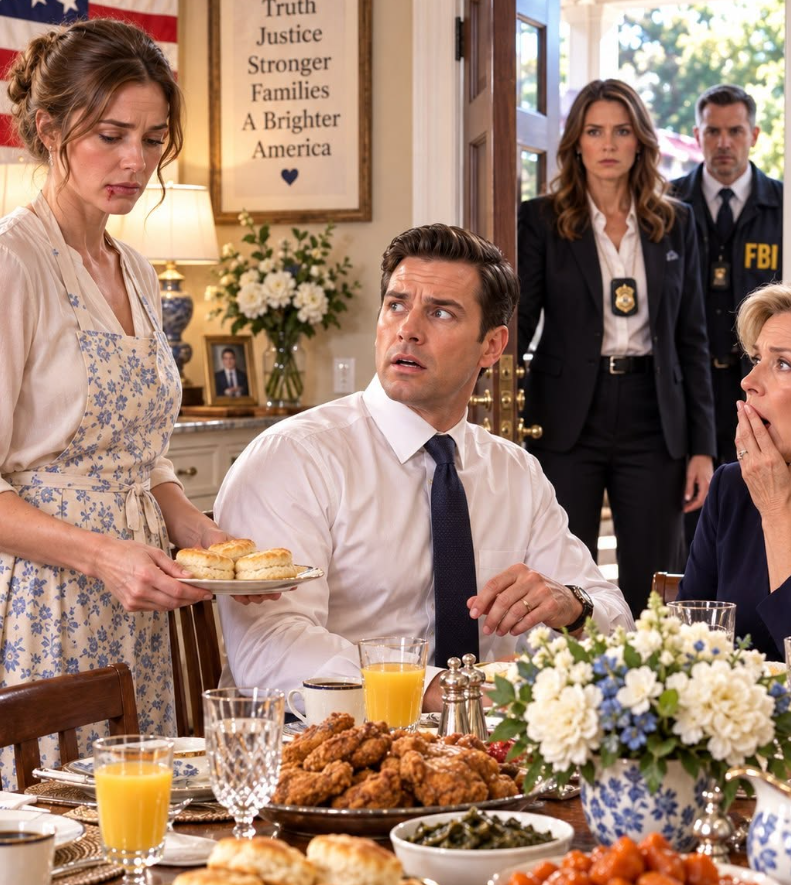
Margaret stepped toward me.
“Caroline, marriages are complicated.”
“No.”
Her eyes narrowed.
“You don’t destroy a family over one mistake.”
“One?”
I almost laughed.
I picked up the first folder.
“Palmetto Strategic Holdings.”
Margaret stopped moving.
Ethan’s face changed.
I continued.
“Four hundred eighty-six thousand dollars transferred over nine months.”
“That’s business.”
“To a shell consulting company managed by Gregory Vale.”
Margaret’s jaw tightened.
Agent Dawson watched silently.
I lifted another sheet.
“Gregory Vale also manages the trust that owns Cypress Ridge Holdings.”
Ethan stared at me.
I had never seen him look genuinely stunned before.
“You had no right—”
“These are public corporate filings.”
I placed the paper down.
“Cypress Ridge purchased three parcels near the proposed waterfront redevelopment zone eight weeks before the zoning changes became public.”
Margaret sat slowly.
My father looked at her.
Not Ethan.
Her.
That told me he understood before she spoke.
Margaret had always been the smarter one.
Ethan was arrogant.
Margaret was disciplined.
The money trail existed because Ethan had become careless.
The structure existed because Margaret had designed it.
Agent Dawson finally spoke.
“Mr. Blackwood, Ms. Blackwood, this investigation did not begin this morning.”
Ethan looked toward her.
“What investigation?”
“The one involving suspected bribery, unlawful disclosure of protected bid information, fraudulent invoicing, and movement of funds through related corporate entities.”
Margaret found her voice.
“This is outrageous.”
Claire remained expressionless.
“You are free to say that.”
“I know people in the attorney general’s office.”
“I’m sure you do.”
For once, Margaret had no response.
Outside, tires moved over the gravel driveway.
Ethan turned toward the windows.
Two dark vehicles stopped in front of the house.
More investigators emerged.
His face lost what little color remained.
He turned to me.
“This was you.”
I shook my head.
“No.”
His eyes narrowed.
“You called them.”
“I gave information to my attorney.”
“You betrayed me.”
I stared at him.
“You hit me because I asked where you were.”
His nostrils flared.
“You have no idea what you’ve done.”
“I know exactly what I did.”
“You destroyed everything.”
“No. I documented what you built.”
For the first time, Ethan looked at my father as though hoping the older man would rescue him.
“Charles, tell her to stop this.”
My father’s expression did not move.
“You still think she needs my permission?”
The question landed harder than any speech could have.
Ethan looked back at me.
Something shifted.
Perhaps he finally remembered who I had been before I became his wife.
Not his hostess.
Not his accessory.
Not the woman who arranged flowers while he discussed business.
A forensic accountant.
A woman trained to follow money until lies became numbers.
And numbers did not care about charm.
Agent Dawson asked Ethan to sit.
He refused.
Deputy Hill said, “Sir.”
That was enough.
Ethan sat.
Margaret remained rigid beside him.
The morning unfolded slowly after that.
Investigators entered Ethan’s office.
They cataloged documents.
Photographed the safe.
Collected devices according to the authority they had brought with them.
Ethan demanded to call his attorney.
He was allowed to.
Margaret called Gregory.
He did not answer.
That frightened her.
I saw it.
Her hand began trembling around her phone.
An hour later, Deputy Hill took my statement.
I described the blow.
The argument.
Ethan’s words.
The broken mug was still on the kitchen floor.
Photographs were taken before anyone cleaned it.
Ethan listened from the next room.
When I repeated his sentence—Do not question me in my own home—he shouted that I was twisting things.
Deputy Hill closed the door.
By noon, the breakfast was cold.
The gravy had formed a skin.
The biscuits hardened in their basket.
Nobody cared.
The house that Ethan treated like a symbol of his authority now felt like a crime scene.
At twelve thirty, his attorney arrived.
He advised Ethan to stop speaking.
That may have been the first intelligent advice Ethan accepted all day.
Margaret’s attorney arrived twenty minutes later.
The two lawyers immediately separated their clients.
I noticed that.
Mother and son had spent years acting united.
The moment consequences appeared, unity became a liability.
By afternoon, I packed one suitcase.
Not because I intended to leave permanently.
Because I did not know whether I wanted to remain in the house that night.
My father waited downstairs.
Sarah came with me.
I opened the bedroom closet.
For several seconds, I simply stared.
So many pieces of my life had been selected around Ethan.
Dresses he liked.
Shoes appropriate for his events.
Jewelry his family considered respectable.
I reached past them and pulled down an old canvas bag.
Sarah watched me.
“You okay?”
“No.”
“Good answer.”
I looked at her.
She gave me a sad smile.
“You don’t have to be okay today.”
That nearly broke me.
Not the investigation.
Not Margaret’s cruelty.
Not even Ethan’s blow.
Kindness did.
I sat on the edge of the bed and cried for the first time.
Quietly at first.
Then harder.
Sarah sat beside me.
Neither of us spoke.
Eventually I wiped my face.
“I feel stupid.”
“For what?”
“Staying.”
She shook her head.
“No.”
“I saw things.”
“You also lived with someone who spent years teaching you to doubt your own interpretation of those things.”
“I should have known.”
“You did know.”
I looked at her.
“That’s why everyone is downstairs.”
I laughed through tears.
She was right.
I had known.
Maybe not soon enough.
Maybe not cleanly.
Maybe not courageously every single day.
But eventually I trusted myself.
And that mattered.
I spent that night at my father’s house.
The room I slept in had once been mine.
He had barely changed it.
My college books still sat on one shelf.
A framed photograph of my mother stood beside the lamp.
At two in the morning, I woke after dreaming Ethan was standing over me.
I sat up, heart pounding.
Then I heard something through the wall.
My father moving around downstairs.
I followed the sound.
He was in the kitchen making tea.
When he saw me, he took down a second cup without asking.
We sat at the table.
For a while, neither of us spoke.
Then he said, “I owe you an apology.”
I frowned.
“For what?”
“I liked him.”
“So did I.”
“I defended him.”
“So did I.”
“I thought he respected you.”
“So did I.”
My father stared at his tea.
“I spent my career believing I could read people.”
“You can.”
“Not always.”
“No one can.”
He looked at me.
“I should have seen it.”
I reached across the table.
“Dad.”
His jaw tightened.
“I want to kill him for touching you.”
Despite everything, I smiled faintly.
“That would complicate the legal strategy.”
He laughed once.
Then his eyes filled with tears.
My father almost never cried.
I had seen him cry when my mother died.
That was all.
Until then.
“I’m proud of you,” he said.
I looked away.
“I don’t feel brave.”
“Bravery and fear are not opposites.”
That sounded exactly like something Judge Whitmore would say.
“Was that from a case?”
“No.”
“Book?”
“No.”
“Mom?”
He smiled.
“Your mother.”
That hurt in the best possible way.
The investigation continued for months.
Ethan was not taken away in dramatic handcuffs that first morning.
Real legal cases rarely unfold like television.
Documents were reviewed.
Accounts examined.
Witnesses interviewed.
Subpoenas issued.
Forensic teams reconstructed transactions.
And with every passing week, Ethan’s world became smaller.
Blackwood Development placed him on administrative leave.
Then removed him.
Business partners distanced themselves.
Board members claimed they had known nothing.
Some were telling the truth.
Some were not.
Gregory Vale eventually began cooperating with investigators.
That was the turning point.
According to information that later became part of public court filings, Gregory had helped establish shell companies at Margaret’s direction.
The companies purchased land before zoning decisions became public.
Payments disguised as consulting expenses were routed through multiple entities.
A city official received benefits through a family-controlled business.
Confidential bid information had been leaked.
Ethan had not invented the scheme.
But he had used it.
Expanded it.
And grown reckless.
He also had another problem.
The night he disappeared before hitting me, he had not been with another woman as I initially suspected.
He had been meeting Gregory.
Gregory had threatened to withdraw from the arrangement.
Ethan responded with threats of his own.
Their conversation had been recorded.
Not by me.
By Gregory.
By the time Ethan walked into our kitchen the next morning, bleeding fury into me because I asked a question, his entire operation was already beginning to collapse.
He just did not know it.
Margaret eventually claimed Ethan had acted independently.
Ethan claimed his mother controlled the financial structures.
Gregory blamed both of them.
Watching them turn on one another taught me something important.
People who build relationships around loyalty enforced by fear rarely remain loyal when fear changes direction.
My divorce attorney filed within forty-eight hours of the breakfast.
Ethan fought everything.
Of course he did.
He challenged accounts.
Property.
Furniture.
My inheritance.
Even my grandmother’s silver.
He demanded the house.
Then refused to pay household expenses.
Then accused me of abandoning him.
Then sent flowers.
I threw them away.
He wrote letters apologizing.
Then letters blaming me.
Then letters explaining that stress had made him “act out of character.”
That phrase made me angry.
Not because it was false.
Because it was clever.
Ethan had not acted out of character.
He had acted without disguise.
The court granted protective orders.
Communication moved through attorneys.
For the first time in years, I could sleep without wondering what mood would enter the bedroom.
That freedom felt strange at first.
Peace can feel uncomfortable when your body has adapted to danger.
I jumped when phones rang.
I checked locks twice.
I apologized constantly for small things.
At restaurants, I still looked toward the door whenever a man raised his voice.
Healing was not a straight line.
Some days I felt powerful.
Other days I cried because I found one of Ethan’s shirts mixed into a box.
I missed the man I thought I married.
That was difficult to admit.
People expected hatred to replace love immediately.
It did not.
Grief took longer.
I grieved mornings on the porch.
Vacations.
Private jokes.
The version of Ethan who sat beside me after my mother’s funeral.
I grieved a marriage that had existed partly in reality and partly in hope.
But missing what I believed did not mean returning to what was true.
Six months after I left, I reopened my forensic accounting practice full-time.
I rented a small office downtown.
Nothing impressive.
Two rooms above a law firm.
Old hardwood floors.
A window overlooking a bookstore.
The first week, I bought myself a new coffee maker.
The second week, I hired an assistant.
The third week, I accepted a corporate fraud case that required me to speak before a board of directors.
The morning of the presentation, I stood in the restroom looking at myself in the mirror.
For a second, I saw the woman from the breakfast table.
Swollen lip.
Steady hands.
Waiting for a door to open.
Then I smiled.
Not Ethan’s favorite polite smile.
Mine.
The board meeting lasted three hours.
I loved every minute of it.
My father retired properly after that.
No consulting.
No advisory panels.
No “one last case.”
He took up fishing badly.
Started growing tomatoes obsessively.
And called me every Sunday morning.
He never again mentioned being ashamed that he had misjudged Ethan.
Instead, he learned something better.
He stopped treating my survival as evidence of his failure.
It was mine to understand.
Not his to fix.
Margaret’s case attracted attention locally.
People who once praised her charity work suddenly pretended they had barely known her.
That bothered me.
Not because I wanted anyone defending her.
Because hypocrisy was too easy.
Margaret had not become cruel the day investigators entered my kitchen.
She had been cruel quietly for years.
People tolerated it because she donated money, chaired committees, wore pearls, and sent expensive flowers to funerals.
Respectability is sometimes just camouflage with good tailoring.
During her deposition in the divorce-related financial proceedings, Margaret was asked whether she remembered seeing my injured lip that morning.
She said yes.
She was asked whether she had been concerned.
She said she assumed Ethan and I had experienced “a marital disagreement.”
Then she was asked whether she had said, “A wife ought to know when to stop speaking.”
There was a pause.
Long enough to matter.
Finally she said, “I may have said something to that effect.”
That sentence destroyed something in me.
Not painfully.
Cleanly.
Until then, some small part of me still wondered whether I had misunderstood her smile.
I had not.
The divorce became final fourteen months after the breakfast.
The court divided marital property.
My premarital inheritance remained mine.
I sold my interest in the Charleston house.
I wanted no part of it.
The family silver came with me.
So did my mother’s crystal.
On the day the papers were signed, Sarah took me to lunch.
She raised a glass of iced tea.
“To being a terribly improper wife.”
I laughed so loudly people turned around.
Months later, portions of the criminal investigation concluded in plea agreements and charges against multiple people connected to the scheme.
I did not attend every hearing.
I did not need to.
For a while, I thought justice meant watching Ethan lose.
Eventually I understood that watching him had kept him at the center of my life.
I was finished doing that.
I attended only one major hearing.
Ethan saw me across the courtroom.
He looked older.
Not dramatically.
Just diminished.
The confidence was gone.
He stared as though expecting some sign that I still cared whether he suffered.
I felt almost nothing.
That surprised me.
When the proceedings ended, he called my name.
“Caroline.”
I stopped.
My attorney looked at me.
I turned.
Ethan stood between two lawyers.
“You ruined my life,” he said.
His voice was low.
Bitter.
Familiar.
For one second, I was back in our kitchen.
Blood on my lip.
Broken mug on the floor.
Then I remembered something.
I walked closer.
Not too close.
“You still think that?”
His eyes hardened.
“You gave them everything.”
“No.”
“You destroyed my company.”
“No.”
“My mother’s reputation.”
“No.”
“My future.”
I shook my head.
“I asked where you spent the night.”
He stared at me.
“You made every choice after that.”
Then I left.
Outside the courthouse, the sun was bright.
My father waited near the steps even though I had told him he did not need to come.
He held two coffees.
I took one.
“Well?” he asked.
“Well what?”
“How do you feel?”
I thought carefully.
“Hungry.”
He looked surprised.
Then laughed.
“Breakfast?”
“Definitely.”
We went to a little diner near the river.
Nothing fancy.
Vinyl booths.
Paper napkins.
Coffee in thick white mugs.
I ordered biscuits and gravy.
My father ordered eggs.
When the food arrived, I stared at my plate for a moment.
He noticed.
“You okay?”
“Yes.”
And I was.
Mostly.
That was enough.
Two years after the morning Ethan hit me, I bought a smaller house.
Not because I could not afford something grander.
Because I no longer wanted rooms designed to impress people.
The new house had a yellow kitchen.
A tiny back garden.
A porch just wide enough for two rocking chairs.
I planted herbs.
Learned to bake sourdough badly.
Hosted dinners for friends who stayed too late and laughed too loudly.
I stopped polishing silver unless I felt like it.
Sometimes I used my mother’s crystal for ordinary lemonade.
The first time my father saw that, he looked horrified.
“Those glasses are antique.”
“I know.”
“You’re putting iced tea in them?”
“Yes.”
He considered objecting.
Then smiled.
“Your mother would approve.”
One Sunday morning, almost three years after the breakfast, I woke before sunrise.
Rain touched the windows.
For a second, my body remembered.
My heart beat faster.
Then I looked around.
My room.
My house.
My life.
Safe.
I went downstairs.
Made coffee.
Opened the windows.
And started breakfast.
Biscuits.
Eggs.
Fried potatoes.
Peach preserves.
Nothing dramatic.
Nobody was coming to arrest anyone.
Nobody was preparing to reveal secrets.
Nobody had to be frightened.
My father arrived around nine carrying tomatoes from his garden.
Sarah came at nine fifteen with pastries I had specifically told her not to bring.
Two colleagues from work showed up later.
By ten, the kitchen was full.
People talking.
Laughing.
Stealing food.
Leaving cups everywhere.
At one point, Sarah held up one of my mother’s crystal glasses.
“You know Margaret would faint if she saw us drinking orange juice out of these.”
I smiled.
“Then pour another.”
Everyone laughed.
I carried biscuits to the table.
Sunlight had started breaking through the rain clouds.
For a moment, I stood in the kitchen doorway and watched people I loved filling my home without fear.
Then my father looked up.
“You joining us?”
I thought of Ethan saying, “Make breakfast.”
I thought of Margaret saying a wife should know when to stop speaking.
I thought of the covered platter.
The recorder.
The opening door.
The terror on Ethan’s face when the world he believed he controlled finally answered back.
Then I looked at my father.
“At the head of the table,” I said.
He grinned.
“Of course.”
I sat down.
Not as somebody’s proper wife.
Not as Judge Whitmore’s daughter.
Not as the woman Ethan had once believed he owned.
Just Caroline.
And for the first time in a very long while, that name felt like more than enough.
Sometimes people ask whether I planned everything.
Whether I knew that morning would end the way it did.
The answer is no.
I knew only one thing when I stood in front of that mirror with blood on my lip.
Silence could protect an abuser.
Or it could protect a plan.
Ethan never learned the difference until the kitchen door opened.
He thought my quiet meant I had surrendered.
He thought breakfast meant forgiveness.
He thought the polished silver meant I still cared about appearances.
He thought a smile meant obedience.
He was wrong about all of it.
I had not made breakfast because I was afraid of him.
I had made breakfast because I wanted him comfortable.
Careless.
Certain.
I wanted him seated at the head of the table when everything he had hidden was placed directly in front of him.
I wanted Margaret there because she had spent years teaching him that powerful families could bury ugly truths beneath beautiful manners.
I wanted my father there because Ethan had used his respect for my father as proof that he was untouchable.
I wanted Sarah there because she knew how much evidence I had collected.
I wanted Agent Dawson there because facts matter most when they reach someone willing to follow them.
And I wanted myself there.
Not running.
Not apologizing.
Not disappearing from my own life.
Standing.
Watching.
Remembering.
The last time I ever saw Ethan outside a courtroom was almost four years later.
I was leaving a restaurant with Sarah when I spotted him across the street.
He was alone.
For one strange second, our eyes met.
Neither of us moved.
He looked older still.
Ordinary.
That was perhaps the most surprising part.
For years, Ethan had seemed enormous inside my life.
His moods changed rooms.
His approval decided evenings.
His anger controlled conversations.
His silence dictated my choices.
Across that street, he was simply a man.
One man among hundreds.
He looked away first.
Sarah followed my gaze.
“Was that—”
“Yes.”
“You okay?”
I thought about it.
Then smiled.
“Yes.”
And this time the word required no effort.
We kept walking.
I never looked back.
The rain started as we reached the car.
Soft at first.
Then harder.
Years earlier, rain against kitchen windows had accompanied one of the worst mornings of my life.
Now I tilted my face upward and let it fall.
Sarah groaned.
“My hair.”
I laughed.
“Come on.”
We ran the last few steps.
Inside the car, breathless and soaked, I realized something my mother had probably understood all those years ago.
A life does not become peaceful because cruel people apologize.
Sometimes they never do.
Peace begins when their voice stops being the loudest one inside your head.
Ethan never gave me closure.
Margaret never admitted what she had done to our marriage.
Nobody returned the years I spent shrinking myself to keep another person comfortable.
But I rebuilt.
That became enough.
I made work I respected.
Kept people around me who did not require me to disappear.
Learned that boundaries did not make me unkind.
Learned that forgiveness was optional.
Learned that leaving could be an act of love toward yourself.
And learned never again to mistake someone’s need for control for devotion.
Every year, on the anniversary of that breakfast, my father jokes that we should make biscuits.
I always agree.
Not because I celebrate Ethan’s downfall.
Because I celebrate the morning I finally believed myself.
The morning I stopped waiting for permission.
The morning a kitchen door opened and the man who thought he controlled everything discovered that I had already taken my life back.
And whenever my father reaches for the gravy, he still looks at me and says the same thing.
“Proper Southern breakfast.”
I always smile.
“Improper Southern daughter.”
He lifts his coffee.
“The best kind.”
And every single year, I drink to that.
💬THE END! THANK YOU FOR READING!