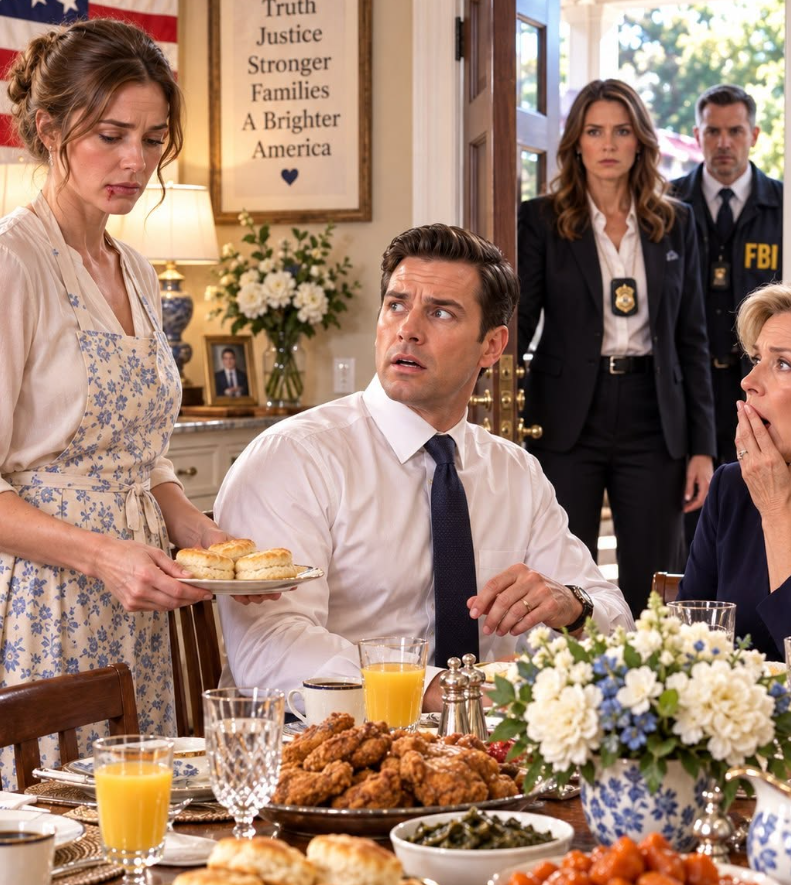
Everything changed because of one simple question. “Where did you spend last night?” That was all I said. My husband, Ethan Blackwood, replied with the back of his hand. The blow came so quickly that I barely saw him move.
One moment I was standing beside the kitchen island with my fingers wrapped around a coffee mug. The next, my head snapped sideways.
My lip struck my teeth. The mug slipped from my hand and shattered against the hardwood floor.
For several seconds, the only sounds in the kitchen were the rain tapping against the windows and the faint hiss of grease cooling in the cast-iron skillet behind me.
Then I tasted blood.
Metallic.
Warm.
Immediate.
I lifted my fingers to my mouth.
When I pulled them away, they were red.
Ethan stood three feet from me.
Completely calm.
His white dress shirt was still perfectly pressed.
His dark tie hung straight.
His cuff links caught the light above the kitchen table.
Even his wedding ring looked polished.
There was no panic in his face.
No regret.
No shock at what he had just done.
Only irritation.
“Do not question me in my own home,” he said.
His voice was almost conversational.
That frightened me more than the blow.
I stared at him.
For six years, I had watched Ethan transform anger into something respectable.
He never shouted where neighbors could hear.
He never broke things if someone might notice.
He never lost control in public.
Ethan believed real power did not require chaos.
He liked calm cruelty.
Measured cruelty.
The kind that could be denied later.
The kind that could be explained away.
He glanced at the blood on my lip and adjusted his cuff.
“I’m serious, Caroline.”
I said nothing.
His mouth slowly curved upward.
There it was.
That satisfied little smile.
He mistook silence for surrender.
He had always done that.
In Ethan’s mind, I was simply Caroline Whitmore Blackwood, the quiet Southern wife who knew how to host a charity dinner, send handwritten thank-you cards, remember birthdays, decorate a Christmas table, and smile while wealthy people said terrible things politely.
He thought my manners meant weakness.
He thought because I spoke softly, I had nothing to say.
He thought because I had tolerated six months of lies, I had not noticed them.
What Ethan never understood was that I had grown up watching powerful men underestimate quiet people.
My father, Charles Whitmore, had spent nearly three decades as a judge.
As a child, I sometimes sat in the back row of his courtroom after school while waiting for him to finish work.
I had watched defendants lie.
Lawyers posture.
Witnesses panic.
Businessmen arrive in expensive suits believing money made them untouchable.
My father taught me something long before I was old enough to understand how useful it would become.
“People reveal themselves when they think nobody important is listening.”
Years later, I became a forensic accountant.
I spent eight years examining financial records for corporations, nonprofit organizations, and private clients.
I knew how fraud looked.
Not in movies.
Not in dramatic suitcases full of cash.
Real fraud was quieter.
A company nobody remembered approving.
An invoice that looked ordinary except for the address.
Payments just small enough not to attract attention.
A signature copied one too many times.
Money moving through layers of accounts until people stopped asking where it began.
Then I married Ethan.
And for a while, I stopped looking.
That was my greatest mistake.
Ethan had been charming when we met.
Not handsome in the obvious way, though people certainly noticed him.
His greatest talent was making you feel selected.
At dinners, he ignored the loudest person in the room and leaned toward whoever seemed least comfortable.
At charity events, he remembered names.
He sent flowers after funerals.
He called older women “ma’am.”
He opened doors.
He listened.
Or pretended to.
When we became engaged, my father liked him.
My mother, who had died three years before our wedding, had met Ethan only twice.
After the second meeting, she told me something I remembered only much later.
“He likes admiration, Caroline.”
I had laughed.
“Most people do.”
She shook her head.
“No. I mean he needs it.”
At the time, I thought she was being protective.
After she died, Ethan became one of the people who helped me through the grief.
That made it easier to trust him.
We married the following spring.
For the first few years, life looked almost embarrassingly perfect.
We bought a restored house outside Charleston with a wide front porch, magnolia trees, and a kitchen Ethan insisted was “made for Sunday breakfasts.”
He joined Blackwood Development, the real estate company founded by his grandfather.
I stepped away from full-time forensic accounting and began consulting from home.
Ethan said he loved having me there.
At first.
Then little things changed.
He started asking why I needed certain clients.
He complained when I traveled.
He disliked male colleagues calling after six.
He wanted to know who I had lunch with.
He began making jokes about how women who earned too much money forgot how to be wives.
I laughed at first.
Then I stopped laughing.
Eventually, I reduced my workload.
Ethan became sweeter.
That should have told me everything.
Control rewarded obedience.
Still, nothing became truly frightening until six months before the morning he hit me.
That was when I noticed the first transfer.
I had been organizing household tax records when I saw a payment from one of Ethan’s business accounts to a consulting firm called Palmetto Strategic Holdings.
The name meant nothing to me.
The amount was forty-eight thousand dollars.
Not enormous by Blackwood Development standards.
Not tiny either.
I probably would have ignored it if I had not seen another transfer three weeks later.
Forty-six thousand.
Then forty-nine.
Then forty-seven.
The numbers were carefully chosen.
Never identical.
Never over fifty thousand.
I knew that pattern.
It looked like someone avoiding an internal approval threshold.
So I checked.
Quietly.
Palmetto Strategic Holdings was registered to a post office box.
Its listed manager was a man named Gregory Vale.
Gregory had supposedly provided “regional acquisition consulting.”
But I could not find evidence of employees.
No legitimate office.
No meaningful business history.
Then I discovered Gregory’s connection to Ethan’s mother.
He had been Margaret Blackwood’s estate attorney for twelve years.
That was when curiosity became concern.
I started keeping notes.
Dates.
Payments.
Names.
I never accessed accounts I had no legal right to enter.
I did not need to.
Ethan left documents everywhere.
His business statements came to the house.
He discussed deals over speakerphone.
He printed contracts and abandoned them on the office table.
He assumed I did not understand his business because I no longer worked in corporate finance full-time.
That arrogance became my greatest source of information.
Within two months, I saw a pattern.
Properties acquired through shell companies.
Construction invoices that did not match project timelines.
Payments to consulting groups connected to people who appeared nowhere in official deal files.
And then I found something worse.
Blackwood Development had been bidding on a redevelopment project involving several blocks of city-owned property.
The competition was confidential.
Yet Ethan seemed to know exactly what other companies were offering.
One night, while he was showering, his phone lit up on the dresser.
I was not searching it.
I did not have to.
The preview appeared across the screen.
DON’T CALL ME AGAIN. WE AGREED THE PAYMENTS WOULD STOP AFTER THE ZONING VOTE.
The sender was listed only as R.M.
When Ethan came out of the bathroom, I was brushing my hair.
I said nothing.
He picked up the phone.
His face changed.
Not much.
Just enough.
That night, I knew two things.
First, whatever Ethan was involved in was larger than hidden consulting fees.
Second, he had begun to realize someone might be watching.
From then on, I became careful.
I photographed documents I was legally permitted to access in our home.
I copied shared financial records.
I saved messages Ethan sent directly to me.
I created a timeline.
I kept duplicates in three separate places.
One copy went into encrypted cloud storage.
Another went onto a drive stored in my father’s home.
A third went to my attorney, Sarah Bennett, with instructions not to open it unless I called.
I also began documenting Ethan’s behavior toward me.
Not because I expected violence.
Not then.
But because control was escalating.
He began taking my car keys during arguments.
He canceled one of my credit cards and said married women did not need “private financial independence.”
He became furious when I reactivated an old checking account in my maiden name.
He read my mail.
He asked household staff what time I left and returned.
Once, after I went to lunch with Sarah, he stood in the bedroom doorway and said, “You have a strange habit of forgetting who provides this life.”
I remember looking around the room.
The antique dresser had belonged to my grandmother.
The painting above the bed had been my mother’s.
Half the down payment on the house had come from my inheritance.
Yet Ethan spoke as though I were a guest he might evict.
I should have left then.
For months afterward, I asked myself why I did not.
There was no single answer.
Love was part of it.
Embarrassment was part of it.
Disbelief was part of it.
People imagine abusive marriages as prisons you recognize immediately.
Sometimes they are.
Sometimes the walls appear one inch at a time.
One compromise.
One excuse.
One apology.
One promise.
Until you look around and realize you have been living inside a structure you helped someone build around you.
Then came the night Ethan disappeared.
He told me he had a late meeting.
At nine, I texted.
No answer.
At midnight, I called.
Voicemail.
At two in the morning, I was awake in bed listening to rain strike the roof.
At four, I heard his car.
Ethan came inside smelling of bourbon and unfamiliar perfume.
He did not go directly upstairs.
He went into his office.
I heard the safe open.
Ten minutes later, he came to bed without speaking.
I waited until morning.
He showered.
Shaved.
Put on his white shirt.
Walked into the kitchen.
And I asked the question.
“Where did you spend last night?”
Then he hit me.
Now, standing beside the broken coffee mug, I realized something strangely clear.
I was done.
Not angry.
Not confused.
Done.
Ethan straightened his jacket.
“My mother is coming by this morning,” he said. “Make breakfast. And try not to shame me.”
I pressed a napkin to my lip.
“Of course.”
His shoulders relaxed.
He believed the world had returned to normal.
Before leaving the kitchen, he stopped beside me.
“You understand why that happened, don’t you?”
I looked into his eyes.
“Yes.”
He smiled.
“Good.”
What I understood was not what he meant.
I understood that the man I married no longer deserved advance warning.
I understood that evidence mattered more than confrontation.
I understood that if Ethan believed he had frightened me into obedience, he might finally become careless.
Most of all, I understood that I needed witnesses.
When he went upstairs, I locked myself in the downstairs bathroom.
My hands were shaking.
I hated that.
I looked at myself in the mirror.
My lip was swollen.
A dark mark had begun forming near the corner of my mouth.
I photographed it.
One picture facing forward.
One from the side.
Then I called Sarah.
She answered on the second ring.
“Caroline?”
“It happened.”
Silence.
Then her voice changed.
“What happened?”
“He hit me.”
“Are you safe right now?”
“For the moment.”
“Leave the house.”
“Not yet.”
“Caroline—”
“I need you to listen.”
I explained.
Breakfast.
Margaret coming.
Ethan’s belief that I was subdued.
When I finished, Sarah said something I had expected.
“This is not a courtroom strategy problem. This is a safety problem.”
“I know.”
“Then act like it.”
“I am.”
She exhaled slowly.
“What are you planning?”
“I want everything served at once.”
“What does that mean?”
“It means I’m done giving Ethan separate opportunities to lie.”
Within twenty minutes, three calls had been made.
The first was to my father.
The second was to the financial crimes investigator Sarah had quietly contacted two weeks earlier.
The third was to a deputy sheriff I knew through my father, not because I wanted favors, but because I wanted the assault formally documented the moment Ethan realized what was happening.
Then I made breakfast.
That part sounds absurd when I say it now.
But cooking saved me from shaking.
I rolled biscuit dough.
Cut butter into flour.
Seasoned chicken.
Whisked gravy.
Peeled yams.
Set coffee to brew.
Every familiar movement reminded me that Ethan had not taken my mind.
He had not taken my skills.
He had not taken the years before him.
He had only convinced himself he had.
By eight thirty, the dining room smelled like every Sunday breakfast my grandmother had ever made.
Warm biscuits.
Peppered gravy.
Fried chicken.
Candied yams.
Green beans with butter.
Peach preserves.
Fresh coffee.
I polished the silver.
Set out my mother’s crystal.
Placed white camellias in the center of the table.
Then I went upstairs and changed.
I chose a navy dress.
High neckline.
Long sleeves.
Simple.
I left the swelling on my lip uncovered.
That was deliberate.
Ethan came downstairs at nine.
He stopped when he saw the table.
For the first time that morning, he looked pleased.
“This,” he said, “is what I’m talking about.”
I adjusted a napkin.
“What do you mean?”
“Knowing how to move on.”
He walked behind me and kissed the top of my head.
Every muscle in my body tightened.
“You look better when you’re not argumentative,” he whispered.
Then the doorbell rang.
Margaret Blackwood entered wearing cream wool, pearls, and enough perfume to announce her arrival before she spoke.
She kissed Ethan.
Then looked at me.
Her eyes went directly to my lip.
She paused.
Not with concern.
With recognition.
I saw it.
A tiny shift.
She knew.
“What happened to your mouth?” she asked.
Before I answered, Ethan said, “Caroline got emotional.”
Margaret looked at him.
Then at me.
And smiled.
“A wife ought to know when to stop speaking.”
I will remember that sentence forever.
Not because it hurt.
Because it freed me from the last bit of guilt I felt about what was coming.
I poured her coffee.
“Cream?”
“Just a little.”
“Sugar?”
“One.”
My hands were steady now.
We sat.
Margaret praised the biscuits.
Ethan complimented the chicken.
They talked about a charity luncheon.
A zoning board member.
A new resort property.
For fifteen minutes, they behaved like people who had never been afraid of consequences.
Then Ethan leaned back.
“You see, Mother? Everything is fine.”
Margaret dabbed her mouth with a linen napkin.
“I told you Caroline would understand.”
Ethan lifted his coffee cup.
“She’s finally acting like a proper wife.”
I stood.
“I forgot one dish.”
Ethan barely looked at me.
I walked into the kitchen.
The covered silver platter was waiting on the counter.
Inside were copies of bank transfers.
Property records.
Invoices.
Messages.
Photographs.
A small digital recorder.
On top sat a flash drive containing the complete timeline I had assembled.
I carried it into the dining room.
Set it in front of Ethan.
Then stepped backward.
At that exact moment, the kitchen door opened.
My father entered first.
Judge Charles Whitmore had retired from the bench eight months earlier, but retirement had changed almost nothing about the way he entered a room.
He did not need to raise his voice.
He did not need to announce himself.
People noticed.
Behind him walked Special Agent Claire Dawson from the state financial crimes division.
Behind Claire came Sarah.
And behind Sarah stood Deputy Marcus Hill.
Ethan’s fork slipped from his hand.
It hit the plate with a sharp metallic sound.
Margaret rose so quickly her chair scraped across the floor.
“What is this?”
My father looked at my face.
His eyes stopped on my lip.
For half a second, the judge disappeared.
My father remained.
I saw fury.
Pure and immediate.
Then he controlled it.
That frightened Ethan more than shouting would have.
“Charles,” Ethan said quickly. “This is a private family matter.”
My father looked at him.
“No.”
One word.
Nothing else.
Agent Dawson stepped forward.
“Mr. Blackwood, my name is Claire Dawson. We have several matters to discuss with you.”
Ethan stood.
His face had gone pale.
“What matters?”
I reached for the silver cover.
Lifted it.
The papers beneath became visible.
Ethan stared down.
His eyes moved from the transfers to the photographs.
Then to the recorder.
Margaret whispered, “Caroline, what have you done?”
I met her gaze.
“I paid attention.”
Ethan looked at me.
The fear in his face changed to rage.
“You stupid—”
Deputy Hill moved slightly forward.
Ethan stopped.
Sarah came to my side.
“Caroline, do you want to make a formal report regarding this morning’s assault?”
Ethan laughed.
Too loudly.
“Assault? She’s being dramatic.”
I took out my phone.
Displayed the photographs.
Time-stamped.
Taken minutes after he struck me.
His expression tightened.
“My wife and I had an argument.”
“You hit me.”
“I barely touched you.”
I looked at my father.
Then back at Ethan.
“That sentence is why I made sure there were no private negotiations today.”