
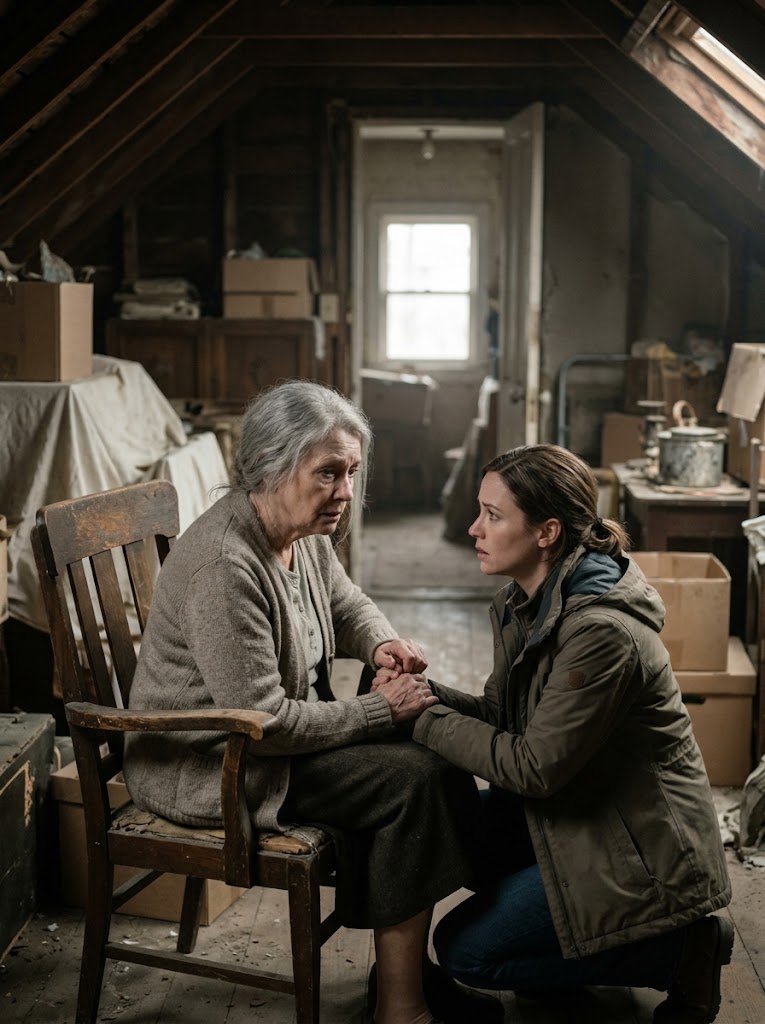
Harold’s text said Margaret was resting, and I was already halfway back to my car when I heard the tapping.
I had brought over a tin of homemade cookies because my husband, Daniel, was stuck at work. I was holding the tin against my hip when the message came in: “I’m out with the guys. Margaret’s resting. You can head home.” It was so unlike Margaret to leave me at the door without answering that I read it twice.
Still, Harold was her husband. I told myself he knew what she needed.
I turned toward the front steps. Then I heard it again. Three little taps, a pause, then three more from somewhere above me.
The house was quiet in that way a house gets when the person inside is trying not to make noise. I set the cookies down and followed the sound. At the top of the stairs was the attic door Harold always kept locked. This time, the key was still in the lock.
I should have called Daniel right then. I should have called someone. Instead, I turned the key and eased the door open. Margaret was sitting by herself in an old chair, with one hand on the arm and the other resting in her lap. She looked frightened and embarrassed, like I’d walked in on something she was ashamed of.
“Margaret, what are you doing up here?”
She reached for me and caught my wrist. Her hand shook. She looked past me toward the stairs.
“He locks me up here whenever he doesn’t want anyone to know what’s really happening in this house,” she whispered. “If Harold finds out you saw me, he’ll tell everyone I’m the one.”
I couldn’t make my mouth work for a second. Then I asked if she could stand. She said she could, but she needed help with the first step. I took her hand and helped her down. She was steady after that, though she kept glancing behind us.
Margaret had never seemed confused to me. She remembered Daniel’s birthday, the names of all his cousins, and that I didn’t like raisins in cookies. Harold had been saying for months that her memory was getting bad. I’d heard it at family dinners and over the phone. He always said it gently, as if he was doing his best with a hard situation.
I had believed him. Not all the way, maybe, but enough to stop asking questions. That part sits with me now.
At the bottom of the stairs, I picked up my phone and called Daniel. He answered with traffic noise behind him.
“Dad says Mom’s resting,” I said. “She’s in the attic.”
He went quiet. I had never heard him go quiet like that.
“What?”
“Harold locked her up there. I’m with her now.”
“Are you sure?”
That question hurt more than I expected. I knew Daniel wasn’t calling me a liar. He was trying to fit my words beside everything he’d heard from his father.
“She’s standing right here,” I said. “I’m sure.”
Daniel told me to stay inside and not let Harold take her anywhere. He said he was leaving work. I promised I’d call if anything changed. I didn’t say I was scared. I didn’t want to make him more confused than he already was.
Margaret asked if I could help her get her purse. It was downstairs in the small bedroom, tucked behind a stack of folded towels.
She had packed a few things in it: her wallet, a little notebook, and a pill bottle. She put the bottle back in the bag quickly when she saw me looking.
“I’ve been saving these,” she said.
“For what?”
“So I can show someone.”
I wanted to ask why she hadn’t told Daniel. I wanted to ask why she hadn’t called me. Instead, I sat beside her on the edge of the bed and waited. She was already having to explain too much.
“He tells people I forget where I am,” she said. “He tells them I get worked up and make things up.”
“Did he say that to Daniel?”
Margaret rubbed the side of her thumb with one finger. “He says I’m getting worse. Daniel wants to believe his dad is taking care of me.”
I couldn’t blame Daniel for wanting that. I also couldn’t pretend it had been enough.
Margaret told me Harold locked her upstairs whenever someone came by and he didn’t want her talking to them. Sometimes he said she was asleep. Sometimes he said she’d had a bad day. He had been doing it for months, she thought. The first time, she said, he called it a misunderstanding. After that, he started keeping the key in his pocket.
“So why was it in the door today?” I asked.
“He must’ve forgotten it.”
The answer came out plain. That little key had been left behind by accident, and it was the only reason I’d found her.
I asked if she wanted to leave with me. She looked toward the front window, then down at her purse.
“I don’t want a scene,” she said.
“I know.”
“He’ll say I’m confused.”
“He can say it. I heard you.”
That seemed to settle something in her. Not much. Just enough for her to stand and come with me into the kitchen.
I saw the medication schedule on the counter. The rows were marked with times and check marks. A few notes had been written in Harold’s square handwriting: “Keep her settled before company.” “Don’t let her answer the phone if she’s worked up.” There was also a folded sheet with names of family members and brief reminders about what to tell them. Beside Daniel’s name, it said, “She’s been forgetful. Don’t argue.”
I read it once, then picked it up again. The ink had smudged by his name, like he’d written it with a damp hand.
Margaret watched me. “He’s been telling that story for a while.”
The list didn’t prove everything she’d told me. But it showed me that Harold had been planning what people heard before they even asked. There was another paper tucked under the schedule, a note about a care home and an appointment to discuss “next steps.” Margaret looked at it and shook her head.
“He says I won’t be safe here much longer,” she said. “He says nobody else can manage me.”
The idea that he meant to have her sent away under a story he’d made up was suddenly not some vague fear. It was written down on his counter.
I called Daniel again. I read him the notes. He asked me to send a picture, so I did. He said he was coming straight there. I told him not to call Harold first.
For a few minutes, things felt almost manageable. Margaret sat at the kitchen table and drank water. I put her purse beside her. I thought we could wait for Daniel, get her into my car, and leave before Harold got back. It felt like the first sensible plan I’d had.
Then tires crunched in the driveway.
Margaret looked at the front door. I did too. Harold had said he was out with the guys, but I hadn’t asked where or for how long. Maybe he’d only gone to the store. Maybe his plans had changed. I reached for my phone. Margaret put her hand over mine.
“Don’t let him send me upstairs again,” she said.
“I won’t.”
The door opened before I could decide whether to call Daniel. Harold came in with his keys in one hand. He stopped when he saw us in the kitchen. His eyes went to Margaret, then to the papers in mine.
“What are you doing here?” he asked me.
“I brought cookies.”
His gaze shifted toward the tin by the front door. “I told you she was resting.”
“She was in the attic.”
He let out a breath and rubbed his forehead. He looked tired, and for just a second I saw the man who’d once carried folding chairs after Daniel’s church picnic without being asked. That’s what made the next part harder, not easier.
“Margaret gets confused,” he said. “She must have gone up there herself.”
“She said you locked her in.”
“She’s been saying things like that. She forgets.”
Margaret stood up. Her fingers were pressed against the table edge. “You put the key in the door.”
Harold turned toward her. “You’re upset. Sit down.”
“No,” I said.
It came out louder than I meant. My voice sounded strange in the kitchen, but I didn’t take it back.
He looked at me like I was the one causing trouble. “You don’t know what it’s like managing this every day.”
That was the line that nearly pulled me back into my old habit of being polite. I wanted to say I was sorry he was under pressure. I wanted to soften it for Daniel’s sake. I had done that before, when Harold talked about Margaret’s memory and I let him finish without asking her what she thought.
But she was right beside me. She was listening.
I held up the medication schedule and the notes. “What does ‘keep her settled before company’ mean?”
Harold reached for the papers. I moved them back.
“Give those to me.”
“No.”
“She can’t keep track of her pills. I’m trying to help.”
“Then why are you writing down what to tell the family?”
He had no answer for a moment. Then he looked at Margaret. “You told her I was trying to put you away?”
Margaret’s chin shook once before she steadied it. “You told me nobody would believe me.”
He shook his head, not quite at me and not quite at her. “She’s been getting worse. I’ve been covering for her.”
The trouble was, he sounded like he believed his own explanation. He’d taken the things he did to control her and called them help for so long that maybe the two had blurred together for him. That didn’t make it safe for her to stay.
Daniel came in while Harold was still talking. He must have run from his car because he was breathing hard. He saw Margaret, then the paper in my hand.
“Dad,” he said, “what is this?”
Harold tried to start again. He said Margaret had confused things. He said he’d been protecting her. Daniel asked why she was locked in the attic if she was resting. Harold said she must have locked herself in. The explanations kept changing, and Daniel heard it too.
“Why didn’t you tell me?” Daniel asked him.
“Because you’d worry.”
Daniel looked at Margaret. “Mom, do you want to leave?”
“Yes,” she said. “I want to go with her.”
That was all. She didn’t raise her voice. She didn’t need to.
Harold stepped between Margaret and the front door. Daniel moved beside him, not touching him, but blocking the way.
“Move, Dad.”
“You’re taking her out of her home because of one bad afternoon?”
“I’m taking her somewhere she can tell the truth.”
Harold looked from Daniel to me, as though one of us would still back down and let him put the story back the way he wanted it. Neither of us did. Margaret took her purse. I took the pill bottle and the notes, and Daniel held the door open.
We left the cookies on the hallway table.
In the car, I called Daniel’s doctor’s office and asked how to arrange an appointment for Margaret with a doctor she could speak to alone. Then I called the county adult-protection line and told them what we’d found. I was shaky enough that I had to repeat the house number twice. I didn’t want to make a false claim, but I wasn’t going to leave her alone with Harold while we tried to sort out what came next.
Daniel followed us to my house. He kept saying he was sorry, and Margaret kept telling him she knew he hadn’t seen it. I was glad she could offer that. I was also glad he didn’t ask her to comfort him for long.
Over the next few days, Margaret met with a doctor without Harold in the room. A family lawyer helped us understand what steps we could take to keep Harold from making decisions for her. Daniel gave the doctor the medication schedule and the papers. The calls from relatives started coming in, and this time Margaret answered for herself.
Harold was no longer the person deciding who could reach her or what they were allowed to hear. That part was handled in real life, with appointments and forms and hard talks. It wasn’t clean. Daniel still had to face how long he’d believed his father. I still had to face how easily I’d accepted Harold’s version because it was easier than questioning it.
That afternoon, I drove Margaret away from the house. She sat in the passenger seat with her purse on her lap. In the rearview mirror, the house got smaller behind us. Margaret watched it go, then took one deep breath through the open window.
The cookies were still warm when I brought them. We left them there.