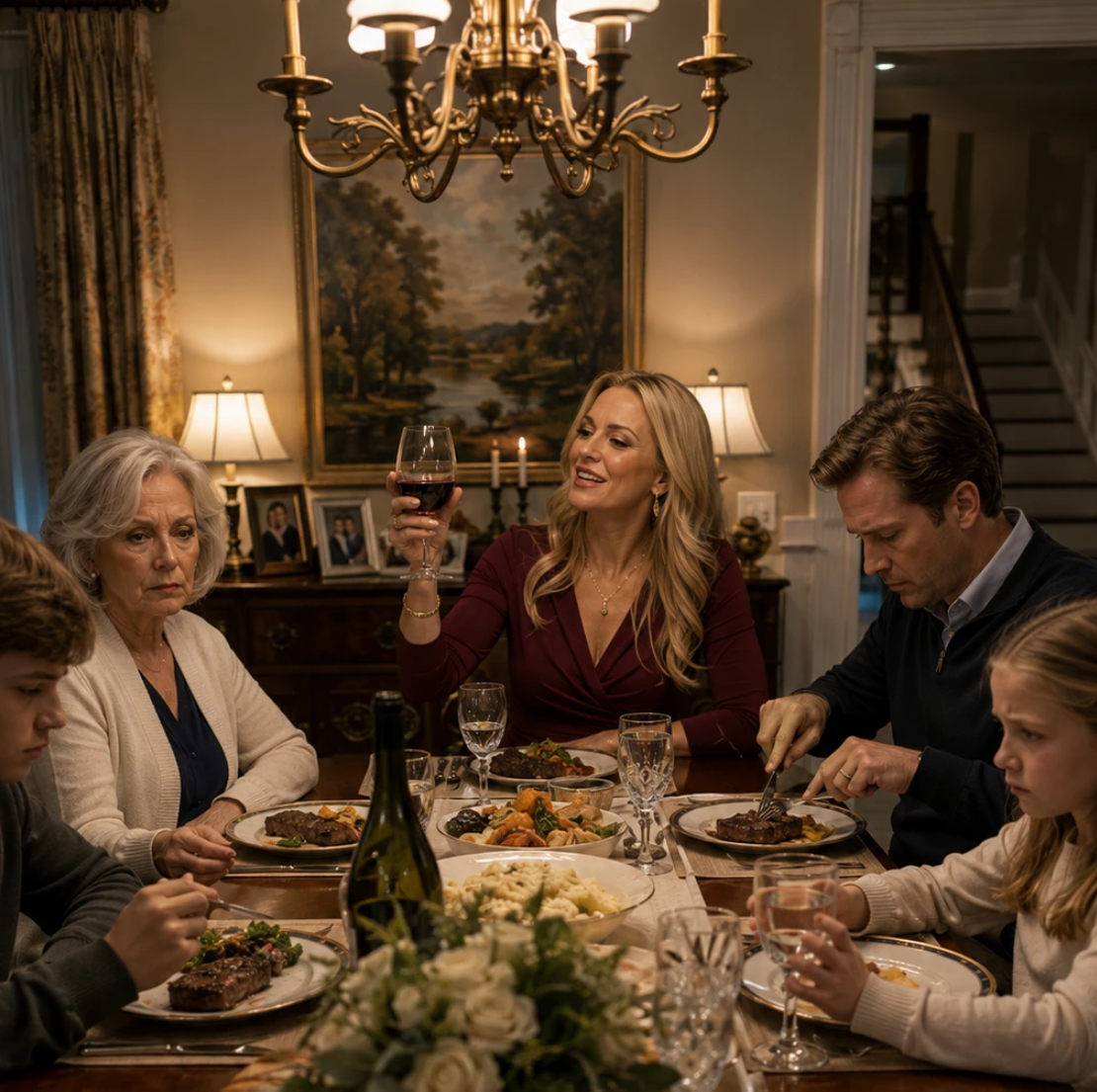
Melinda lifted her wine glass beneath the warm dining-room lights and smiled at me with the quiet satisfaction of someone delivering a long-awaited victory.
“We bought our own house, Mom,” she said. “So now you can finally start learning how to live alone.”
The words settled over the table like ice.
My son, Connor, did not look at me.
He lowered his eyes and continued cutting his steak as though his wife had merely commented on the weather.
No objection.
No apology.
Not even a pause.
Then Melinda laughed softly.
“And thank you for staying here all these years without paying anything,” she added. “But now that we have a home of our own, we really don’t need you here anymore.”
That was when I understood exactly what they believed.
They thought this house belonged to them.
They thought I had spent twelve years depending on their generosity.
They thought they were the ones allowing me to stay.
Across the table, my grandson Jackson froze with his fork halfway to his mouth.
Lily tightened both hands around her water glass.
They were still young, but they recognized cruelty when they heard it.
The room became painfully quiet.
Even the faint scrape of silverware against porcelain sounded harsh.
I looked at Melinda’s triumphant expression.
Then at Connor’s bowed head.
Then at the two grandchildren I had helped raise while their parents worked late, traveled often, and built the life they now claimed to have created entirely by themselves.
For twelve years, I had cooked their meals.
Paid household expenses.
Helped with school pickups.
Covered emergencies.
Kept the peace.
And remained silent while Melinda slowly took control of my kitchen, my furniture, my routines, and eventually the story of whose home this really was.
I tolerated the insults because I loved my son.
I ignored his silence because admitting what it meant would have hurt too much.
I told myself that family required patience.
Compromise.
Sacrifice.
But sacrifice without limits eventually stops looking like love.
It starts looking like permission.
And that evening, Melinda had finally said enough to make me withdraw mine.
I straightened the napkin across my lap.
Then I smiled.
Not angrily.
Not bitterly.
Peacefully.
That frightened her more than tears would have.
Her fingers tightened around the stem of her wine glass.
She had expected me to collapse.
Perhaps she imagined I would beg for more time.
Ask whether their new house had a spare room.
May you like

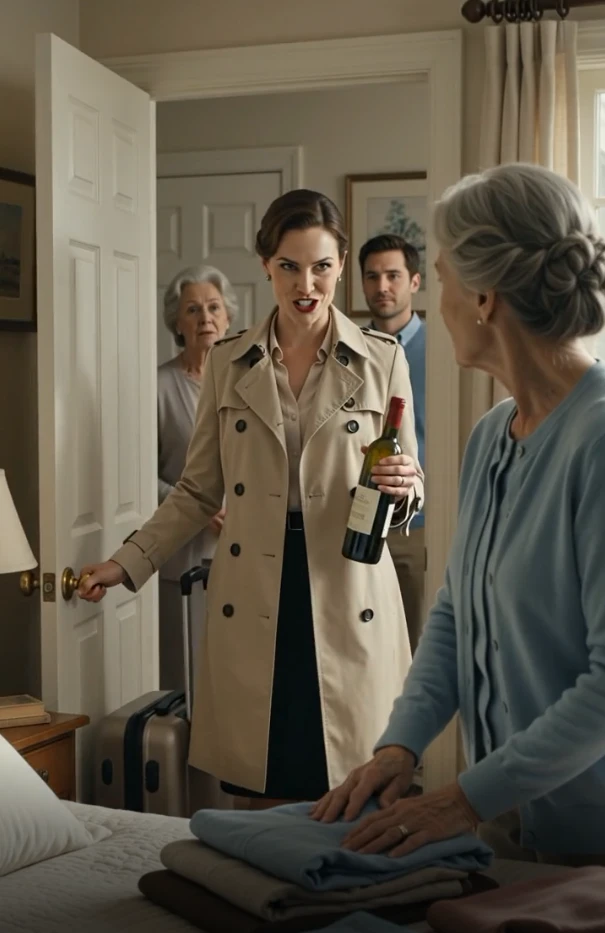
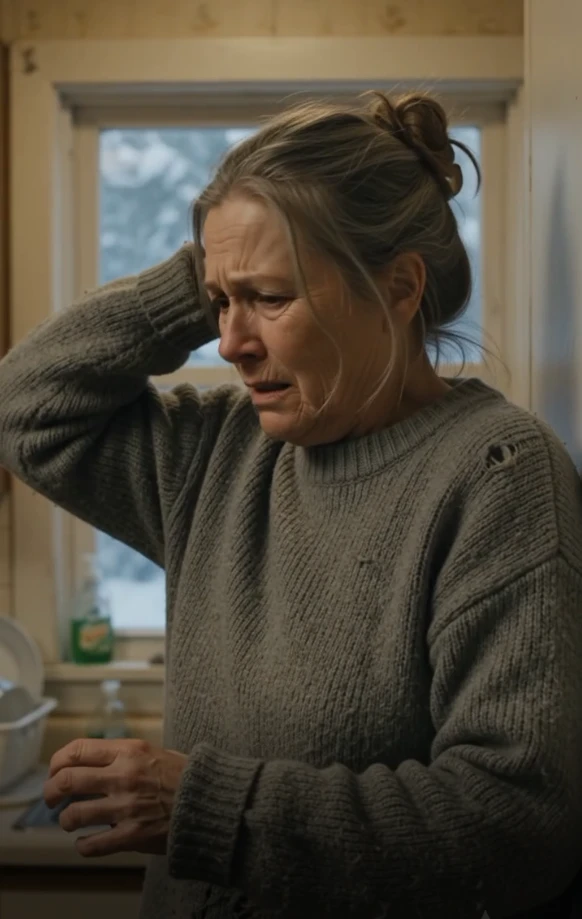
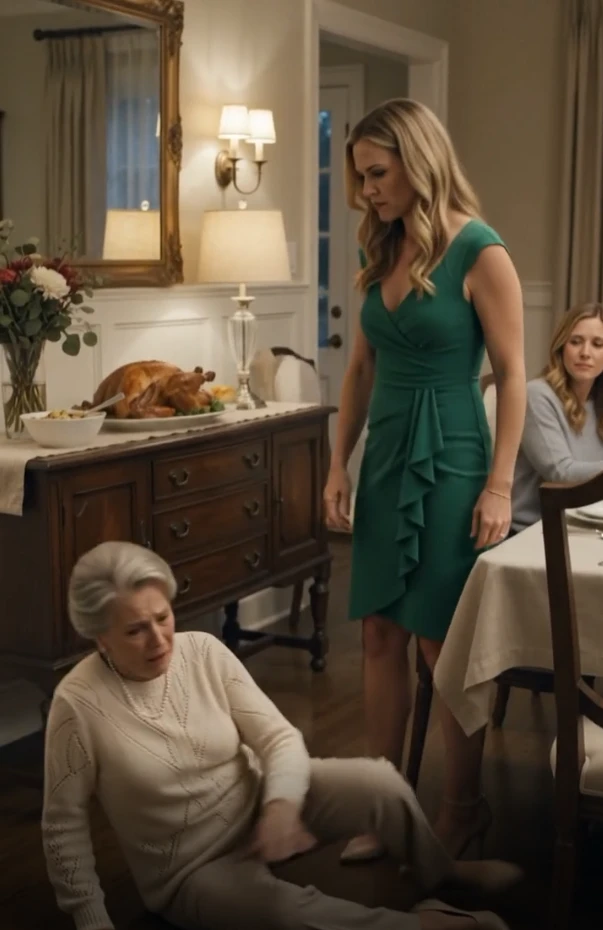
Promise to become quieter, smaller, and easier to tolerate.
Instead, I looked directly at her.
“That’s wonderful, Melinda.”
Her smile flickered.
“I’m glad you finally want a place of your own,” I continued. “Because I have some news too.”
Her knife slipped from her fingers and struck the plate with a sharp clatter.
Connor looked up for the first time.
Jackson stared at me with the same worried eyes his grandfather once had.
Beside him, Lily gripped her glass so tightly that her knuckles turned pale.
Melinda slowly lowered her wine.
“What news?”
The triumph had disappeared from her voice.
In its place was something she could not completely hide.
Fear.
For twelve years, I had allowed them to believe a version of the truth that made their lives comfortable.
I let them think my silence meant weakness.
I let them forget whose name remained on every important document.
I let them build plans on the assumption that I would never challenge them.
But silence has an expiration date.
And sometimes the truth waits until the exact moment it can do the most damage.
I looked first at Connor.
Then at Melinda.
Finally, I said, “News that matters to you more than anyone else sitting at this table.”
Connor placed his knife down.
“What are you talking about, Mom?”
His voice carried the careful irritation of a man who wanted the conversation controlled before it became inconvenient.
I folded my hands in front of me.
“I’m selling this house.”
For a moment, nobody moved.
The chandelier hummed softly above us.
Somewhere in the kitchen, the refrigerator motor clicked on.
Melinda blinked.
Then she laughed.
It was short and uncertain.
“You can’t sell this house.”
“I can.”
“No, you can’t.”
Her certainty returned too quickly, as though volume could replace knowledge.
“This is Connor’s house.”
Jackson looked from his mother to me.
Lily stopped breathing for a second.
Connor leaned back in his chair.
“Mom, what exactly do you mean?”
“I mean the property is being listed next Monday.”
Melinda stared at him.
“Tell her.”
Connor did not answer.
Her eyes sharpened.
“Connor.”
He looked at me instead.
“You said Dad left the house to the family.”
“He did.”
“There. See?” Melinda said. “The family. That means Connor.”
I almost admired the ease with which she erased everyone else from a word.
“Your father left the house to me,” I said. “His family.”
Connor’s face lost color.
Melinda shook her head.
“No. You told us we could move in.”
“I did.”
“You said it would be our home.”
“It was your home.”
“Then you cannot suddenly take it away.”
“I’m not taking it away. You announced that you bought another one.”
“That’s not the point.”
“It is exactly the point.”
Melinda pushed her chair back.
The legs scraped sharply against the hardwood floor.
“We have invested twelve years into this property.”
I looked around the dining room.
At the curtains I purchased.
The table my late husband, Walter, had chosen.
The floors I refinished.
The crown molding I paid to restore.
“What did you invest?”
Her mouth opened.
Then closed.
“We maintained it.”
“The gardener is paid from my account.”
Connor looked down.
Melinda’s voice rose.
“We renovated the kitchen.”
“I paid the contractor.”
“We chose the cabinets.”
“Yes. You chose them.”
“We replaced the roof.”
“The insurance settlement and my savings replaced the roof.”
She looked toward Connor again.
“Say something.”
My son rubbed one hand across his jaw.
“Mom, this is coming out of nowhere.”
“No, Connor. It is coming after twelve years.”
“You never told us you wanted to sell.”
“You never told me you considered me a guest.”
“That’s not what we meant.”
I looked at him.
Melinda had spoken the words, but Connor had allowed them to remain in the room unchallenged.
“What did you mean?”
He glanced at his children.
“This isn’t the time.”
“It became the time when your wife thanked me for living in my own home without paying.”
Jackson lowered his fork.
“Grandma owns the house?”
Melinda turned toward him.
“This is an adult conversation.”
“He asked a simple question,” I said.
I looked at my grandson.
“Yes, Jackson. I own the house.”
His eyes widened.
“All of it?”
“All of it.”
Lily’s small voice followed.
“Then why did Mom say you had nowhere else to go?”
Melinda went still.
Connor looked at his wife.
“What?”
Lily’s eyes filled with fear.
She had not meant to expose anything.
I softened my voice.
“It’s all right, sweetheart.”
Melinda reached toward her.
“Lily, you misunderstood.”
“No, I didn’t.”
Her voice trembled, but she continued.
“You told Aunt Denise that Grandma stayed because she spent all her money and couldn’t afford an apartment.”
Connor’s face tightened.
“When did she say that?”
“Last Christmas.”
Melinda stood.
“I am not being interrogated by a child.”
“No,” I said. “You are being contradicted by one.”
Her eyes snapped toward me.
For years, I had absorbed moments like that quietly.
The dismissive tone.
The correction.
The implication that any disagreement from me was confusion, age, or oversensitivity.
That evening, I allowed the silence afterward to belong to her.
Connor finally spoke.
“Why are you selling?”
The question was so revealing that I almost missed it.
Not why had they hurt me.
Not whether I had somewhere safe to go.
Why was I disrupting their expectations?
“Because I’m tired of financing a life in which I am treated as an inconvenience.”
“We never asked you to finance us.”
I turned toward him.
“Would you like a list?”
His jaw tightened.
Melinda crossed her arms.
“This is ridiculous.”
I stood slowly.
My knees were stiff, but my back remained straight.
“I agree.”
Then I walked to the old walnut sideboard.
Melinda had wanted to replace it for years.
She called it dated.
Walter had restored it himself during the first winter of our marriage.
Inside the bottom drawer was a blue folder.
I carried it to the table and placed it between Connor and Melinda.
“What is that?” Connor asked.
“The version of your life you stopped noticing.”
I opened the folder.
The first page was the property deed.
My name appeared alone beneath the legal description.
Evelyn Grace Harper.
Melinda stared at it.
She read the page twice.
Then she flipped to the second document.
Property-tax statements.
Paid from my account.
Homeowner’s insurance.
Paid from my account.
Utilities.
Repairs.
School tuition contributions.
Medical copayments.
Vehicle expenses.
A twelve-year record of assistance.
Not every grocery receipt.
Not every birthday gift.
Not every small act of love.
Only the major expenses Walter had taught me to document.
Connor turned each page more slowly than the last.
Melinda stopped pretending to read.
“What is the total?” he asked.
“Eight hundred forty-six thousand dollars.”
Jackson inhaled sharply.
Melinda laughed again, but no humor remained in it.
“That’s impossible.”
“It includes the house.”
“You already owned the house.”
“Yes.”
“So that does not count as money you spent on us.”
I studied her face.
“You lived in a four-bedroom home without paying rent for twelve years.”
“We were family.”
“Family does not mean value disappears.”
Connor reached the final page.
At the bottom, beneath the total, was one handwritten sentence.
None of this was a loan. It was love. But love should never require me to lie about what I gave.
His eyes stayed on the words.
“Why did you keep this?”
“Your father taught me to maintain records.”
Melinda leaned forward.
“So this is blackmail?”
“No.”
“You’re threatening us with a list of everything you ever did.”
“I’m correcting the story you have been telling.”
Connor closed the folder.
“Mom, we appreciate what you’ve done.”
“Do you?”
“Of course.”
“What did you believe I contributed to this household?”
He hesitated.
Melinda answered for him.
“You helped with the children.”
“I raised them for nearly half their waking lives.”
“That is what grandparents do.”
Jackson looked at her.
“Grandma takes us to school every day.”
“Not every day.”
“Four days a week,” he said.
Lily added, “And she stays when you go to conferences.”
Connor’s face changed slightly.
He knew how often those conferences became long weekends.
Melinda’s voice sharpened.
“That is enough.”
“No,” I said. “It has been enough for a long time. That is why it is ending.”
I took another envelope from the folder.
The white paper looked ordinary.
It contained the detail that frightened Melinda most.
“What is that?” she asked.
“A copy of the purchase agreement for your new house.”
Connor’s head lifted.
Melinda’s chair struck the table as she turned.
“How did you get that?”
“I did not get it from you.”
Connor looked between us.
“What is she talking about?”
I slid the document toward him.
The new house was a newly constructed property in a gated development twenty minutes away.
Five bedrooms.
Three-car garage.
Outdoor kitchen.
Pool.
Purchase price: $1.28 million.
Connor had told me nothing about the price.
Nothing about the mortgage.
Nothing about where the down payment came from.
He examined the first page.
Then his eyes stopped on the financing section.
“Melinda.”
She did not answer.
“What is this?”
Her face had gone pale.
I remained standing beside the table.
“Your wife applied for the mortgage using expected proceeds from the sale of this property.”
Connor looked at me.
Then back at the document.
The contingency clause was clear.
Their down payment included a bridge loan secured against projected equity from the sale of the current residence.
My residence.
The house they did not own.
Connor’s lips parted.
“I thought your father gave you the down payment.”
Melinda’s father, Leonard, owned three car dealerships and enjoyed mentioning them in almost every conversation.
Melinda had told Connor that Leonard was providing $280,000 toward their purchase.
The documents showed otherwise.
The lender expected more than $410,000 from the sale of my house.
A house neither borrower had the legal right to sell.
“I was going to explain,” Melinda said.
Connor stared at her.
“How did you submit this?”
“It was preliminary.”
“There’s an approval letter.”
“Conditional approval.”
“You listed this property as ours.”
“As a family asset.”
“My mother’s name is the only name on the deed.”
Melinda’s composure cracked.
“She was always going to leave it to us.”
I felt those words more deeply than any insult she had delivered that evening.
Not because they surprised me.
Because they revealed the calculation beneath twelve years of tolerance.
The house was not my home in Melinda’s mind.
It was delayed inventory.
Something she expected to receive after I died.
Jackson looked frightened.
“Mom, were you going to sell Grandma’s house?”
“No.”
The answer came too quickly.
Connor lifted the agreement.
“This says we have to list it within thirty days of closing.”
“That was just to satisfy underwriting.”
“How?”
“We could transfer the title.”
The room became silent.
Connor slowly lowered the document.
“Transfer it from Mom?”
Melinda looked toward me.
I saw the instant she decided honesty would not save her.
So she chose aggression.
“You were going to give it to Connor eventually.”
“Eventually,” I said, “usually means after the owner is dead.”
“Don’t be dramatic.”
“You made plans using the value of my home without asking me.”
“We assumed you would help your son.”
“I have helped my son for twelve years.”
“And now you’re punishing us because of one poorly worded comment.”
I looked at Connor.
“Did you know?”
His face answered before his mouth did.
Not everything.
But something.
“I knew we might need your signature,” he admitted.
Jackson looked at him.
“Dad?”
Connor closed his eyes.
I felt no satisfaction.
Only a deep, quiet sorrow.
“What did Melinda tell you?” I asked.
“That you would probably transfer partial ownership.”
“Did I ever say that?”
“No.”
“Did you ask me?”
“No.”
“Why?”
He looked toward the table.
“Because I knew you might say no.”
There it was.
The sentence that ended my need to protect him.
He had not been deceived completely.
He had simply preferred not to know enough to feel responsible.
Melinda’s chair moved again.
“We are not losing the new house because you suddenly need attention.”
I looked at her.
“This has nothing to do with attention.”
“It has everything to do with attention. You have never liked that Connor built a life with me.”
Connor’s head lifted.
“That isn’t true.”
“She wants you dependent on her.”
“Melinda.”
“She paid for things so she could control us.”
I had heard versions of that accusation before.
Not from her directly.
Through changes in Connor’s tone.
Through invitations that stopped arriving.
Through financial decisions made without me while my money quietly covered the consequences.
I looked at my son.
“Did you believe that?”
His silence lasted too long.
“Sometimes,” he said.
Jackson pushed his chair back.
“I’m done eating.”
His voice was thick.
Lily followed him immediately.
“Me too.”
Melinda reached toward them.
“Sit down.”
“No,” Connor said.
The firmness in his voice surprised everyone.
“Let them go.”
The children left the dining room.
Their footsteps moved quickly up the staircase.
A bedroom door closed.
The three adults remained beneath the warm lights.
The steaks grew cold.
The wine remained unfinished.
I gathered the documents into the folder.
Connor watched me.
“What happens now?”
“The sale agreement for this house has already been signed.”
His face changed.
“You have a buyer?”
“Yes.”
“When?”
“Three weeks ago.”
Melinda stared at me.
“You planned this before tonight.”
“I planned to sell before tonight. I did not plan to tell you this way.”
“Why didn’t you say anything?”
“I was waiting for your announcement.”
She blinked.
“You knew about the new house.”
“Yes.”
“How?”
“The lender contacted me.”
Connor rubbed his forehead.
“Why would they contact you?”
“Because the title search showed neither of you owned this property.”
The lender had called twelve days earlier.
A polite woman named Rachel explained that my name had appeared during verification and asked whether I intended to transfer ownership.
At first, I believed there had been a mistake.
Then Rachel sent the signed application.
Melinda had listed herself and Connor as equitable owners.
She had estimated the house’s value.
She had projected proceeds.
And beside the phrase anticipated title cooperation, she had entered my name.
Not my signature.
Not yet.
But enough to show what they expected.
I could have confronted them then.
Instead, I called my attorney.
Then a real-estate agent.
The house attracted three offers before it was publicly listed.
The buyers were a retired pediatrician and her husband.
They loved the old walnut sideboard.
The garden.
The window seat where Lily read after school.
They offered cash and agreed to a delayed closing so the children could finish the semester without disruption.
The sale was legal.
Clean.
Entirely mine to make.
“What about us?” Connor asked.
“You bought a house.”
“The financing will collapse.”
“That is a matter between you, your wife, and your lender.”
Melinda stood so quickly that wine spilled across the tablecloth.
“This is vindictive.”
“No. Vindictive would be allowing you to commit fraud and then reporting you after closing.”
She froze.
Connor looked at me.
“Fraud?”
“Your application contains false claims about ownership.”
Melinda’s face tightened.
“It was an estimate.”
“My attorney disagrees.”
Fear entered the room again.
Not the fear of losing comfort.
The fear of consequences.
Connor leaned back, stunned.
“You spoke to an attorney?”
“I did.”
“You were going to let us sign the closing papers?”
“No. My attorney notified the lender this afternoon.”
Melinda gripped the back of her chair.
“You sabotaged our mortgage.”
“I corrected false information.”
“It is the same thing.”
“No,” Connor said quietly. “It isn’t.”
She turned toward him.
“What?”
His eyes remained on the purchase agreement.
“We don’t own this house.”
She stared at him as though he had betrayed her.
“We were supposed to.”
“According to who?”
“Your father intended it.”
“Dad left it to Mom.”
“He expected it to stay in the family.”
“And you expected her to die on schedule?”
The words landed harder because they came from him.
Melinda’s mouth opened.
No answer emerged.
Connor stood.
For the first time that evening, he looked directly at me.
“How long do we have?”
“The buyers take possession in sixty days.”
“Sixty?”
“Yes.”
“The new house closes in forty-five.”
“Not without new financing.”
He nodded slowly.
Then he looked toward the ceiling, where his children had retreated.
“We need to find somewhere to live.”
Melinda stared at him.
“We are not giving up the house.”
“We cannot buy it.”
“Your mother can fix that.”
Connor’s expression changed.
Something in him finally recognized the pattern because she stated it so plainly.
Not Mom might help.
Not could we ask.
Your mother can fix that.
He turned toward her.
“She doesn’t have to.”
Melinda laughed in disbelief.
“After everything I have done for this family?”
I looked at her.
“What have you done?”
The question was not cruel.
It was sincere.
She understood that, and it enraged her more.
“I raised two children.”
“With me beside you.”
“I supported Connor.”
“With my money beneath you.”
“I made this house a home.”
“You tried to leverage it without my knowledge.”
Her face reddened.
“You always hated me.”
“No.”
The truth came easily.
“I wanted to love you.”
That silenced her.
“I defended you when friends warned me I was disappearing inside my own life. I told myself your criticism came from stress. I told myself Connor’s silence came from exhaustion. I told myself the children needed stability.”
My voice remained calm.
“But the children have been learning that the person who gives the most deserves the least respect. I will not teach them that anymore.”
Connor closed his eyes.
Melinda’s expression hardened.
“So what? You sell the house and walk away with all the money?”
“It is my house.”
“Connor is your only child.”
“Yes.”
“You were going to leave it to him.”
“Once.”
Connor opened his eyes.
The word reached him.
“Once?”
I met his gaze.
“My estate plan changed last month.”
Melinda’s breath caught.
Connor looked stunned.
“To what?”
“The sale proceeds will purchase a smaller home for me. The remainder will be placed into two education trusts.”
“Jackson and Lily?” he asked.
“Yes.”
Melinda’s face changed again.
She had expected exclusion to mean punishment.
Instead, she discovered I had protected the only two people at the table who had recognized my pain without benefiting from it.
“The trusts will be managed independently,” I continued. “Neither parent can borrow from them, redirect them, or use them as collateral.”
Melinda’s eyes flashed.
“You don’t trust us.”
“No.”
The answer required no hesitation.
Connor sank back into his chair.
I expected anger.
Instead, he looked ashamed.
“You shouldn’t,” he said.
Melinda turned on him.
“Stop agreeing with her.”
“She’s right.”
“She is destroying our future.”
“No. We built a future using something that wasn’t ours.”
“You built nothing,” she snapped. “You failed in business twice. Your mother paid for everything. I was the one who found a way out.”
Connor stared at her.
The cruelty in her voice was not new.
Only newly directed at him.
“You told me your father was funding the down payment.”
“He said he would help.”
“How much?”
She looked away.
“How much, Melinda?”
“Fifty thousand.”
Connor laughed once.
It sounded hollow.
“You told me two hundred eighty.”
“I knew you wouldn’t agree to the house otherwise.”
“So you lied.”
“I solved a problem.”
“With Mom’s property.”
“With future family equity.”
The phrase seemed rehearsed.
Perhaps she had repeated it to the lender.
To herself.
To anyone who needed the theft to sound like planning.
Connor looked at the woman he had defended through years of small humiliations.
Then he glanced toward the staircase.
“What else have you lied about?”
Melinda went still.
I recognized the question for what it was.
The first crack in a wall built over twelve years.
She crossed her arms.
“This is not happening in front of your mother.”
“My mother paid for the room.”
“Connor.”
“Did your father really cover the private-school deposit last year?”
Melinda said nothing.
He turned toward me.
“Mom?”
“I did.”
His face crumpled slightly.
Melinda had told him Leonard paid because he wanted the children to have opportunities.
In reality, she came to me privately after Connor’s business lost a major client.
She made me promise not to tell him.
She said his pride could not survive another failure.
I believed I was protecting him.
Instead, I had helped her control what he knew.
“The car repair?” he asked.
“Me.”
“The summer camp?”
“Me.”
“The tax shortfall?”
“Me.”
Each answer stripped another layer from the life Melinda had presented as her achievement.
Connor looked physically ill.
“Why didn’t you tell me?”
“Because she asked me not to.”
He looked at Melinda.
“You let me thank your father.”
“It didn’t matter who paid.”
“It mattered enough for you to lie.”
She grabbed her wine glass and emptied it.
Then she walked from the dining room.
The sound of her heels crossed the hallway.
A moment later, the front door slammed.
Connor and I remained.
For several minutes, he said nothing.
Then he looked at the cold dinner.
“Did you really pay for this too?”
“Yes.”
His eyes closed.
“I’m sorry.”
The words were quiet.
I had imagined hearing them for years.
In my imagination, they healed something.
In reality, they only marked the place healing might begin.
“I know you are,” I said.
“That’s not enough.”
“No.”
He looked toward the staircase.
“I need to talk to the kids.”
“Yes.”
“Will you stay?”
The question held so much unintended irony that he heard it himself.
His face tightened.
“Of course you’ll stay. It’s your house.”
“For sixty days.”
He nodded.
Then he rose.
At the doorway, he stopped.
“Why did you wait twelve years?”
I looked at Walter’s empty chair.
The one no one had sat in since his death.
“Because after your father died, I was afraid losing you would mean losing the rest of my family.”
Connor swallowed.
“And now?”
“Now I understand that keeping people near me is not the same as being loved by them.”
He went upstairs.
I cleared the table alone that night.
Not because anyone expected me to.
Because it was still my dining room, and I wanted to leave it in peace.
I poured Melinda’s spilled wine down the sink.
Wrapped the untouched steaks.
Turned off the chandelier.
Before bed, I passed Jackson’s room.
His door opened.
“Grandma?”
He stood in the hallway wearing an old basketball shirt and flannel pants.
Lily appeared behind him.
“We heard some of it,” he said.
“I know.”
“Are you leaving us?”
The fear in his voice was the one consequence I had dreaded.
I knelt carefully so we were closer to eye level.
“I am selling the house. I am not leaving you.”
“But where will you live?” Lily asked.
“I found a cottage near the river.”
“Does it have a bedroom for us?”
“Two.”
Her face relaxed slightly.
Jackson remained serious.
“Are Mom and Dad getting divorced?”
“I don’t know.”
“Dad is crying.”
The image hurt more than I expected.
“He has difficult things to understand.”
“Did he really think the house was his?”
“Yes.”
Jackson frowned.
“How can an adult not know who owns a house?”
Sometimes children ask the question adults spend years avoiding.
“Because believing something can be more comfortable than checking whether it is true.”
He considered that.
“Mom knew.”
“Yes.”
His shoulders lowered.
“That’s worse.”
“Yes.”
Lily stepped forward and wrapped both arms around my neck.
“You can live with me when I grow up.”
I held her tightly.
“That is a beautiful offer.”
“And I won’t make you pay.”
I closed my eyes.
Behind her, Jackson looked away, embarrassed by his own tears.
I reached for his hand.
He let me take it.
The following morning, Melinda had not returned.
Connor found her at her sister Denise’s apartment.
She sent a text saying she needed space and would speak only after I withdrew the lender notification.
I did not.
By Monday afternoon, the mortgage approval for the new house was suspended.
The builder retained part of their deposit under the contract.
Melinda blamed me publicly.
She posted a carefully worded message online about “elderly relatives using inheritance to control adult children.”
She did not mention that the inheritance belonged to someone still alive.
She did not mention the false mortgage application.
She did not mention twelve years of free housing.
Friends responded with sympathy until Denise commented.
You tried to finance your new house with property you didn’t own. Tell the whole story.
The post disappeared within twenty minutes.
But screenshots remained.
Melinda’s parents called Connor that evening.
Leonard was furious.
Not with me.
With his daughter.
He had never promised $280,000.
He had refused to contribute after learning the purchase required Connor to assume a mortgage nearly three times his annual income.
Melinda had told him I agreed to transfer the house.
She had lied to both families.
The dinner announcement had not been only cruelty.
It had been strategy.
Once they announced their move publicly and described me as a dependent guest, she intended to pressure me into signing.
She expected embarrassment to make me cooperative.
She believed I would rather surrender the property than expose how little authority I appeared to have in my own family.
She almost understood me.
She simply based her plan on the woman I had been the previous year.
The lender opened an internal review.
Because no deed transfer had occurred and I notified them before closing, the matter did not become a criminal case.
But Melinda’s false representations remained in the file.
The builder canceled the purchase after financing failed.
They lost thirty-two thousand dollars from the deposit and upgrade fees.
Connor learned that twenty thousand had come from their joint emergency account.
The remaining twelve had been charged to a credit card he did not know existed.
That discovery led to others.
Designer furniture deposits.
Private club dues.
Trips described as work conferences.
More than ninety thousand dollars in hidden consumer debt.
Melinda had maintained the appearance of prosperity by borrowing against a future she assumed my death would fund.
Connor moved into the downstairs guest room.
Not because I ordered him out of the bedroom.
Because Melinda refused to return while I remained in the house.
For three weeks, he drove to Denise’s apartment to see her.
Their conversations ended in arguments.
Melinda demanded that he persuade me to cancel the sale.
Connor refused.
Then she demanded that he challenge the deed.
His attorney explained there was nothing to challenge.
Walter’s estate had been properly settled.
The title was clear.
My ownership was absolute.
Finally, she asked Connor to choose.
Her or me.
For years, that question would have terrified him into silence.
This time, he recognized the trap.
“I choose honesty,” he told her.
She called that an answer.
Perhaps it was.
They separated before the house sale closed.
The children remained with Connor during the school week and spent alternate weekends with Melinda.
I never spoke against her in front of them.
I did not need to.
Children see the difference between a parent who is wounded and one who recruits them into the wound.
Melinda tried twice to tell Jackson that I had destroyed their family.
The second time, he answered, “Grandma didn’t apply for a house using your name.”
He was thirteen.
Old enough to understand more than she realized.
She stopped discussing it with him.
The final sixty days changed Connor more than the previous twelve years.
He began paying the utility bills.
At first, he did not know where to find the account numbers.
He had never asked.
He packed the children’s lunches.
The first week, Lily returned home with an untouched sandwich because he forgot she hated mayonnaise.
He apologized and learned.
He handled school pickup.
He scheduled Jackson’s orthodontist appointment.
He discovered how many ordinary tasks had been disappearing into my day without recognition.
One Thursday evening, he found me wrapping glasses in newspaper.
“Mom.”
I looked up.
He stood in the kitchen holding a stack of envelopes.
“What are these?”
“Household statements.”
“Why are they in your name?”
“Because I pay them.”
“All of them?”
“Yes.”
He sat at the table.
The same table where Melinda had announced my removal.
“I thought we covered groceries.”
“You covered some.”
“The insurance?”
“Me.”
“Property tax?”
“Me.”
“The children’s phone plan?”
“Me.”
He put his face in his hands.
“I don’t know how I let this happen.”
“You accepted the version of reality that required the least from you.”
He looked up.
“That’s harsh.”
“It’s also true.”
He nodded slowly.
“I know.”
Then he arranged the statements in front of him.
“Show me how to transfer everything.”
It was not redemption.
But it was work.
I showed him.
On the final weekend before closing, Melinda came to collect the last of her belongings.
She arrived wearing large sunglasses and carrying herself with the cold dignity of someone who had rehearsed indifference.
The children were visiting her parents.
Connor remained upstairs.
I was in the dining room packing Walter’s china.
Melinda stopped in the doorway.
The room looked bare.
No curtains.
No artwork.
The walnut sideboard had already been moved to my cottage.
She stared at the faded rectangle on the wall where our family portrait once hung.
“You won,” she said.
I placed a plate carefully into the box.
“This was never a competition.”
“It was to you.”
“No. A competition requires two people trying to take the same thing. I was trying to keep my dignity. You were trying to take my property.”
She removed the sunglasses.
Her eyes looked tired.
“I spent twelve years in this house.”
“So did I.”
“I raised my children here.”
“So did I.”
“That is different.”
“Why?”
“Because they are mine.”
The words revealed the boundary she had always drawn.
Her children.
Her husband.
Her house.
My labor.
My money.
My silence.
“You treated me like hired help,” I said.
“You made yourself indispensable.”
“I made myself useful.”
“You wanted them to need you.”
“Perhaps I did.”
The admission surprised her.
It also freed me.
“After Walter died, being needed felt safer than being alone. I allowed too much because every sacrifice bought another day near my family.”
Her expression softened for half a second.
Then hardened again.
“You see? You were controlling us.”
“No. I was afraid. There is a difference.”
“Not to the people living with it.”
She was not entirely wrong.
That mattered.
I had used generosity to avoid asking whether I was truly respected.
I had solved problems before Connor faced them.
I had hidden Melinda’s lies because exposure threatened family peace.
My mistakes did not excuse hers.
But healing required me to see my own.
“You should have set boundaries,” she said.
“Yes.”
She had expected resistance.
My agreement unsettled her.
“I should have required rent. I should have divided responsibilities. I should have told Connor every time I covered a debt you asked me to conceal.”
Her lips pressed together.
“But you should not have lied about owning my house.”
She looked away.
“No.”
The word was almost inaudible.
It was the closest thing to accountability she had offered.
I continued wrapping the china.
After a moment, she spoke.
“I really thought you would sign.”
“I know.”
“You always did.”
“I know.”
She looked at me.
There was no triumph left in either of us.
Only the truth of what repeated surrender teaches people to expect.
“What happens to the money?” she asked.
“Some bought my cottage. The rest goes into trusts for Jackson and Lily.”
Her face tightened.
“You cut Connor out.”
“I protected the children.”
“He is your son.”
“Yes.”
“He made mistakes.”
“So did I.”
“Then why do you get to keep everything?”
“Because it was mine before the mistakes began.”
She flinched.
Then picked up a box near the doorway.
Before leaving, she stopped.
“Do you hate me?”
“No.”
That answer seemed to hurt her more than yes would have.
“I stopped giving you enough power to hate.”
She left without another word.
The sale closed on a rainy Tuesday morning.
The buyers, Dr. Miriam Patel and her husband, Samuel, met me at the title office.
Miriam promised to preserve the window seat.
Samuel asked whether Walter’s rose bushes needed special care.
I gave him a handwritten page of instructions.
When I signed the final document, my hand remained steady.
Connor sat beside me.
He was not required to attend.
He came because he said I should not close one chapter of our family alone.
Afterward, we drove to the house one last time.
Jackson and Lily waited on the front porch.
Each held a small cardboard box.
The rooms echoed around us.
Lily ran her hand along the height marks carved inside the pantry door.
Miriam had agreed not to paint over them.
Jackson stood in the living room, staring at the empty space where the television had been.
“I thought I’d feel sadder,” he said.
“You may later,” I told him.
“Do you?”
“Yes.”
“Even after what happened?”
“A place can hold beautiful memories and still become somewhere you need to leave.”
He nodded.
Connor carried the final suitcase outside.
Then he returned alone.
“Mom, I need to tell you something.”
I waited.
“The night Melinda announced the house, I knew she was going to say you had to leave.”
The confession did not surprise me.
Still, it hurt.
“How long did you know?”
“Two days.”
“And you said nothing.”
“I told myself she would be gentler.”
“Why didn’t you stop her?”
He looked toward Walter’s empty chair, now pushed against the wall.
“Because part of me wanted the same thing.”
The honesty entered the room without defense.
“I wanted a life where I didn’t feel like a child in my mother’s house.”
“You could have rented or purchased a home years ago.”
“I know.”
“But staying here was easier.”
“Yes.”
“And blaming me for your discomfort was easier than admitting you benefited.”
His eyes filled.
“Yes.”
I breathed slowly.
“Thank you for telling me.”
“You’re not angry?”
“I’m deeply hurt.”
He nodded.
“That’s worse.”
“It may be.”
He looked at me.
“I don’t want you to forgive me because I’m your son.”
“Good.”
“I want to become someone you can forgive without betraying yourself.”
For the first time, his apology was not asking me to relieve him.
It was accepting that relief had to wait.
I touched his cheek.
“You look like your father when you finally tell the truth.”
A tear slipped down his face.
“He would be ashamed of me.”
“He would be disappointed.”
“That’s not better.”
“No. But disappointment leaves room for change.”
We walked outside together.
Connor rented a modest three-bedroom townhouse near the children’s school.
For the first time in twelve years, he paid his own housing costs.
The first month frightened him.
The second humbled him.
By the third, he had created a budget.
He sold his luxury SUV and bought a used station wagon.
Jackson complained until he discovered it could carry more camping equipment.
Lily decorated her room with paper stars.
They adapted.
Children often survive the loss of appearances more easily than adults.
My cottage sat fifteen minutes from the river.
It had pale yellow walls, a small garden, and a covered porch wide enough for four chairs.
The first morning after I moved in, I woke to silence.
No school alarms.
No cabinet doors.
No list of errands waiting on the counter.
For several minutes, panic moved through me.
I had spent so long being useful that peace felt like neglect.
Then sunlight reached across the bedroom floor.
I made coffee.
Carried it to the porch.
And listened to the river.
Living alone was not something I needed to learn.
I needed to remember.
I joined a book club at the library.
Reconnected with two friends Melinda once described as “too negative.”
Took a watercolor class.
Burned my first landscape painting and laughed so hard the instructor joined me.
I began making plans that did not require anyone else’s crisis.
Connor visited every Sunday afternoon.
He knocked.
Even after I gave him a key, he knocked.
The first few visits were awkward.
He brought groceries I did not need.
Offered repairs that were not necessary.
Apologized too often.
Eventually, we learned how to sit together without using service as a substitute for affection.
One Sunday, he arrived with Jackson and Lily carrying a long wooden box.
“What is this?” I asked.
Jackson grinned.
“Open it.”
Inside was a brass plaque.
Connor had removed it from the old house before closing.
It had been attached inside Walter’s workshop.
The engraving read:
A home belongs to the people who protect one another inside it.
Walter had ordered it after Connor was born.
I had forgotten it existed.
Connor held it carefully.
“I used to think Dad meant the person paying the mortgage.”
“He didn’t.”
“I know.”
We mounted it beside the cottage door.
The following spring, the trusts were finalized.
Each grandchild would receive education funds at eighteen, with additional access at twenty-five for housing or business purposes.
Neither Connor nor Melinda could touch the principal.
Melinda objected through her attorney.
The objection failed because the money was mine.
Eventually, her anger exhausted itself.
She took a full-time position at a property-management company and moved into a smaller apartment.
She and Connor finalized their divorce.
They learned to exchange the children in a grocery-store parking lot without arguing.
It was not a happy ending for their marriage.
But remaining together inside resentment and deception would not have been happy either.
One year after the dinner, Connor invited me to Lily’s birthday.
The party was held in his townhouse backyard.
Folding tables.
Paper decorations.
A supermarket cake leaning slightly to one side.
Nothing matched.
Everything felt honest.
Melinda attended.
She stood near the fence speaking with her sister.
When I arrived, our eyes met.
She gave a small nod.
I returned it.
No embrace.
No performance.
A boundary can be peaceful without becoming reconciliation.
Jackson carried a chair from the garage.
He placed it beneath the shade tree beside the family table.
“This one is yours, Grandma.”
I smiled.
“You remembered.”
“I always will.”
Connor came out carrying a tray of lemonade.
He set it down and looked at the chair.
Then at me.
“There’s room next to me.”
The words were simple.
But I heard what they replaced.
Not behind us.
Not in the kitchen.
Not wherever we need help.
Next to me.
I sat.
During cake, Lily made a wish and blew out twelve candles.
Frosting ended up on her nose.
Jackson laughed.
Melinda took pictures.
Connor cut the first slice and handed it to me.
His hand trembled slightly.
“For Mom,” he said.
No one corrected him.
No one acted as though I had received something unearned.
Later, while the children opened gifts, Connor sat beside me.
“I drove past the old house yesterday.”
“How did it look?”
“The Patels painted the front door blue.”
“Walter wanted blue.”
“I remember.”
He watched Lily hold up a new art set.
“Do you miss it?”
“Sometimes.”
“Do you regret selling?”
“No.”
He nodded.
“I used to think losing the house was the worst thing that happened to me.”
“And now?”
“Losing the version of myself that lived there may have saved me.”
I looked at him.
He had more gray near his temples.
More humility in his voice.
Fewer excuses.
“Your father would be proud of that sentence,” I said.
“Would you?”
“I’m getting there.”
His eyes shone.
That answer was enough.
As the sun lowered, Melinda approached.
She held two paper plates.
“One is chocolate,” she said. “One is vanilla.”
I chose vanilla.
She handed it to me.
For a moment, neither of us knew what to say.
Then she looked toward the brass bracelet on my wrist.
Walter had given it to me on our thirtieth anniversary.
“I’m sorry I said you lived with us for free,” she said.
Connor became still beside me.
Melinda continued before either of us responded.
“You paid for more than I wanted to admit. And you did more for the children than I thanked you for.”
It was not a complete apology.
She did not mention the mortgage application.
The lies.
The attempt to push me from my own home.
But it was true.
And truth, even incomplete, was more than she had offered before.
“I appreciate you saying that,” I replied.
She nodded.
Then walked back toward the children.
Connor watched her leave.
“Are you going to forgive her?”
“That is not one decision.”
“What do you mean?”
“Forgiveness can happen in pieces. Trust does not have to follow.”
He considered that.
“I’m learning.”
“So am I.”
The party ended after sunset.
Jackson carried my bag to the car.
Lily hugged me twice.
Connor stood beside the driver’s door.
“Text when you get home.”
“I will.”
He hesitated.
“Mom?”
“Yes?”
“Thank you for not leaving me in the lie.”
I looked back at the warm little townhouse.
At the mismatched tables.
At the children waving through the screen door.
At Melinda gathering paper cups instead of expecting someone else to do it.
Then I looked at my son.
“I did leave you,” I said gently. “I left the version of you that needed me to stay silent.”
He absorbed the words.
“And the rest?”
“The rest followed me out.”
He smiled through tears.
I drove home beneath a sky turning dark blue above the river.
The cottage porch light glowed ahead.
Beside the door, Walter’s plaque caught the light.
A home belongs to the people who protect one another inside it.
For twelve years, Connor and Melinda believed I remained because I had nowhere else to go.
The truth was simpler.
I stayed because I loved them.
I left because I finally loved myself enough to stop calling erasure a sacrifice.
Inside, I placed the leftover birthday cake in my refrigerator.
Made a cup of tea.
And sat in my favorite chair near the window.
No one had ordered me to become smaller.
No one had reminded me that I was lucky to be there.
No one was waiting for me to pay a bill, solve a crisis, or disappear after serving everyone else.
The house was quiet.
Mine.
Not because my name appeared on a deed.
Because every room allowed me to exist fully inside it.
I looked toward the empty chair across from me and thought of Walter.
Then I smiled.
My son had told me to learn how to live alone.
What he never understood was that I had been alone for years.
The difference was that now, at last, I was free.