
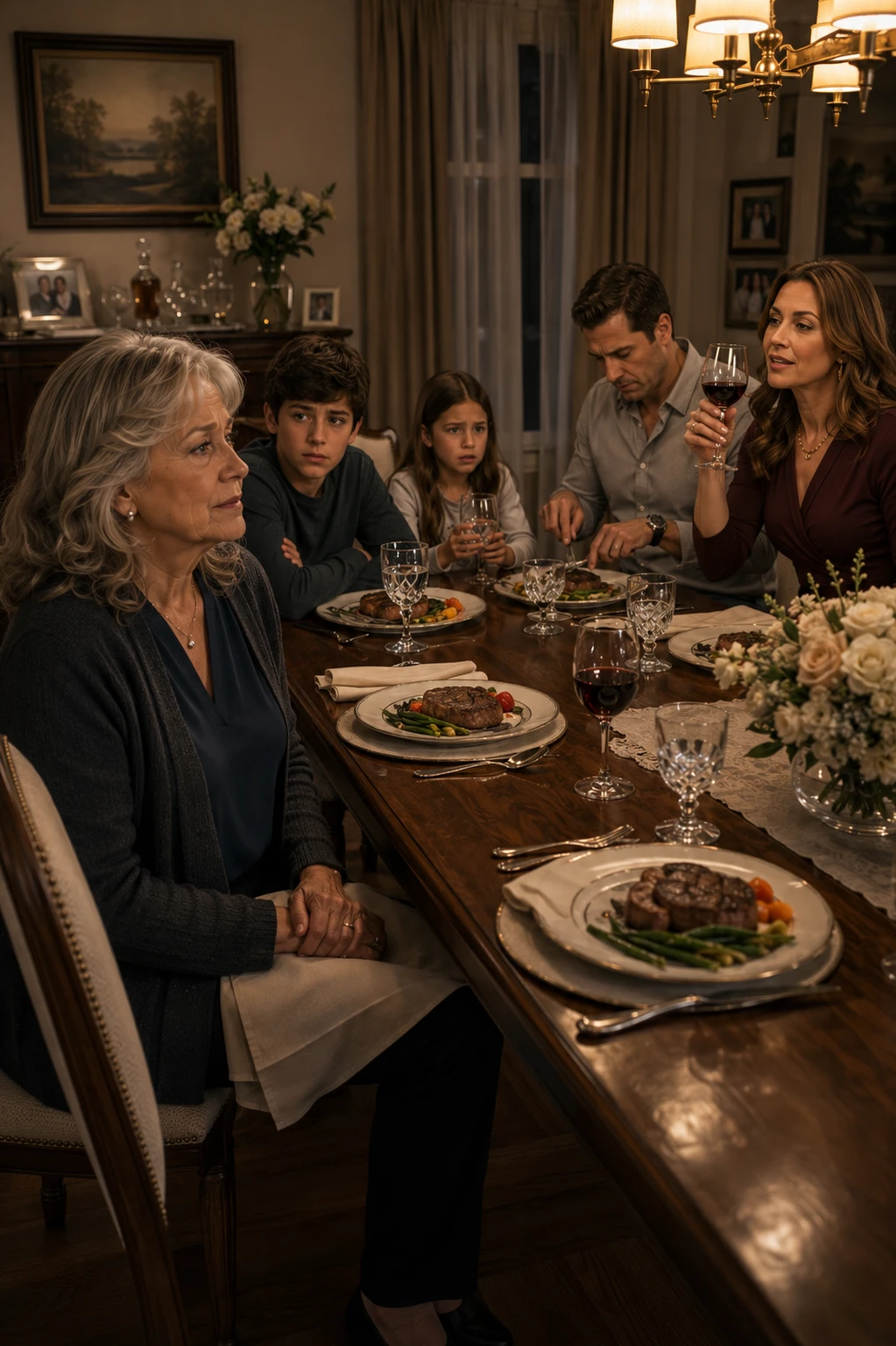
My son and daughter-in-law had lived in my home for twelve years.
Then, over a dinner I had paid for, they raised a glass and announced that they had finally bought a house of their own—so I could begin learning how to live alone.
They expected me to be devastated.
Instead, I smiled.
Because I had been waiting twelve years for that exact moment.
And they had no idea what their new beginning was about to cost them.
Melinda lifted her wine glass beneath the warm dining-room lights and looked directly at me.
Her smile was narrow.
Controlled.
Almost triumphant.
“We purchased our own home, Mom,” she said. “So now you can finally start living by yourself.”
The words settled over the table like frost.
My son Connor lowered his eyes and continued slicing his steak as though his wife had merely commented on the weather.
He did not defend me.
He did not tell her she was being cruel.
He did not even pause.
Then Melinda gave a small laugh and added, “And thank you for staying here all these years without paying a thing. But now that we have a house of our own, we really don’t need you here anymore.”
The room became painfully still.
Even the faint scrape of silverware against porcelain sounded insulting.
My grandson Jackson froze with his fork halfway to his mouth.
His younger sister, Lily, tightened both hands around her water glass.
Children recognize cruelty long before they understand the reasons adults use to excuse it.
They knew something had just broken.
They simply did not know what to call it.
I looked across the table at my family.
At Melinda’s satisfied expression.
At Connor’s bowed head.
At the two grandchildren I had helped raise while their parents worked, traveled, and built the life they now claimed had been achieved entirely on their own.
I did not cry.
Strangely, I did not even feel close to tears.
The hurt was there, of course.
But beneath it, something older and stronger began to wake.
For twelve years, I had swallowed every insult for the sake of peace.
I had ignored the way Melinda slowly took control of my kitchen, my furniture, and my routines.
I had allowed Connor to remain silent because admitting what his silence meant would have hurt too much.
I told myself that family required patience.
Compromise.
Sacrifice.
But sacrifice offered without limits eventually becomes permission.
And that evening, Melinda had finally said enough to make me withdraw mine.
I straightened the napkin across my lap.
Then I lifted my eyes and smiled.
It was not an angry smile.
It was peaceful.
Almost gentle.
That frightened Melinda far more than tears would have.
Her fingers tightened around the stem of her wine glass.
She had expected me to collapse.
She had prepared herself for pleading, humiliation, and desperate questions about where I was supposed to go.
Perhaps she imagined I would ask for another month.
A spare room.
Some forgotten corner of their new house where I might quietly make myself small.
Instead, I looked directly at her.
“That’s wonderful, Melinda.”
Her smile flickered.
“I’m glad you finally want a life of your own,” I continued. “Because I have some news too.”
The knife slipped from her fingers and struck the plate with a sharp clatter.
Connor looked up for the first time.
Jackson stared at me with the same troubled eyes he had inherited from his grandfather.
Beside him, Lily held her glass so tightly that her knuckles turned pale.
Melinda slowly lowered her wine.
“What news?”
Her voice had changed.
The pride was gone.
In its place was something she could not completely conceal.
Fear.
I drew in a slow breath.
For twelve years, I had allowed them to believe a version of the truth that benefited them.
I had watched them grow comfortable.
Entitled.
Careless.
I had kept quiet because I loved my son and wanted my grandchildren to grow up inside a stable home.
But silence has an expiration date.
And sometimes, the truth chooses the exact moment it wants to enter the room.
I looked at Connor.
Then at Melinda.
Finally, I said, “News that matters to you more than anyone else sitting at this table.”
Melinda tried to laugh.
The sound came out brittle.
“Well?”
I rested my hands beside my plate.
“The house you are sitting in has never belonged to either of you.”
No one moved.
Connor’s knife remained suspended over his steak.
Melinda blinked once.
Then again.
“What?”
“This house belongs to me.”
She stared at my face as if waiting for some sign that I was joking.
When she found none, she turned toward Connor.
He had gone completely pale.
“Tell her,” she said.
Connor swallowed.
“Melinda—”
“Tell her she’s confused.”
He lowered the knife.
I could see the moment she understood that his silence was not disbelief.
It was recognition.
“You knew?” she whispered.
Connor looked toward the children.
“Not here.”
“No. Here.”
Her voice sharpened.
“You told me your father left you this house.”
“He did intend for me to inherit it eventually.”
“Eventually?”
The word struck the table.
I answered before Connor could reshape the truth.
“After my death.”
Melinda’s face emptied.
I continued calmly.
“My husband and I purchased this property thirty-nine years ago. When he died, his interest passed to me. Connor was named as a future beneficiary in our original estate plan.”
I looked directly at my son.
“He was never made an owner.”
Connor’s shoulders dropped.
Melinda pushed back from the table.
“You have been living here for free.”
“No.”
I almost admired her refusal to understand.
“I own the house. I paid the mortgage until it was satisfied. I pay the property taxes, insurance, major repairs, and most of the utilities.”
“You told me we covered the house,” she said to Connor.
“We covered some bills.”
“You said the house was basically yours.”
Connor rubbed one hand across his forehead.
“I thought it would be one day.”
“And you let me believe it belonged to us now?”
He did not answer.
Melinda looked around the dining room.
At the chandelier she had selected without consulting me.
The curtains she replaced because mine looked old.
The china cabinet she had begun referring to as hers.
The house had not changed.
Only her relationship to everything inside it had.
Jackson slowly lowered his fork.
“Grandma,” he asked, “this is your house?”
“Yes, sweetheart.”
His eyes moved toward his parents.
“Then why did Mom say you had to leave?”
No one answered him.
Lily’s lower lip trembled.
“Are you leaving?”
I turned toward her.
“No.”
Relief crossed both children’s faces.
That relief told me more about the atmosphere in our home than I wanted to know.
Melinda noticed it too.
Her humiliation began turning into fury.
“You let us live a lie for twelve years.”
“No,” I said. “Connor told you a lie. I allowed you to live in my home.”
“You heard me call it ours.”
“Yes.”
“You watched us renovate.”
“You replaced curtains and painted two rooms.”
“We paid for the kitchen island.”
I looked at the marble island visible through the doorway.
“I paid the contractor after your card was declined.”
Connor shut his eyes.
Melinda turned toward him again.
“You said you handled that.”
“I did.”
“With her money?”
He remained silent.
She laughed.
This time there was no humor in it.
“So what exactly did we pay for?”
I reached into the leather folder resting on the chair beside me.
Neither of them had noticed it when dinner began.
I opened it and removed a twelve-page summary.
“Streaming services,” I said. “Two years of internet. Approximately half the electric bill for thirty-one months. And groceries on the weeks when you remembered.”
I placed the summary in front of them.
“Everything else is documented.”
Connor stared at the total.
Mortgage payments after they moved in.
Taxes.
Insurance.
Roof repairs.
A replacement furnace.
The water heater.
Plumbing.
School transportation.
Groceries.
Childcare.
Summer programs.
Emergency dental bills.
The car I purchased after Connor’s old one failed.
Twelve years of assistance reduced to numbers neither of them could dismiss as sentiment.
Melinda’s voice lowered.
“You kept records?”
“I kept receipts.”
“Why?”
“Because six weeks ago, a property-management company called to ask whether I had approved a tenant for this house.”
Connor’s head lifted sharply.
Melinda’s hand moved toward her wine.
She did not drink.
I looked at her.
“The company had been told this property would become available on the first of next month.”
She said nothing.
“They had a signed lease,” I continued. “A corporate tenant. Five thousand eight hundred dollars per month.”
Jackson looked between us.
“You were going to rent Grandma’s house?”
Melinda found her voice.
“We believed it belonged to your father.”
“You knew Grandma lived here.”
“It was supposed to help pay for the new house.”
There it was.
The plan, finally spoken aloud.
Their new home was a six-bedroom property in a gated development across town.
I had seen the listing.
Stone entrance.
Swimming pool.
Movie room.
Three-car garage.
The purchase price was far beyond what Connor and Melinda could reasonably afford.
They planned to use the rental income from my house to cover almost half the new mortgage.
And they had planned to obtain that income by removing me.
Connor leaned toward me.
“Mom, listen. We were going to find you somewhere comfortable.”
“Where?”
He hesitated.
Melinda answered.
“There’s an apartment complex near Jackson’s school.”
“How much is the rent?”
Neither knew.
“What floor?”
No answer.
“Was a unit reserved?”
Silence.
I looked at Connor.
“You did not find me somewhere comfortable. You assumed I would disappear once you told me to.”
His eyes filled.
“That wasn’t how I saw it.”
“No. You avoided looking.”
Melinda picked up the lease summary.
“You cannot cancel an agreement we signed.”
“I already did.”
She stared at me.
“The property manager contacted the owner listed in the county records. Me.”
Her face hardened.
“We can find another tenant.”
“No, you cannot.”
“You cannot stop us from renting out a house Connor will inherit.”
“I can stop you while I am alive.”
My voice remained quiet.
“And as of yesterday, Connor will no longer inherit it.”
The sentence landed harder than the first revelation.
Connor stared at me.
“What?”
I removed another document.
“My estate plan has been amended.”
“You removed me?”
“I removed your automatic ownership of this property.”
His face crumpled with a kind of shock that might have looked like grief if I had not known what he was losing.
Not me.
The house.
Melinda snatched the document.
“What happens to it?”
“After my death, the house will enter a protected trust for Jackson and Lily.”
Both children looked at me.
“They will not control it until they are thirty-five. It cannot be pledged for debt, transferred to a spouse, or sold by their parents.”
Melinda’s fingers tightened around the pages.
“You cannot cut us out and give everything to children.”
“I can decide what happens to my property.”
Connor’s voice broke.
“Mom, this is extreme.”
“So was changing the locks on the upstairs study last month.”
He went still.
I had come home from a doctor’s appointment and found a new keypad installed on the room where my husband’s files had always been stored.
Melinda claimed she needed privacy for work.
Inside, my attorney later found copies of the deed, property-tax statements, insurance records, and financial projections for the new house.
They had been searching for proof of ownership.
When they found none, they created their own version.
I removed the final document from the folder.
“The lease was not the only paperwork sent to the lender.”
Melinda’s face changed.
Connor stared at her.
“What did you submit?”
She looked toward the children.
“Not in front of them.”
“You announced their grandmother’s removal in front of them,” I said. “The truth can remain in the room too.”
The new mortgage application included projected rental income from my property.
It also included a letter claiming I had gifted Connor my ownership interest.
My name appeared at the bottom.
The signature was copied from a medical authorization I had signed the year before.
Connor looked at the paper.
His mouth opened.
“You told me Mom signed it.”
“I thought she would.”
“You said it was done.”
“She was always going to leave the house to you.”
“That does not make the signature real.”
For the first time that evening, Connor sounded angry with his wife.
It did not excuse him.
He had signed the mortgage application.
He had accepted the rental projection.
He had planned my removal.
Whether he understood how Melinda produced the supporting document changed the criminal details.
It did not change the betrayal.
“The final loan wire is scheduled for nine tomorrow morning,” I said.
Melinda’s eyes flew toward me.
Their announcement had been premature.
They had signed the closing documents that afternoon.
Received temporary access codes.
Ordered furniture.
Told friends they were homeowners.
But the purchase would not record until the lender released the funds the following morning.
I had already notified the bank that the lease was invalid and the ownership letter forged.
The transfer had been suspended pending investigation.
“You called our lender?” Melinda demanded.
“The lender called the legal owner of the property listed as collateral support.”
“That house is not collateral.”
“The projected rental income was required for your approval.”
Connor looked at her.
“You said we qualified without it.”
“We qualified after the lease.”
He pushed his chair back.
“How much did you put down?”
“One hundred and ten thousand.”
His face drained.
“We only had seventy.”
Melinda said nothing.
Connor stood.
“Where did the rest come from?”
She looked toward the table.
I already knew.
Three weeks earlier, forty thousand dollars had been withdrawn from the education account I established for Jackson and Lily.
Melinda had access because I once trusted her to pay tuition and school expenses.
The withdrawal was marked educational housing planning.
The children had not attended any program with that name.
I placed the account statement beside the forged letter.
Jackson read the heading.
“That was our college money.”
Melinda turned toward him.
“It was temporary.”
Lily began crying.
“You took our money?”
“We were going to replace it after renting this house.”
“With money from my home,” I said.
Melinda stood.
“You are acting as though we stole from strangers.”
“No.”
My voice remained calm.
“You stole from people who trusted you.”
Connor stared at the statement.
“How could you do this?”
She turned on him.
“Do not pretend you didn’t want that house.”
“I didn’t know you touched the children’s account.”
“You never wanted to know where anything came from.”
The sentence silenced him.
It was cruel.
It was also accurate.
Connor had spent twelve years accepting every convenience that appeared around him.
Childcare.
Meals.
Repairs.
Money.
A house.
He asked few questions because answers might have required gratitude or limits.
Melinda had not created that part of him.
She had learned how to use it.
The front doorbell rang.
No one moved.
Then the bell rang again.
My attorney, Samuel Bennett, entered moments later.
I had given him the access code that afternoon.
Beside him stood a representative from the mortgage lender.
Melinda looked at me as though I had staged an execution.
I had not.
I had arranged a meeting.
The difference was that the truth arrived with documents.
Samuel sat at the end of the table.
The lender’s representative introduced herself as Karen Lowell and explained that the mortgage funding had been frozen due to material misrepresentation.
The invalid lease removed the projected income required for approval.
The false ownership letter triggered a fraud review.
The missing education funds created another problem because the down payment had been certified as personal savings.
The closing would not proceed.
The seller was entitled to retain the earnest-money deposit under the financing representation clause.
Connor sank into his chair.
“How much do we lose?”
Melinda did not answer.
Karen did.
“Sixty-five thousand dollars in nonrefundable earnest money, plus appraisal, legal, and expedited-closing fees.”
Connor stared at his wife.
“You risked sixty-five thousand?”
“I was trying to build something for us.”
“You were building it with Mom’s house and the children’s money.”
Melinda’s voice rose.
“Because your mother kept everything!”
I looked around the dining room.
“Everything?”
“I have spent twelve years waiting for you to step aside.”
The words came out before she could stop them.
Jackson looked at his mother with horror.
Lily cried silently beside him.
Melinda saw their faces and tried to recover.
“That isn’t what I meant.”
“Yes,” I said. “It is.”
She turned toward me.
“You had the largest bedroom. You controlled the accounts. You expected us to ask permission for everything.”
“It was my bedroom. My accounts. My home.”
“We were supposed to become a family.”
“You confused family with possession.”
Samuel placed a formal notice on the table.
Connor and Melinda’s permission to occupy my home would end in thirty days.
I did not need to remove them immediately.
They already planned to move.
But the notice prevented them from remaining indefinitely after the new purchase collapsed.
It prohibited further access to my financial records, trust accounts, property documents, and locked rooms.
It also required repayment of the children’s education funds.
Connor read the notice.
“You’re evicting us?”
“I am ending twelve years of temporary housing.”
“Where are we supposed to go?”
The question should have broken me.
For most of his life, I had answered it before he finished asking.
A spare room.
A loan.
A phone call.
A solution.
That evening, I allowed it to remain his question.
“I don’t know.”
He looked at me as though he had never heard those words before.
Melinda laughed bitterly.
“You’ve been waiting for this.”
“Yes.”
Everyone turned toward me.
I looked at my son.
“I have been waiting twelve years for you to want a home of your own.”
My voice trembled.
“I imagined the day differently.”
I had pictured boxes on the porch.
Grandchildren running between houses.
A farewell dinner filled with gratitude.
Connor handing back the key and thanking me for keeping his family safe while they rebuilt.
I had never imagined being told I could begin learning how to live alone.
“I waited because I believed moving out would mean you had become secure,” I continued. “I did not know you were planning to finance your independence by taking everything that made mine possible.”
Connor covered his face.
Melinda remained standing.
Her anger had nowhere to go.
Not toward the bank.
Not toward Samuel.
Not toward the deed.
So she directed it toward me.
“You have destroyed our future.”
“No.”
I looked at the forged signature.
“You built your future on something you did not own.”
The meeting ended after nine.
Karen took copies of the documents.
Samuel secured the children’s account and froze Melinda’s access.
Connor and Melinda went upstairs.
Their argument continued behind the closed door long after Jackson and Lily came into my bedroom.
Lily climbed beside me without asking.
She had not done that since she was eight.
“Are Mom and Dad going to jail?”
“I don’t know.”
“Will they lose us?”
“No one is deciding that tonight.”
Jackson remained near the doorway.
“Did Dad know?”
“He knew you were being moved out of your home,” he said before I could answer.
There was anger in his voice.
Not childish anger.
The beginning of adult disappointment.
I held out my hand.
He sat beside us.
“Your father made a serious choice,” I said. “Your mother made serious choices too. But you are not responsible for fixing either of them.”
“Are we allowed to stay here?”
“Yes.”
The answer came immediately.
“This will always be a place where you are welcome.”
Jackson looked toward the hallway.
“What about them?”
I could hear Connor’s voice through the ceiling.
“For the next thirty days,” I said. “After that, they need to build a life that does not depend on taking mine.”
The investigation lasted six months.
Because the mortgage never funded, no lender lost the purchase amount.
That mattered legally.
It did not erase the forged letter, false lease, or misuse of the education account.
Melinda pleaded guilty to attempted mortgage fraud, forgery, and unauthorized withdrawal of trust funds.
She received probation, community service, mandatory financial counseling, and restitution.
Connor avoided criminal charges related to the signature after cooperating and proving he had not created the document.
But the lender held him responsible for the false statements he had signed without reading.
His professional license was suspended for six months.
He lost the management position that had made the expensive new house seem possible.
The seller kept the earnest money.
The furniture deposits were mostly nonrefundable.
The gated house returned to the market before they ever spent a night inside it.
Their new beginning cost them nearly one hundred thousand dollars.
More painfully, it cost them the story they had told about themselves.
They were not disciplined adults who had finally purchased a home after supporting an elderly mother.
They were two people who had lived rent-free for twelve years, used an older woman’s property as imaginary income, and taken money from their children to purchase a life they could not afford.
Melinda blamed me publicly.
She told relatives I had tricked them.
She said I deliberately hid the deed.
She described herself as a victim of an elderly woman who changed her mind out of jealousy.
Then Samuel released no statement.
He did not need to.
The county records were clear.
So were the mortgage documents.
Truth is often quiet because evidence does not require emotion to survive.
Connor and Melinda moved into a two-bedroom rental at the end of the thirty days.
Jackson remained with me during the school week because their apartment was outside his district.
Lily stayed three nights each week.
I did not compete for them.
I did not ask them to choose.
I gave them keys, bedrooms, meals, and the right to love their parents without defending what they had done.
Melinda resented that.
Connor appeared relieved.
That relief showed me how much of the parenting I had carried without naming it.
Their marriage lasted another year.
It ended when Connor discovered additional credit-card debt and learned Melinda had been making payments to her mother from their joint account.
Melinda said Connor had become disloyal.
Connor finally told her that loyalty without honesty had nearly cost him his children, his career, and his mother.
They divorced.
For months afterward, Connor called me.
At first, every conversation contained an emergency.
A security deposit.
A car repair.
Attorney fees.
The children’s expenses.
Each request arrived wrapped in apology.
I answered the apology.
I did not answer the invoice.
“I can’t help you with that,” I said the first time.
He went silent.
“You have the money.”
“That is not the same as owing it to you.”
“I’m trying to rebuild.”
“So am I.”
He hung up angry.
Two days later, he called back.
“I’m sorry.”
“For what?”
“For believing an apology should reopen your account.”
That was the first honest thing he said after leaving.
The house changed slowly.
I restored my husband’s chair beside the window.
Melinda had moved it into the basement because she said the fabric looked tired.
I returned my blue dishes to the kitchen cabinet.
I rehung the family photographs she had replaced with decorative mirrors.
The dining table remained where it had always stood.
For several months, I expected to feel lonely.
Instead, I discovered how much loneliness had existed while five people occupied the house.
Loneliness is not always an empty room.
Sometimes it is cooking for a family that discusses your removal while eating what you prepared.
Sometimes it is paying every bill while being thanked for staying free.
Sometimes it is having a son beside you who chooses silence because defending you would inconvenience him.
Living alone was different.
I chose the music.
Ate when I was hungry.
Left a book on the sofa without anyone calling it clutter.
Made coffee only for myself on mornings when the grandchildren were with their parents.
The quiet did not reject me.
It rested around me.
I began hosting Sunday dinners for several widows from my church.
No one assumed.
Everyone brought something.
One woman made bread.
Another brought flowers.
A retired teacher named Ruth always washed the serving dishes before I could stop her.
When the grandchildren joined us, the dining room became louder than it had been in years.
But the noise no longer belonged to entitlement.
It belonged to people who understood they had been invited.
I revised my estate plan again.
The house would remain in trust for Jackson and Lily, but neither could remove the other, mortgage it alone, or transfer it to a spouse.
If they did not wish to keep it, the property would be sold and part of the proceeds would fund temporary housing for grandparents raising grandchildren.
Connor received a separate modest trust.
Enough for stability.
Not enough to finance another illusion.
When I told him, he nodded.
No argument.
No question about whether he could receive more.
He had been living in a small apartment for almost two years by then.
He cooked.
Handled his own laundry.
Worked beneath a supervisor younger than him while rebuilding his professional reputation.
The children said he apologized when he was wrong.
Not always quickly.
But without asking them to comfort him afterward.
One Sunday afternoon, Connor came to the house carrying a cardboard box.
He rang the bell.
He still possessed no key.
I opened the door but did not step aside immediately.
“May I come in?”
The question mattered.
“Yes.”
He entered.
Inside the box were household records he had found while separating from Melinda.
Receipts.
Insurance statements.
Utility bills.
And a notebook I had kept during the children’s early years.
Each page listed school schedules, medical appointments, meals, and expenses.
Connor sat at the dining table and read silently.
“You did all this?”
“Yes.”
“Why didn’t I notice?”
“You benefited from not noticing.”
He closed the notebook.
“I thought you liked taking care of everyone.”
“I liked loving you.”
His eyes filled.
“That wasn’t the same thing.”
“No.”
He looked around the dining room.
“I told Melinda you lived here free.”
“I know.”
“I told her Dad had left me the house.”
“I know.”
“I knew that wasn’t legally true.”
The confession came quietly.
“Why did you say it?”
“Because she was impressed.”
He lowered his head.
“She came from a family that owned property. I was embarrassed that we needed to move in with you.”
“So you rewrote the story.”
“I made myself the generous son and you the dependent mother.”
The sentence hurt.
It also named the deepest betrayal.
Not the forged letter.
Not the failed house purchase.
The story Connor had told until he almost believed it.
“I’m sorry,” he said.
I waited.
“I’m sorry I used your generosity to improve my image.”
His voice broke.
“I’m sorry I let my children believe the house belonged to me. I’m sorry I sat at this table while Melinda told you to leave.”
He looked toward the chair where he had been seated that night.
“I heard every word.”
“Yes.”
“I kept cutting my steak because I was afraid that if I looked at you, I would have to admit what we were doing.”
I felt tears gather.
“You chose your comfort over my dignity.”
“Yes.”
He did not explain.
He did not mention Melinda’s temper.
He did not describe himself as trapped.
He allowed the truth to remain his.
“Do you forgive me?” he asked.
“Partly.”
Pain crossed his face.
He accepted it.
That mattered.
“What does the rest require?”
“Time in which your behavior stops asking the same question.”
He nodded.
Our relationship returned one ordinary choice at a time.
Connor arrived when invited.
He left when asked.
He did not move furniture.
He did not discuss the value of the property.
When the roof needed repairs, he offered to help find contractors.
I declined because Samuel had already arranged estimates.
Connor said, “Alright.”
No injury.
No argument.
No attempt to turn my independence into rejection.
Jackson graduated from high school.
At the celebration, he thanked me for giving him a stable place to study.
Then he thanked his parents for attending counseling and learning to speak to one another without using him as a messenger.
Lily entered college three years later with her education account restored.
Melinda had repaid every dollar under the restitution order.
She attended the send-off dinner at a restaurant.
She sat across from me.
For most of the evening, we spoke only when necessary.
Before leaving, she approached my chair.
“I blamed you for everything,” she said.
“Yes.”
“I thought if you gave us the house, none of it would have happened.”
“If I had given you the house, you would have learned that forgery and cruelty worked.”
She lowered her eyes.
“I know that now.”
It was not an apology.
Not completely.
But it was the first sentence she spoke without treating me as the obstacle in her life.
“I’m glad Lily has her money back,” I said.
“So am I.”
We did not embrace.
Not every relationship needs to become warm in order to become peaceful.
Sometimes distance is the most honest form of reconciliation available.
On the twelfth anniversary of the night they announced their new house, Connor asked whether he could prepare dinner in my kitchen.
“The same menu?” I asked.
He looked embarrassed.
“Steak might be too obvious.”
“Steak is fine.”
Jackson and Lily came.
Ruth brought bread.
Samuel joined us after work.
Connor cooked awkwardly but carefully.
He paid for every ingredient.
When the meal was ready, he waited until I chose my chair.
No one raised a glass before everyone was seated.
During dinner, Lily began laughing about the first week Connor lived alone and called her because he did not know how to clean the filter in his dishwasher.
Jackson reminded him that he once believed towels replaced themselves.
Connor accepted the teasing.
Then he lifted his water glass.
My body tightened instinctively.
He noticed.
“I don’t have an announcement,” he said gently.
Everyone laughed.
The tension dissolved.
Connor looked at me.
“I only want to say thank you for allowing me to sit at this table again.”
My eyes filled.
“You are my son.”
“I know.”
He glanced around the dining room.
“But that does not make every chair mine.”
No one spoke for a moment.
Then Jackson raised his glass.
“To Grandma’s house.”
Lily joined him.
“To Grandma.”
We drank.
After dinner, everyone carried plates into the kitchen.
Connor washed them.
Jackson dried.
Lily packed leftovers.
No one left me alone beside a table filled with the evidence of their celebration.
When the kitchen was clean, Connor placed the final glass in the cabinet.
“Mom?”
“Yes?”
“Are you happy living alone?”
The question no longer sounded like a threat.
I looked through the doorway.
At the chair beside the window.
The family photographs.
The dining table where cruelty had once arrived dressed as a toast.
“I do not live alone,” I said.
He frowned slightly.
“You mean because Jackson visits?”
“Because solitude and abandonment are not the same thing.”
I looked at him.
“I have friends. I have your children. Sometimes I have you.”
His eyes filled.
“And when no one is here, I still have myself.”
Connor nodded.
“I’m sorry I made that sound like a punishment.”
“For a while, I believed you.”
He came closer but waited before touching me.
I opened my arms.
He hugged me carefully.
Not as a man reclaiming his place.
As a son grateful to be offered one.
After everyone left, the house settled into quiet.
I walked through the dining room and stopped beside the chair where Melinda had raised her glass twelve years earlier.
For a long time, I believed that night was the moment my family broke.
It was not.
The breaking had happened slowly.
Every meal I cooked without acknowledgment.
Every expense I covered without discussion.
Every insult Connor heard and chose not to answer.
The announcement only made the fracture visible.
It also gave me the chance to stop widening it with my own silence.
They had told me to learn how to live alone.
I did.
I learned to pay attention to what peace felt like when no one demanded that I earn my place inside it.
I learned that a quiet house could contain more love than a crowded one filled with entitlement.
I learned that helping adult children should not require a parent to become homeless in everything except name.
And I learned that forgiveness did not mean returning the deed, the key, or the authority over my life.
The house remained mine.
The future remained protected.
Connor remained my son.
All three truths could exist together.
Before going upstairs, I turned off the dining-room light.
The table disappeared into shadow.
Twelve years earlier, Connor and Melinda had believed buying a larger house would mark the beginning of their independence.
Instead, losing it taught them what independence actually cost.
Rent.
Work.
Honesty.
Responsibility.
Consequences.
Things I had quietly paid on their behalf for too long.
Their failed beginning had cost them money, reputation, and a marriage built on illusion.
Mine had cost me the fantasy that love alone made people safe.
But it had also returned something far more valuable.
My home.
My voice.
My peace.
And every time the doorbell rang after that, I decided who entered.
Not the deed.
Not obligation.
Not guilt.
Me.
That was the life I had waited twelve years to begin.