
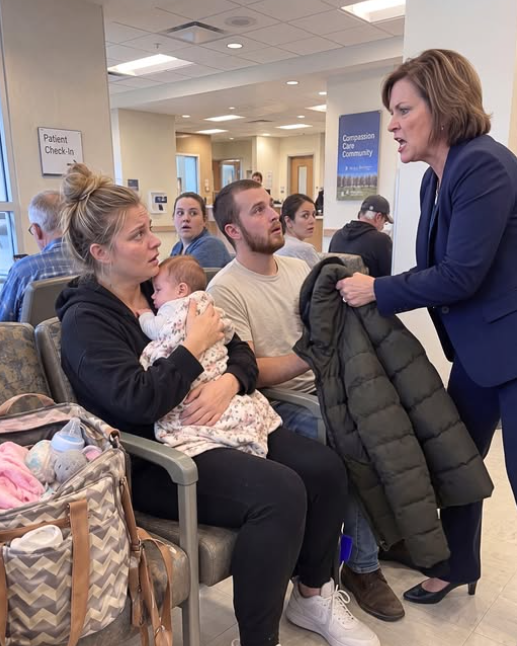
My husband and I were sitting in the ER with our sick baby when my mother-in-law stormed in, grabbed his coat, and shouted, “He didn’t sign up for this much stress! You’re the mother!” I stared at her for a moment, then did something neither of them expected.
Part 1: The Night My Mother-in-Law Crossed the Line
My daughter June was four months old when her fever climbed to 104 degrees in the middle of the night. I was thirty-one, working as a nurse practitioner in emergency medicine, so I knew enough to understand that this was not something we could simply watch until morning.
Before becoming a mother, I had spent six years being the calm person in rooms where families were terrified. I had also spent two years helping care for my mother after her early-onset Parkinson’s diagnosis, so exhaustion and responsibility were not unfamiliar to me; when something needed to be done, I had learned to do it whether anyone thanked me or not.
My husband Ethan was different. He was loving, funny, and genuinely thoughtful, but he had grown up as the only child of Sylvia Donnelly, a woman who had spent thirty-three years protecting him from almost every discomfort before he could learn from it.
I had seen that pattern before. After I miscarried our first pregnancy, Sylvia called Ethan every day to tell him how difficult the loss must be for him, while I sat in the next room wondering whether she remembered that I had been the one who was pregnant.
I said nothing because I wanted to protect my marriage. I eventually learned that avoiding conflict did not eliminate it; it merely allowed the same problem to grow quietly.
When June was born, Ethan initially became exactly the father I hoped he would be. He changed diapers, shared night feedings, and learned to swaddle her with almost obsessive concentration, but around her seventh week, a major product launch at work began consuming his energy.
Gradually, I became the default parent. Ethan was tired from work, and while I understood that exhaustion, I noticed that whenever I was equally exhausted, the baby still needed feeding, comforting, changing, and attention.
Then June got sick.
Her fever began mildly on Thursday and continued climbing despite medication. At one in the morning, the thermometer read 104.1, and her pediatrician told us to go directly to the emergency room.
In the waiting room, June cried against my chest while I rocked her and tried to keep her calm. Ethan paced beside us, increasingly irritated by how long we were waiting.
“This is ridiculous. I have a massive presentation at nine AM. I can’t be doing this all night.”
“Her fever is still going up. We just have to wait for the doctor.”
“Well, I’m exhausted.”
A few minutes later, Ethan stepped away with his phone. I assumed he was contacting his boss, but twenty minutes later the automatic doors opened and Sylvia walked into the emergency room after driving forty minutes in the middle of the night.
She never looked at June.
Instead, she walked straight to Ethan, grabbed his coat from the chair, and pushed it into his hands.
“Let’s go. I’m taking you to my house. You can get a few solid hours of sleep before your presentation.”
I stared at her.
“Sylvia, what are you doing? We’re waiting for the doctor.”
“He is exhausted. He can’t sit in a waiting room all night.”
“She is his daughter. I’m exhausted too.”
That was when Sylvia finally lost control. In front of the nurses, the other patients, and my sick four-month-old daughter, she raised her voice until the entire waiting room became silent.
“He didn’t sign up for this much stress! You’re the mother. Figure it out.”
I did not cry or argue with her.
Instead, I stood up with June in my arms and looked at Ethan, who was holding his coat and waiting for someone else to decide what he should do.
That was when I realized Sylvia was not the only person I needed to confront.