
Part 5: The Voice That Stayed
The deputies cleared the soil away slowly, taking care not to move me too quickly. When the pressure around my chest finally eased, I realized how difficult it was to breathe without the straw.
The paramedic kept speaking to me in short, calm sentences. She told me where her hands were, asked whether I could feel my legs, and placed a blanket around my shoulders as soon as they lifted me free.
My body shook uncontrollably. I could not tell whether it was cold, fear, exhaustion, or the sudden fact that no one was holding me down anymore.
They took me to the hospital, where doctors examined the dehydration, bruising, and prolonged pressure on my body. An obstetrician checked the baby before anyone asked me to give a statement.
For several unbearable minutes, the room held only the sound of equipment. Then the doctor looked at me and said the words I had been afraid to hope for.
“The baby has a heartbeat.”
I cried so hard I could barely hear anything else. The baby had been trapped in that yard with me, and still there was a small, steady rhythm on the monitor.
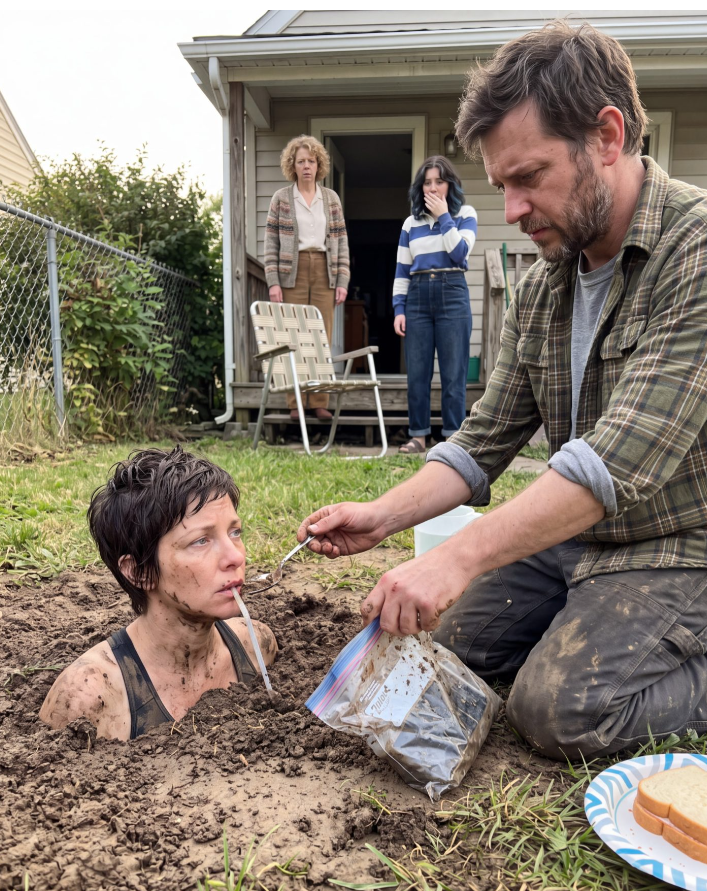
My husband, his mother, and Mara were taken away separately. The deputies collected the phone, preserved the recordings, photographed the backyard, and documented the hidden straw, the pitcher, the discarded food, and the hole where they had buried me.
None of them could claim they had not understood what was happening. Their own voices had explained it.
At first, my husband tried to say it had been a family matter that had gone too far. His mother insisted she had only stood nearby because she did not know what to do, while Mara claimed she had believed I could leave whenever I wanted.
But the recordings did not change when they changed their stories. They held my husband calling it discipline, his mother calling it a lesson, and Mara treating my suffering as an inconvenience between ordinary conversations.
The evidence was not dramatic because it did not need to be. It was patient, clear, and impossible to intimidate.
I spent the next several weeks in a place he did not know. I changed my number, met with an advocate, attended medical appointments, and learned how to accept help without apologizing for needing it.
Some days, the memory came back through small things: the sound of rain hitting soil, the smell of wet grass, or a plastic straw in a restaurant glass. When that happened, I reminded myself that memory was not a command to return.
My husband sent messages through relatives. Some were angry, some were pleading, and some claimed he was ashamed and wanted to explain.
I never answered.
For too long, he had used explanations to turn cruelty into confusion. I no longer needed to debate what I had lived through.
The case moved forward because the recordings, photographs, medical reports, and witness accounts all told the same story. My husband and the two family members who helped him were forced to face consequences for what they had done, not because I screamed louder than they did, but because the truth had been preserved before they could bury it.
Months later, I stood in a small nursery with one hand resting on my growing stomach. The room was quiet, painted a soft color I had chosen myself, with no one demanding to know whether the baby would be a boy or a girl.
I thought about the narrow straw beneath the dirt and the phone I had hidden by my shoulder. I had not felt brave when I pressed the record button.
I had felt terrified.
But I had kept breathing. I had kept listening. And when the people who wanted to erase my voice finally heard it played back to them, they learned the one thing they had never understood.
Silence is not surrender.