
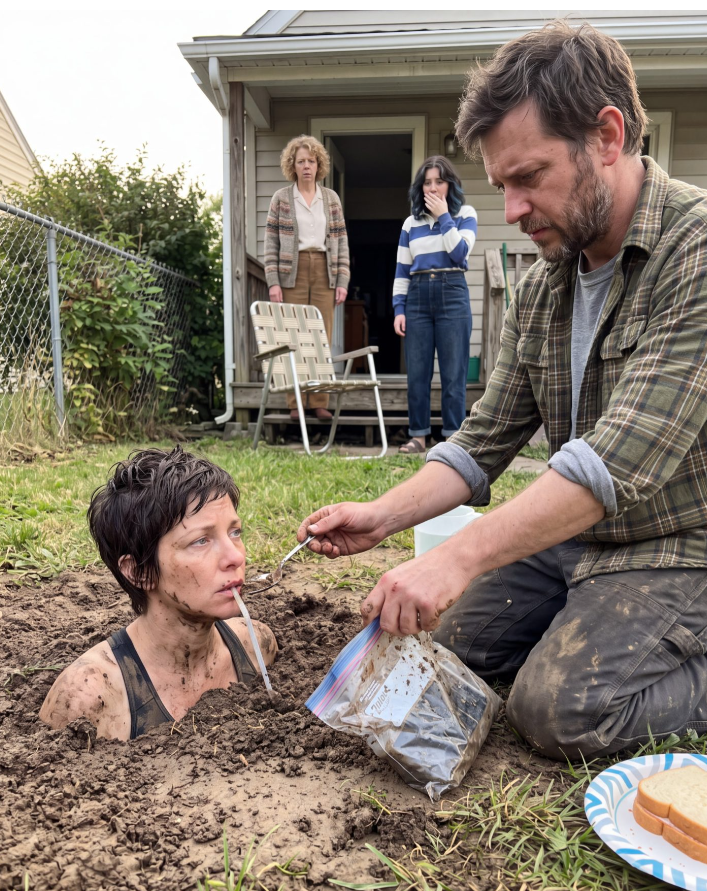
My husband bur:!ed me al!ve in our backyard while I was pregnant and called it “discipline.” He stood on the porch with his mother and sister, watching me bre@the through a tiny str@w bur:i:ed under the dirt. They thought fe@r would make me apologize. They laughed because they believed nobody would ever know what they did. When my husband finally found it, a stranger’s voice came through the speaker: “We have your location.”
Part 1: The Straw Beneath the Dirt
They buri:ed me in the backyard with only my head exposed, then called it a pun!shment for disobedience. I was pregnant, unable to move, and f0rced to breathe through a narrow str@w hidden beneath the soil while my husband watched from the porch with his mother and sister.
Before dawn, the dirt pressed cold and wet against my jaw until my teeth hu:3rt. By afternoon, it tra:pped the heat around my body, making every breath feel stale as water ran through my hair and down my face.
The yard smelled of mud, cut grass, and the sour water they kept pouring over me. Whenever the porch boards creaked, I counted footsteps without lifting my eyes.
My husband’s steps were slow and heavy near the railing. His mother moved more carefully, as though my suffering were merely an inconvenience, while his sister Mara scraped her lawn chair across the porch before carrying it onto the grass.
I learned their movements because looking at them gave them what they wanted. They wanted to see fear, pleading, and promises that I would never challenge them again.
My husband called it discipline. His mother called it a lesson, and Mara said families should handle problems privately before adjusting her chair so its legs would stay out of the mud.
So I kept breathing.
The str@w was barely wide enough to puII air through, and I had to stay deliberate. If I inhaled too fast, the plastic colla:psed against my lips; if I breathed too slowly, panic rose until the dirt seemed to tighten around me.
I focused on the few things I still controlled: inhale, pause, exhale, listen.
Our baby shifted low inside me that first morning, a faint pressure beneath my ribs. I waited for another movement, but nothing came, and that silence frightened me more than the laughter behind me.
I remembered the last time the baby had moved before they dragged me outside. I had been in the kitchen with one hand against the counter, listening to my husband speak with his mother in the hallway while a freezer bag lay folded inside my pocket.
Then I remembered him telling her that embarrassment was the only language I understood. That was when I realized the argument had already ended; they had made their decision before I ever stepped into the yard.
When he leaned over the railing and asked whether I was finally ready to behave, I lowered my eyes. He mistook my silence for surrender.
That was useful.
Near my right shoulder, beneath loose soil, my phone was hidden inside the freezer bag, its microphone exposed and screen dark. I had slipped it there before they brought me outside, and although my hand was buried too, there was just enough room around one wrist for me to move a finger.
They had not left that space out of kindness. They simply believed I was too fr!ghtened to use it.
Every few hours, I found the record button by touch. I could not see the screen, so I depended on the phone’s vibrations: one short buzz meant recording had begun, and another told me it had stopped.
The files captured different moments, but the laughter rarely changed. My husband explained that a wife who followed directions would never end up in the dirt, while his mother asked whether the baby could feel me being stubborn.
Mara said the insects were probably harmless, though she stepped away whenever one landed near her sandal. They spoke as though I could not hear them, then raised their voices whenever they wanted anyone nearby to believe this was normal.
My husband had spent months telling others that I became confused when I was upset. The phone was not there to rescue me.
It was there because I needed something that could remember the truth without shaking.