Part 2
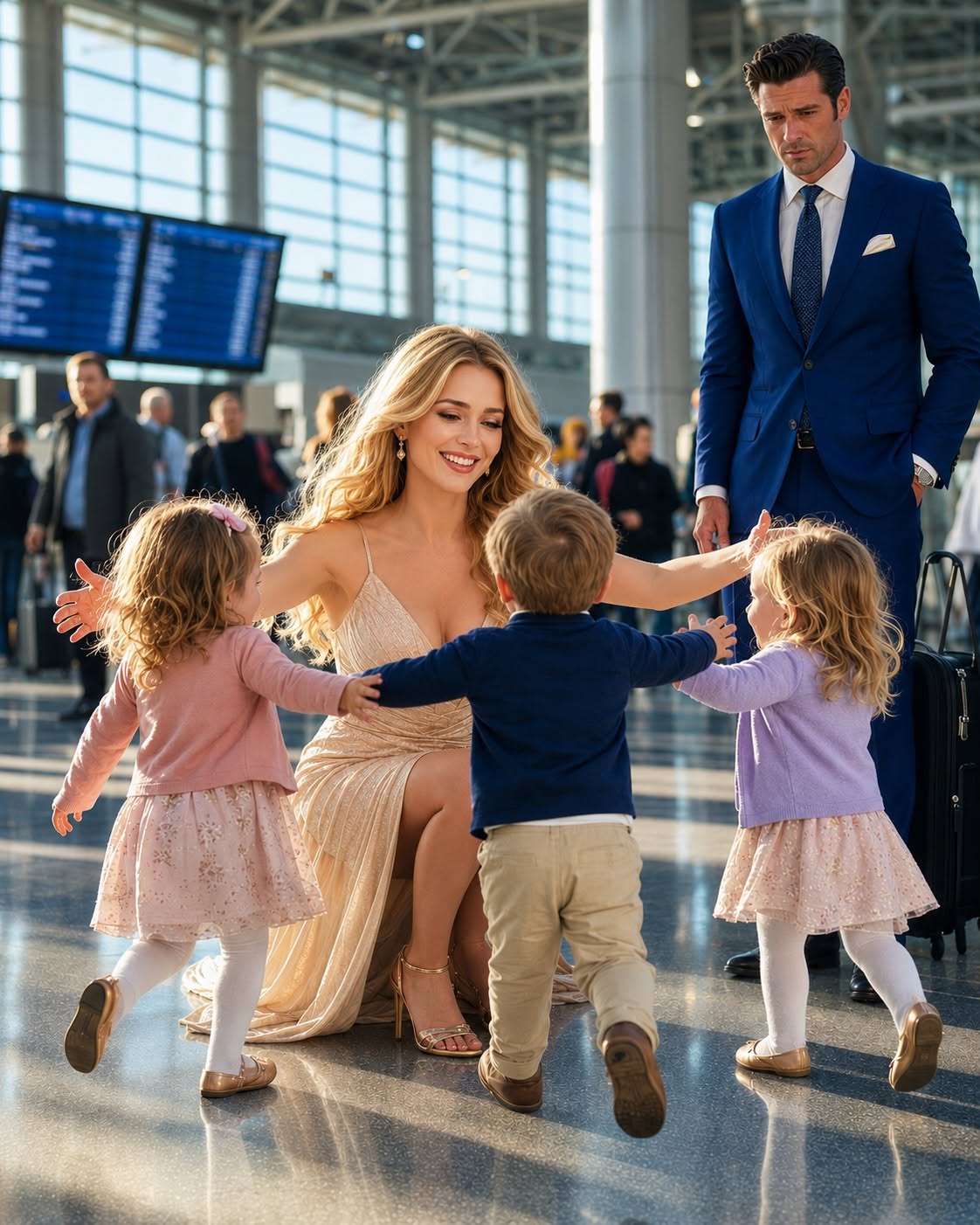
The woman running toward us moved with the polished urgency of someone used to being obeyed.
She was tall and elegant, with dark hair swept into a smooth knot at the nape of her neck. Her cream coat looked expensive without trying to look expensive, and the small diamond studs in her ears caught the airport lights each time she turned her head.
“Graham,” she called again, breathless now.
He didn’t answer.
He was still staring at the children.
At our children.
Then the woman reached us, slowing only when she saw his phone in pieces on the floor, his face pale, and me standing there with one toddler on my hip and two more gathered around my legs.
For a moment, she seemed confused.
Then her eyes landed on me.
Recognition flashed across her face.
Not the vague kind that says, I think I’ve seen you somewhere.
The sharp kind.
The kind that says, I know exactly who you are.
“Emily Hart,” she said quietly.
My stomach tightened.
I had never met this woman in my life.
Graham finally turned toward her, and whatever silent storm had overtaken him seemed to deepen.
“Vivian,” he said.
The name meant nothing to me at first.
Then it did.
Vivian Carlisle.
I had seen her in photographs beside Graham at business galas, real estate openings, political fundraisers. A poised woman from a family whose wealth had been woven into Boston for generations. I remembered her because of the way she always stood beside him in those pictures—not close enough to be warm, but close enough to imply a claim.
I had once asked Graham about her.
He had shrugged and said, “Old family connection. Nothing more.”
Standing in front of me now, Vivian Carlisle did not look like nothing more.
Her gaze lowered to my children.
Our daughter, Lily, still held out the cracker, as though every adult in this strange little circle needed a snack and a chance to calm down.
Vivian blinked once.
Then again.
Her eyes moved from Lily to Oliver, whose small arms were wrapped around my leg, then to Sophie, asleep against my shoulder with her cheek pressed into my coat.
Something changed in her expression. It wasn’t anger. It wasn’t shock exactly.
It was understanding.
“Oh,” she whispered.
Graham drew in a slow breath. “Vivian, this isn’t—”
“Don’t,” she said.
The word was soft, but it stopped him completely.
I looked between them, trying to make sense of the tension that had suddenly become thicker than the crowd around us. Travelers continued to pass on either side. A rolling suitcase clipped the heel of a man in front of us. Somewhere nearby, a child began crying because his boarding pass had been folded wrong. Life continued with the ordinary chaos of an airport.
May you like

But inside our small circle, everything had gone still.
Vivian’s face softened as she looked at Lily.
“How old are they?” she asked.
I hesitated.
It was such a simple question, but nothing about the moment felt simple.
“Seventeen months,” I said.
Graham’s head snapped toward me.
“Seventeen?”
“Yes.”
His throat worked. “Triplets?”
I gave a small nod.
For the first time, his eyes filled with something I had never seen there before. Not confidence. Not control. Not charm.
Grief.
It came so suddenly that I almost looked away.
Almost.
“Emily,” he said, “I didn’t know.”
“No,” I replied. “You didn’t.”
The answer was calm, but it carried eighteen months of midnight feedings, pediatric appointments, unpaid bills, fevers, first steps, first words, and every lonely moment when I had wanted to call him but refused to beg again.
He flinched.
Vivian looked at him then, and I saw something pass between them. Something old. Something heavy.
“Graham,” she said, “we have to go.”
His jaw tightened. “Not now.”
“Our flight leaves in forty minutes.”
“I said not now.”
The sharpness in his voice made Oliver tuck his face against my jeans. Graham noticed instantly. His expression shifted with guilt.
“I’m sorry,” he said, crouching slightly, not too close. “I didn’t mean to scare you.”
Oliver peeked at him with suspicious blue-gray eyes.
Graham stared back, almost helplessly.
“What’s his name?” he asked me.
I should have had an answer ready. I should have been prepared for this moment in some private corner of my mind. But I hadn’t been. I had imagined many things over the past eighteen months. A message from Graham. A lawyer’s letter. A photo of him engaged to someone else. A headline about another luxury tower with his name attached to it.
I had never imagined standing near a departure gate with crumbs on my sweater, a diaper bag digging into my shoulder, and the man who had abandoned us looking like his life had just split open.
“Oliver,” I said.
Graham repeated it under his breath. “Oliver.”
Lily stepped closer to him. “I’m Lily.”
His mouth trembled before he managed a smile. “Hi, Lily.”
She studied him seriously. “You dropped your phone.”
“I did.”
“It broke.”
“Yes,” he said. “It did.”
She nodded with the grave wisdom of toddlers. “Mama says we don’t throw things.”
A sound escaped him. Not quite a laugh. Not quite a sob.
“I’ll remember that,” he said.
Vivian’s eyes closed briefly.
When they opened, she looked at me, and there was something like apology there.
“I’m sorry,” she said.
I didn’t know how to receive that from her.
“For what?”
Her lips parted, but Graham stood suddenly.
“Vivian,” he warned.
That one word told me everything and nothing.
Vivian looked at him, her expression cooling. “She deserves to know.”
“Not here.”
“Then where?” she asked. “At the gate? On the plane? After the wedding?”
The word landed between us with an almost audible crack.
Wedding.
My eyes moved to Graham’s left hand.
No ring.
Then to Vivian’s.
A diamond flashed on her finger.
I felt something inside me fold in on itself. Not heartbreak, exactly. That had happened long ago. This was different. This was the ache of realizing the past had kept moving without you while you were too busy surviving to notice.
“You’re getting married,” I said.
Graham turned to me quickly. “It’s not what you think.”
That almost made me laugh.
Because the thing about hearing that sentence from someone who once broke your heart is that it never sounds reassuring. It sounds rehearsed.
Vivian gave him a sad look. “Graham.”
He ran a hand through his hair, ruining its careful shape. “Emily, please. I need a chance to explain.”
Sophie stirred against my shoulder and made a small uncomfortable noise. I shifted her higher, my arms aching in the familiar way they always did after holding one child too long while watching the other two like a hawk.
“We’re not doing this in the middle of an airport,” I said.
Graham’s eyes sharpened with panic. “Are you leaving?”
“Yes. That’s generally what people do at airports.”
His expression flickered as though he deserved the edge in my voice and knew it.
“Where are you going?”
I hesitated.
The old Emily might have answered automatically. The Emily who trusted him. The Emily who believed love was enough to make frightened men brave.
That Emily had spent eighteen months becoming someone else.
“That’s not your concern,” I said.
He looked as if I had slapped him.
Vivian glanced at the children again. “Emily, I know you have no reason to trust either of us, but please let me say one thing.”
“I don’t even know why you know my name.”
Her face tightened.
Graham closed his eyes.
The crowd around us shifted as boarding for a nearby flight began. People formed a crooked line by the gate desk. A man in a navy suit muttered into his headset. A grandmother opened a packet of animal crackers and spilled them into her purse.
Normal life.
Impossible life.
Vivian stepped closer, careful to keep her voice low.
“I know your name because eighteen months ago, I found a letter addressed to Graham on his desk,” she said. “It was from you.”
The terminal seemed to tilt slightly.
“A letter?”
Graham’s face went white.
I stared at him. “What letter?”
Vivian looked confused now. “You didn’t write it?”
“No.”
Graham’s jaw tightened. “Vivian, stop.”
She turned toward him. “You told me she sent it.”
“I know what I told you.”
“And was any of it true?”
He didn’t answer.
A chill moved through me that had nothing to do with the airport air-conditioning.
“What letter?” I asked again.
Vivian swallowed. “It said you didn’t want contact. That you had decided the pregnancy was not his responsibility. That accepting financial support would be enough.”
I could hear my own heartbeat.
Lily tugged on my coat. “Mama?”
I looked down at her bright sweater, her trusting face, her half-eaten cracker, and forced myself to breathe.
“I never wrote that,” I said.
The words came out quiet, but Graham heard them. So did Vivian.
His face changed again.
Not shock this time.
Something closer to fear.
Vivian turned fully toward him. “Graham.”
He bent and picked up the broken pieces of his phone, as if having something to do with his hands might help him survive the moment.
“I thought…” He stopped. Started again. “I thought it was from you.”
“No,” I said. “You didn’t.”
His eyes lifted to mine.
And there it was.
The truth.
He had not thought that letter was from me.
Maybe he had wanted Vivian to think it was. Maybe he had wanted the world to think I had released him from responsibility. Maybe he had needed a clean version of a cruel choice.
But he knew.
He had always known.
I stepped back.
Graham moved forward instinctively. “Emily.”
“No.”
The word stopped him.
All three children reacted to the tone. Sophie woke with a soft whimper, Lily pressed against my side, and Oliver began picking nervously at the seam of his sleeve.
I lowered my voice immediately.
“Not here,” I repeated. “Not around them.”
Graham looked at the children, and something inside him seemed to break all over again.
Vivian inhaled slowly. “I need to tell you something else.”
Graham turned on her. “Vivian, don’t.”
But she was no longer looking at him.
She was looking at me.
“The wedding isn’t real,” she said.
I blinked.
“What?”
“It’s not a wedding. Not in the way people think.” She twisted the diamond ring on her finger, then pulled it off. “Our families wanted a merger between our companies. A public engagement made it cleaner. The ceremony this weekend was supposed to formalize the business arrangement and make our partnership look stable.”
“That sounds exactly like a wedding,” I said.
A faint, humorless smile touched her mouth. “In our families, sometimes it is.”
I looked at Graham.
He said nothing.
I had once loved that silence. I had mistaken it for depth. I had thought quiet men carried oceans.
Sometimes they were only hiding locked rooms.
“So you left me,” I said slowly, “then let another woman believe I wanted nothing from you, while you agreed to marry her for a business deal?”
Pain crossed his face. “It wasn’t that simple.”
“It never is when you’re the person explaining.”
Vivian lowered her gaze. “I didn’t know there were children. I knew about a pregnancy because of the letter. Graham told me you wanted privacy. He said you had moved on.”
The careful composure in her voice cracked slightly.
“I believed him because I wanted to.”
That honesty surprised me.
I studied her, this woman I had thought might be my replacement, or his future, or some polished enemy from a world I had never belonged to.
But Vivian looked tired.
Not glamorous tired.
Soul tired.
The kind that came from playing a role too long.
“Why are you telling me this?” I asked.
She looked at Graham before answering.
“Because I spent the last year convincing myself that practicality was not the same as cowardice. Then I watched him look at these children, and I realized we were both about to build a life on top of something rotten.”
Graham’s expression tightened. “Vivian.”
“No,” she said, her voice still controlled but firmer now. “You had months to tell me the truth. You had months to tell her the truth. You had months to find out whether that baby had been born. You chose silence every time.”
I expected satisfaction to bloom in me as she said it.
It didn’t.
There was no victory in hearing someone else name the wound. Only the ache of realizing how many people had been standing around it, pretending not to see.
Oliver tugged my hand.
“Plane?” he asked.
I looked toward our gate. Our boarding group was probably already forming.
“Yes, sweetheart,” I said. “Soon.”
Graham’s eyes darted to the gate number behind me. “Where are you going?”
I didn’t answer.
“Emily, please.”
There was something raw in his voice now, stripped clean of status and polish.
“I know I have no right to ask. I know that. But please don’t disappear before I can talk to you. Before I can… before I can understand.”
I laughed softly despite myself.
“You want to understand?” I asked. “Try this. They like bananas cut into circles, not strips. Lily wakes up singing before sunrise. Oliver won’t sleep unless his dinosaur is tucked in beside him. Sophie gets hiccups when she laughs too hard. They all had ear infections at the same time last winter, and I slept sitting up for three nights because every time I put one down, another cried.”
His face crumpled by degrees.
I kept going, not because I wanted to hurt him, but because once the words started, I couldn’t stop.
“They took their first steps in the living room of my apartment while my neighbor recorded it because I only had two hands. Their first birthday cake was made from a boxed mix because I was too tired to bake from scratch, and they loved it anyway. Lily says thank you to pigeons. Oliver waves at buses. Sophie kisses books before I read them.”
My throat tightened.
“They are not a concept you can decide to understand now. They are people. Little people. And you missed the beginning.”
He stared at me, eyes shining.
“I know.”
“No,” I said. “You don’t.”
Sophie put her hand against my cheek. “Mama sad?”
That nearly undid me.
I kissed her palm. “No, baby. Mama’s okay.”
Vivian looked away quickly, blinking.
The overhead speaker crackled.
“Final boarding call for Flight 2197 to Portland, Maine.”
My flight.
Graham heard it too.
“Portland?” he said.
There was too much hope in his voice, as if I were not vanishing across the world, as if one state away meant he could still undo time by driving north.
I adjusted the diaper bag on my shoulder. “We’re visiting my sister.”
“Where in Portland?”
“Graham.”
His name in my voice held a warning.
He nodded slowly, accepting the boundary, though it looked like it cost him.
“Can I give you my number?” he asked.
I glanced at the broken phone in his hand.
He almost smiled, then didn’t.
“Vivian has mine,” he said.
Vivian’s eyebrows lifted. “That assumes I’m still managing your life.”
A flicker of embarrassment crossed his face.
I surprised myself by reaching into the side pocket of the diaper bag. I found an old grocery receipt and a purple crayon. There was always a crayon somewhere. I wrote my email address on the back, slowly, while Graham watched as if the small scrap of paper were a legal pardon.
I handed it to Vivian.
Not him.
She understood the choice immediately.
“I’ll make sure he gets it,” she said.
“No,” I replied. “You’ll use it to send me yours. If there needs to be communication, I want it in writing first. No calls. No surprise visits. No lawyers. Not yet.”
Graham’s jaw flexed at the word lawyers.
But he nodded.
“Whatever you need.”
The answer came too easily.
I looked him in the eye. “Don’t say that unless you mean it.”
“I mean it.”
Maybe he did.
In that moment.
But I had learned that people could mean things sincerely and still fail to live up to them when life became inconvenient.
Lily wandered a step toward him again.
“Bye,” she said.
Graham stared at her.
Then he crouched, slowly, carefully, waiting for permission from me with his eyes.
I gave the smallest nod.
“Bye, Lily,” he said.
She considered him. “You sad?”
His lips parted.
“Yes,” he whispered. “I think I am.”
She held out the rest of her cracker.
He accepted it as if it were something precious.
“Thank you.”
“You’re welcome.”
Oliver hid behind my leg but lifted one hand in a tiny wave. Graham waved back. Sophie, still half-asleep, rested her head on my shoulder and looked at him with serious, drowsy eyes.
For one brief second, he looked like a man being introduced to the universe and realizing he had spent his life admiring only the frame.
Then I turned away.
Walking toward the gate with three toddlers felt like trying to guide three small planets through an asteroid field. Lily wanted to walk by herself. Oliver wanted to be carried. Sophie wanted the water bottle. My boarding pass stuck to my palm. The diaper bag slid down my shoulder.
I did not look back.
Not until we reached the jet bridge.
Then I allowed myself one glance.
Graham was still standing there.
Vivian beside him.
The crowd flowed around them, but they remained motionless, looking after us.
I stepped onto the plane and left him behind again.
Only this time, he was the one watching me go.
The flight to Portland lasted less than an hour, but by the time we landed, I felt as though I had lived through an entire season of my life.
My sister, Anna, was waiting near baggage claim with a handmade sign that read WELCOME, TINY CHAOS TEAM.
The moment Lily saw her, she shrieked, “Auntie!”
Anna crouched with open arms, and Lily ran straight into them. Oliver followed more cautiously, clutching his dinosaur. Sophie, now fully awake and delighted by the echo of the airport, shouted something that sounded like “Bagel!” for reasons known only to herself.
Anna looked up at me over their heads.
Her smile faded.
“What happened?”
I tried to answer.
Instead, tears filled my eyes.
Anna rose quickly and wrapped one arm around me while still holding Lily with the other.
“Oh, Em,” she whispered. “Was it him?”
I nodded against her shoulder.
She didn’t ask another question. Not there. Not while the children were dancing in circles around her suitcase and Oliver was introducing his dinosaur to a trash can.
That was one of the things I loved most about my sister. She knew when a story needed space before it could be spoken.
At her small house in South Portland, the children settled in with the fearless adaptability of toddlers. Within twenty minutes, Lily had found a basket of wooden blocks, Oliver had lined up toy cars by color, and Sophie had discovered Anna’s patient old dog, Mabel, who accepted sticky-handed affection with saintly resignation.
I sat at the kitchen table with both hands around a mug of tea I had not yet tasted.
Anna leaned against the counter.
“Start wherever you can,” she said.
So I did.
I told her about Terminal C.
About Lily and the cracker.
About Graham’s face.
About Vivian Carlisle, the engagement ring, the false letter, the business marriage, the email address on a grocery receipt.
Anna listened without interrupting. Her expression shifted from disbelief to anger to concern, but she kept her voice steady.
When I finished, the late afternoon light had softened across the kitchen floor.
Anna exhaled slowly.
“Well,” she said, “that is a lot for one airport.”
I gave a watery laugh. “That’s your analysis?”
“My full analysis includes several words I won’t say in front of the children.”
I looked toward the living room. Lily had placed a block on Mabel’s head and was applauding. Mabel looked resigned to her fate.
“What am I supposed to do now?” I asked.
Anna came to sit across from me.
“You don’t have to decide everything today.”
“I know.”
But I didn’t feel like I knew. My mind kept splitting into impossible directions.
Graham had hurt me.
Graham had abandoned them.
Graham had lied.
But Graham had also looked at our children with such naked loss that the memory unsettled every neat conclusion I had built around him.
For eighteen months, I had survived by making him simple.
He was the man who left.
He was the locked door.
He was the absence at the other end of every hard day.
Now he was something worse.
Complicated.
Anna reached across the table and squeezed my hand.
“Do you want him in their lives?”
I stared into my tea.
“I want them to never feel unwanted,” I said.
“That’s not the same question.”
“I know.”
Outside, a gull cried somewhere beyond the houses. The sound pulled me back to childhood summers, to sandy feet and melted popsicles and the illusion that growing up meant life would become easier to understand.
It didn’t.
It only gave you more people to protect.
“I don’t know what he wants,” I said. “Maybe he wants forgiveness because guilt is uncomfortable. Maybe he wants a photo for his conscience. Maybe he wants to prove to himself he isn’t his father.”
Anna tilted her head. “His father?”
I hadn’t told her much about Graham’s family. He rarely spoke of them himself. But once, late at night in my apartment, after too much rain and half a bottle of red wine, he had told me about Whitaker House. That was what they called it, not home. A Beacon Hill mansion full of portraits, rules, and cold dinners.
His father had built towers and reputations. His mother had hosted benefits and disappeared into silence. Graham had learned early that needing anything made him vulnerable, and vulnerability in that house was treated like a crack in expensive marble.
“He said his father believed love made people weak,” I said.
Anna’s expression softened despite herself. “That explains something. It doesn’t excuse anything.”
“I know.”
My phone buzzed on the table.
I jumped.
Anna looked at it.
The screen showed a new email.
From: Vivian Carlisle.
My heart began to pound.
I opened it.
Emily,
This is Vivian. I know today was overwhelming, and I will respect the boundaries you set. I’m writing only to confirm you have my contact information.
I also want to say clearly that I did not know Graham had children. Had I known, I would not have participated in hiding that truth.
There are things you should be aware of, but I will not put them all into one message without your consent. For now, please know this: the letter I found was not the only document concerning you.
I believe someone else may have been involved.
Vivian
I read the last line three times.
Anna leaned closer. “What does that mean?”
“I don’t know.”
Another email arrived before I could breathe.
This one was from Graham.
The subject line was empty.
Emily,
I have written this message six times and deleted it because every version sounded like an excuse.
I am sorry.
Not in the way people say it when they want the conversation to end. I am sorry in the way that makes it hard to look at myself.
I left because I was afraid. I told myself I was being honest by saying I could not be a father. The truth is that I was choosing the life I knew over the life I did not understand. I thought money could replace presence. I thought distance would keep things clean. I was wrong.
I did not know there were three children. I understand that does not erase what I did know.
I would like to know their names, only when you are ready. I would like to know what they need. I would like to contribute financially immediately, but I will not send anything unless you agree to how it should be handled. I will not come to Portland. I will not call. I will not involve attorneys unless you decide that is necessary.
I know I have no right to ask for trust. I am asking for the chance to earn a place carefully, slowly, and only if it is good for them.
Graham
I sat back.
Anna watched me.
“Well?” she asked.
I rubbed my forehead. “It sounds like him.”
“That could be good or bad.”
“Both.”
I read the message again, searching for manipulation, pressure, hidden hooks. I found regret. I found restraint. I found words that sounded as though they had been dragged out of him one by one.
But words were easy compared to 3 a.m. fevers.
Words did not assemble cribs.
Words did not hold a child through a tantrum.
Words did not undo absence.
Still, I replied.
Their names are Lily, Oliver, and Sophie.
That was all.
I stared at the screen after sending it, wondering whether I had opened a door or only unlocked a window.
His response came ten minutes later.
Thank you.
Nothing more.
Somehow that made me cry harder than a long speech would have.
That night, after baths and pajamas and the elaborate bedtime negotiation known as three toddlers in a new house, I sat on the floor between their travel cribs and listened to them settle.
Lily fell asleep first, one arm flung dramatically over her face.
Oliver whispered to his dinosaur until his words dissolved into breathing.
Sophie fought sleep with offended determination, then surrendered mid-sigh.
The room became quiet except for the soft hum of Anna’s old radiator.
I stayed there a long time.
In the dim light, they looked impossibly small.
And Graham’s.
And mine.
Entirely themselves.
The next morning, I woke to find Anna making pancakes shaped like uncertain circles.
“Before you say anything,” she warned, “art is subjective.”
Lily ate three. Oliver inspected each bite for structural flaws. Sophie put syrup in her hair.
For two hours, life felt almost normal.
Then Vivian called.
I didn’t answer.
She sent an email instead.
Emily,
I apologize for reaching out again so soon. I would prefer not to alarm you, but I think waiting would be worse.
I found copies of documents in Graham’s Boston office this morning. They were in a sealed file connected to the Whitaker-Carlisle merger.
One document appears to be a draft custody waiver with your name on it. Another is a medical information release form. Both contain signatures that may be intended to resemble yours.
I do not know whether they were ever used.
Graham says he has never seen them before.
I think you should request your medical records from the clinic where your pregnancy was first confirmed.
Vivian
I read the email while standing barefoot in my sister’s kitchen, Sophie’s sticky hand wrapped around my ankle.
For a moment, I couldn’t move.
Anna came up beside me. “Emily?”
I handed her the phone.
Her face hardened as she read.
“What clinic?” she asked.
“Cambridge Women’s Health,” I said slowly.
The place where I had gone when the test turned positive. The place that had confirmed the pregnancy. The place that had called two weeks later to say my follow-up appointment had been canceled.
At the time, I had assumed it was an administrative mistake. Then Graham left, and I changed doctors because I couldn’t bear the thought of passing his office building on the way to appointments.
I remembered something else now.
A nurse telling me, gently but oddly, “Your contact preferences have been updated.”
I had been too overwhelmed to ask what that meant.
My skin prickled.
Anna put the phone down.
“You need records.”
“I know.”
“And maybe legal advice.”
“I know.”
She looked toward the living room, where the children were building a block tower around Mabel.
“But first,” Anna said softly, “you need to breathe.”
I tried.
The air felt thin.
By noon, I had emailed the clinic requesting my records. By one, I had received an automated reply saying requests could take up to thirty days. By two, Anna had called an attorney friend who agreed to speak with me the next morning.
By three, Graham emailed again.
Vivian told me what she found. I don’t know where those documents came from. I know that sounds impossible to believe. I am trying to find out.
I will send you anything I discover.
Emily, did anyone from my office contact you after I left?
I stared at the question.
At first, I thought the answer was no.
Then memory shifted.
A phone call.
About six weeks after Graham walked out.
A woman’s voice, professional and warm.
She said she worked with Graham’s family office. She said they wanted to arrange financial support. I had been standing in the hallway outside my new doctor’s office, one hand on my stomach, trying not to cry because I had just learned there were three heartbeats.
The woman had mentioned paperwork.
I remembered telling her, “I’m not signing anything until Graham speaks to me himself.”
She had paused.
Then she said, “Mr. Whitaker prefers to keep communication through proper channels.”
I hung up.
After that, nothing.
I had buried the memory because it hurt too much. Because it felt like one more proof that he could outsource even the end of us.
I wrote back.
Someone called once. A woman. I don’t remember her name. She said she worked with your family office.
His reply took longer this time.
When it came, it was only one line.
My family office has never employed a woman in that role.
I felt cold from the inside out.
That evening, Graham did not email again.
Vivian did.
Emily,
I need to be careful with what I say until I understand more. But there is one person who had access to Graham’s office, his personal correspondence, and the merger documents.
His mother.
Margaret Whitaker.
I sat very still.
Graham’s mother.
I had met Margaret Whitaker only twice.
The first time was at a museum benefit, where she looked at me with a polite smile and eyes that measured everything. My dress. My shoes. My lack of pedigree. Graham’s hand at the small of my back.
The second time was at a private dinner in Back Bay. She had asked about my work at the literacy foundation and said, “How admirable,” in the same tone someone might use for a child’s macaroni necklace.
After dinner, while Graham took a call, she had touched my arm and said, “My son confuses rescue with affection. It’s an old habit.”
I had pretended not to understand.
I understood now.
Anna read the email and muttered, “That family needs a hobby.”
Despite everything, I smiled.
But the smile faded quickly.
“What would she gain?” I asked.
Anna raised an eyebrow. “Control?”
It was too easy an answer.
And yet, sometimes the easy answer was true.
For the next two days, Graham respected my boundaries.
He sent only three emails.
The first contained the name of a family attorney he said not to trust.
The second contained a scanned copy of the false letter Vivian had mentioned.
Seeing it made my hands shake.
The letter was written in formal, sterile language I would never use. My name appeared at the bottom in a signature that resembled mine only if someone had seen it once and tried to remember the shape.
The third email was different.
Emily,
I found something today.
After you told me about the call, I asked my assistant to search archived visitor logs from the week after you told me you were pregnant. My mother visited my office twice. That was unusual.
On the second visit, she signed in with a guest named Claire Mercer.
Do you know that name?
I did.
Not well.
But I did.
Claire Mercer had been the intake coordinator at Cambridge Women’s Health.
She was the woman who had smiled at me over a clipboard and said, “Congratulations, Emily. Let’s get you started.”
My breath caught so sharply that Anna turned from the sink.
“What?”
I handed her the phone.
Her eyes widened.
“Okay,” she said slowly. “That is not nothing.”
No.
It was not nothing.
It was the first thread that looked like it might lead somewhere real.
The next morning, the clinic finally called.
Not because of my records request.
Because, according to the woman on the phone, my file had been flagged.
“Flagged how?” I asked.
“I’m not able to discuss details until we verify your identity in person,” she said.
“I live in Maine right now.”
“I understand. But this involves a release authorization from last year, and there appear to be irregularities.”
Irregularities.
Such a clean word.
A word that could cover theft, lies, betrayal, and the quiet rearrangement of someone’s life.
I scheduled an appointment for Friday in Cambridge.
When I told Graham, he replied within minutes.
I can meet you there.
I typed no.
Then deleted it.
I typed absolutely not.
Deleted that too.
Finally, I wrote:
You can wait outside. Anna will be with me.
His answer came back:
Understood.
Friday arrived gray and damp, the kind of New England day where the sky seemed undecided about rain.
Anna drove while I sat in the passenger seat, watching the road unspool south toward Boston. The children stayed with Anna’s neighbor, a retired kindergarten teacher who had raised five children and considered triplets “a lively morning.”
I spent most of the drive rehearsing what I would say if I saw Margaret Whitaker.
I came up with nothing that sounded like me.
At Cambridge Women’s Health, the waiting room looked exactly as I remembered. Pale blue walls. Framed prints of flowers. A little table with outdated magazines. The faint scent of hand sanitizer and coffee.
Graham stood outside under the awning.
No suit today.
Dark coat. Open collar. Tired eyes.
He looked younger without the armor of perfect tailoring.
Or maybe just less protected.
Anna parked at the curb and gave him a look through the windshield that could have frozen soup.
“Be civil,” I murmured.
“I am being civil. My face has simply expressed an independent opinion.”
Despite my nerves, I almost laughed.
Graham opened my door, then seemed to remember he might not have the right and stepped back.
“Emily.”
“Graham.”
Anna came around the car. “I’m Anna.”
“I know,” he said, then quickly added, “Emily mentioned you. Before.”
Before.
The word lingered.
Anna’s expression softened by half a degree. “Then you know I’m not decorative.”
“Yes,” he said. “I gathered that.”
We went inside together. Graham stayed near the entrance, as promised.
The clinic administrator, a woman named Ms. Patel, met us in a private office. She was in her fifties, with kind eyes and the careful manner of someone carrying bad news in a professional setting.
“Ms. Hart,” she said, “thank you for coming in.”
I sat with Anna beside me.
Ms. Patel folded her hands on the desk.
“I want to begin by saying that our clinic takes patient privacy extremely seriously. We recently conducted an internal audit after a former employee was named in an unrelated compliance investigation.”
“Claire Mercer?” I asked.
Ms. Patel’s expression flickered.
“Yes.”
My stomach dropped.
She continued carefully. “During that audit, we discovered that your file had been accessed multiple times by Ms. Mercer after you transferred care. There was also a release form in your file authorizing limited disclosure of pregnancy confirmation information to a third party.”
“I never signed that.”
“I understand,” Ms. Patel said gently. “Based on our preliminary review, we have concerns about the validity of the signature.”
Anna reached for my hand.
“What third party?” I asked.
Ms. Patel hesitated.
Then she opened a folder and slid a copy across the desk.
The name at the top was not Graham’s.
It was not Vivian’s.
It was not even Margaret Whitaker’s.
The authorized recipient was listed as Whitaker Family Advisory Group.
My eyes blurred.
“What information did they receive?” I asked.
“Pregnancy confirmation,” Ms. Patel said. “Estimated gestational age. Appointment history. And one early ultrasound note.”
I stared at her.
“An ultrasound note?”
She nodded.
“It indicated a possible multiple pregnancy requiring follow-up confirmation.”
The room went very quiet.
Possible multiple pregnancy.
Graham had said he didn’t know.
Vivian had said she didn’t know.
But someone in the Whitaker circle had known there might be more than one baby.
Long before I had told anyone else.
“Who requested it?” Anna asked.
Ms. Patel looked down.
“The release was submitted by courier. The contact number attached to the request belonged to a private administrative line.”
“Whose line?” I asked.
Ms. Patel turned another page.
“I can provide you with a copy for your attorney. But I believe Mr. Whitaker may recognize it.”
When we stepped back into the waiting room, Graham stood immediately.
I handed him the copy without a word.
He looked at it.
At first, he seemed confused.
Then his face changed.
“What?” I asked.
He swallowed.
“This number,” he said. “It’s not my mother’s office.”
“Then whose is it?”
He looked toward the rain-streaked window.
For several seconds, he said nothing.
“Graham,” I said.
His eyes returned to mine.
“It belonged to my father.”
The air left my lungs.
“Your father is dead,” I said.
“Yes.”
“When did he die?”
“Three years ago.”
Anna’s voice sharpened. “Then how was his private administrative line used eighteen months ago?”
Graham looked down at the paper, his expression unreadable.
“I don’t know.”
But his voice told me something else.
He had an idea.
Outside, rain began to fall harder, tapping against the windows like impatient fingers.
Graham folded the document carefully, then looked at me with a kind of fear I had never seen in him before.
“There’s something I need to show you,” he said.
“No,” Anna said immediately.
He didn’t look at her. He looked only at me.
“My father kept private records. Journals, correspondence, instructions for the family trust. After he died, everything was sealed in storage. I never opened most of it.”
“Why would your father’s records matter?” I asked.
Graham’s face was pale.
“Because two weeks before he died, he changed the terms of the Whitaker family trust.”
I waited.
He continued, voice low.
“At the time, I thought it was another way to control me. But there was a clause. A strange one. I barely read it because I didn’t think it would ever matter.”
“What clause?”
He looked toward the copy in my hand.
“Any biological child of mine born before my fortieth birthday becomes a direct beneficiary of the trust,” he said. “Not through me. Not controlled by me. Directly.”
Anna stared at him. “How much are we talking about?”
Graham did not answer right away.
That was answer enough.
My pulse beat hard in my throat.
“So someone had a reason to know about my pregnancy,” I said.
His jaw tightened.
“Yes.”
“And a reason to make sure I stayed away.”
“Yes.”
The rain blurred the world beyond the glass.
I thought of Margaret Whitaker’s cool smile.
Of a false letter.
Of a forged release.
Of a phone call from a woman who should not have existed.
Of my children sleeping in borrowed cribs in Maine, unaware that adults had been moving paper around their lives before they were even born.
Then Graham said the words that shifted the ground beneath all of it.
“Emily, if my father’s clause was triggered by Lily, Oliver, and Sophie, then someone may have been trying to hide them not just from me.”
He paused.
“Someone may have been trying to hide them from the trust.”
My hand tightened around the folder.
Before I could respond, Graham’s broken replacement phone buzzed in his coat pocket. He looked at the screen, and every bit of color drained from his face.
“What is it?” I asked.
He turned the phone so I could see.
The message came from an unknown number.
It contained no greeting.
No explanation.
Just a photograph.
Three toddlers playing in Anna’s living room.
My children.
Taken that morning.
And beneath it, one line of text:
You should have left the past alone.
END OF PART 2 – LIKE, SHARE AND COMMENT “THE ENTIRE STORY” IF YOU WANT TO READ THE FULL STORY