Part 3 — Final Part
For a moment, the mansion forgot how to breathe.
The chandelier above the foyer glittered with a thousand frozen points of light. The polished floor reflected all of us in pieces—my mother standing rigid near the staircase, Prudence gripping the railing as if the house itself had begun to tilt, Sarah halfway down the steps with one hand pressed to her chest, and Thomas Vale at the open door, holding an old envelope as though it weighed more than stone.
I looked at the envelope.
Then at my mother.
“What does he mean?” I asked.
Gertrude’s lips parted, but no sound came out.
That frightened me more than denial would have.
My mother had always known how to speak. She could turn any accusation into an insult, any wound into a performance, any truth into something slippery. But now she stood trapped in silence while the wind moved through the open doorway behind Thomas and stirred the hem of her coat.
“Mother,” Prudence whispered.
Gertrude turned on her. “Go upstairs.”
Prudence flinched, but she did not move.
I took the envelope from Thomas.
The paper had yellowed with age. My name was written across the front in unfamiliar handwriting.
Daniel.
Not Daniel James.
Not Mr. Mercer.
Just Daniel.
My fingers tightened around it.
“Who wrote this?”
Thomas answered quietly. “Your father.”
Something inside me pulled tight.
For most of my life, the word father had been a bruise. I knew him only through my mother’s stories. He had been selfish. Weak. A man who walked out and never looked back. A coward who left her to work, beg, and bleed for her children.
I had hated a ghost because she told me to.
And now that ghost had handwriting.
I opened the envelope carefully.
Inside were folded pages, a photograph, and a small silver key taped to an index card.
The photograph came loose first.
It showed a younger version of my father standing beside a woman with kind eyes and dark hair. Between them stood two children.
One was me.
The other was Prudence.
I was maybe four. Prudence was barely walking. My father had one hand on my shoulder. The woman—Evelyn—was holding Prudence against her hip, smiling at her like she belonged there.
My throat tightened.
I looked up. “Who was she?”
Thomas stepped inside slowly. “Evelyn Vale. My sister.”
Sarah reached the bottom of the stairs.
My mother’s eyes flashed toward her. “This has nothing to do with Sarah.”
“It has everything to do with Sarah,” I said, still staring at the photograph. “Because this is what you do. You erase people and call it protection.”
Gertrude’s face hardened.
Thomas inhaled as if preparing to walk through a fire.
“Your father, Michael, was married to Evelyn before he married Gertrude,” he said. “Evelyn couldn’t have children. When she and Michael divorced, it was peaceful at first. Then he met your mother. They married quickly. You were born. Prudence followed.”
May you like




My mother let out a sharp laugh. “You make it sound so clean.”
“It was never clean,” Thomas said. “But Michael did not abandon his children.”
I looked down at the pages in my hand.
The first letter began:
My dear Daniel,
The words blurred before I could read more.
Sarah came beside me, close enough that our shoulders touched. She did not speak. She simply stayed there, and somehow that gave me the strength to keep standing.
Thomas continued. “Your parents’ marriage became difficult. Gertrude believed Michael still loved Evelyn. Maybe he did. Maybe not. But I know this: when he left the house, he did not leave you. He filed for shared custody. He wanted you and Prudence with him at least part of the time.”
“No,” Prudence said faintly.
Thomas looked at her with sorrow. “Yes.”
My mother’s voice cut through the room. “He wanted to take them from me.”
“He wanted to see them,” Thomas replied.
“You weren’t there!”
“I was there after the accident.”
The word accident landed like a glass dropping in another room.
I stared at him. “What accident?”
Thomas’s eyes dimmed. “Michael was driving to court with documents. Custody papers. Letters. Financial records. He was hit by a truck on Route 19 during a storm.”
A memory stirred.
Rain against a window.
My mother crying in the kitchen.
Prudence asleep on a couch.
A black dress hanging from a door.
Then nothing.
“I was told he moved away,” I said.
Thomas nodded slowly. “That is what Gertrude told everyone she could. But a few people knew he died. Evelyn knew. I knew. The lawyer knew.”
“Then why didn’t anyone tell us?”
Thomas looked at my mother.
Gertrude’s chin lifted. “Because I was their mother.”
“That is not an answer,” I said.
“It is the only answer that mattered.” Her voice trembled now, but not with weakness. With rage shaped by years of fear. “He humiliated me. He made me feel replaceable in my own home. Evelyn hovered over everything. Her money. Her manners. Her perfect kindness. Then he wanted the children too.”
Thomas took a step forward. “Evelyn loved those children.”
“She wanted to steal them!”
“She wanted to help raise them because Michael asked her to. Because she had helped since they were babies. Because you were drowning and refused every hand extended to you.”
My mother’s face twisted. For one brief second, I saw what she must have been then: young, abandoned by love, terrified of being judged, too proud to accept help, too wounded to tell the truth.
Then her eyes moved to Sarah.
The softness vanished.
“She would have done the same,” Gertrude said. “Women like Evelyn always do. They smile, they comfort, they wait, and then your son forgets who his real family is.”
Sarah did not retreat.
“I never wanted to take Daniel from you,” she said.
My mother’s laugh was brittle. “You did.”
“No,” Sarah replied quietly. “You pushed him away and blamed me for standing where he could still reach someone.”
Silence followed that.
Not dramatic silence.
Not victorious silence.
The kind of silence that arrives when words find the hidden center of something.
I looked at Thomas. “What is Harbor Light?”
He swallowed. “It began as a private investigation firm. Years ago, Gertrude hired me under pressure. She said she would ruin Evelyn’s reputation if I didn’t help keep the past quiet. Evelyn had been ill by then. Cancer. Gertrude knew that. She knew Evelyn wanted to leave something for you and Prudence.”
Prudence’s eyes widened. “Leave something?”
Thomas nodded. “A trust.”
Gertrude turned away.
My hand tightened around the silver key taped to the card.
Thomas pointed to it. “That key opens a safe deposit box. Evelyn left letters, photographs, legal documents, and a trust fund. Half for Daniel. Half for Prudence. It was never meant to replace your mother. It was meant to protect you.”
“How much?” Prudence whispered.
Thomas looked sadder than before. “Enough that neither of you needed to live afraid.”
My mother’s shoulders rose and fell.
I stared at her. “You knew?”
She did not answer.
“You knew there was money meant for us?”
Her voice came low. “Money always comes with strings.”
“So you hid it.”
“I preserved my family.”
I stepped closer. “You took from your own children.”
“I kept you mine!”
The words rang through the foyer.
Jamie’s small voice came from the stairs. “Daddy?”
All of us turned.
He stood there in his pajamas, rubbing one eye, one of his new toy cars clutched against his chest. Behind him, the house stretched upward in silence, grand and bright and suddenly too large for any child to understand.
Sarah moved at once.
“It’s okay, sweetheart,” she said, climbing toward him. “You had a dream.”
Jamie looked past her at my mother. Then at Thomas. Then at me.
“Is Grandma mad again?”
Sarah stopped.
I closed my eyes.
That question, more than any bank record or legal document, told the truth of the house.
I went to him and knelt halfway up the stairs.
“No,” I said gently. “Grandma is not in charge of your fear anymore.”
He frowned, trying to understand.
I held out my hand. “Come here.”
He came into my arms, warm and sleepy, trusting me because I had stayed when I promised I would.
Thomas watched him with tears standing in his eyes.
“He looks like Michael,” he whispered.
Jamie lifted his head. “Who’s Michael?”
I looked at the photograph still in my hand.
“My father,” I said.
Jamie thought about this. “Your daddy?”
“Yes.”
“Did he come back too?”
The innocence of it nearly broke the room.
I kissed his hair. “In a way, maybe he did.”
That night, no one left.
Mr. Henson returned after my call, arriving with a notary, two folders, and the steady patience of a man who had seen families torn apart by secrets and still believed paper could help hold truth together. Thomas gave him copies of everything he had brought. Old court filings. Death records. Letters from my father. Correspondence from Evelyn’s attorney. Receipts showing monthly payments from accounts Gertrude controlled into Harbor Light.
Not blackmail, exactly.
Not clean enough to be business.
Not simple enough to be forgiveness.
A long silence purchased in installments.
Gertrude sat through it all in the living room, her face turned toward the dark window. Prudence sat across from her, smaller than I had ever seen her, wiping tears with the sleeve of her sweater.
At one point, my sister looked at me.
“Did she really leave something for me too?”
Thomas opened another envelope.
This one had Prudence’s name on it.
My sister stared at it as if it might disappear if she reached too quickly.
“She wrote to you every birthday,” Thomas said. “Until she passed.”
Prudence covered her mouth.
Gertrude whispered, “Do not read that.”
Prudence looked up.
For the first time in her life, perhaps, she did not obey.
She opened the letter with shaking hands.
The room grew still as her eyes moved across the page.
I did not know what Evelyn had written, not then. I only saw my sister change as she read. Her face crumpled, but not with shame alone. With grief for something she had never known she lost.
When she finished, she pressed the letter to her chest.
“She remembered my yellow shoes,” Prudence whispered.
Thomas smiled through his sadness. “She bought them.”
Prudence looked at my mother. “You said Dad bought them before he left.”
Gertrude’s jaw tightened.
Prudence’s voice cracked. “You let me hate people who loved me.”
My mother’s eyes flashed. “Love? Where were they when I was working double shifts? Where was Evelyn when I had two crying children and no husband beside me?”
Thomas answered softly. “At your door. Many times. You refused to open it.”
Gertrude stood so quickly the table lamp trembled.
“You think I should have let that woman pity me?”
“No,” Thomas said. “I think you should have let your children be loved.”
My mother’s face changed again. This time, anger did not come fast enough to cover the wound.
For a second, she looked very old.
Then she walked out of the room.
No one followed.
Near dawn, after the legal papers had been sorted and the immediate accounts frozen, I found Sarah in the kitchen making tea.
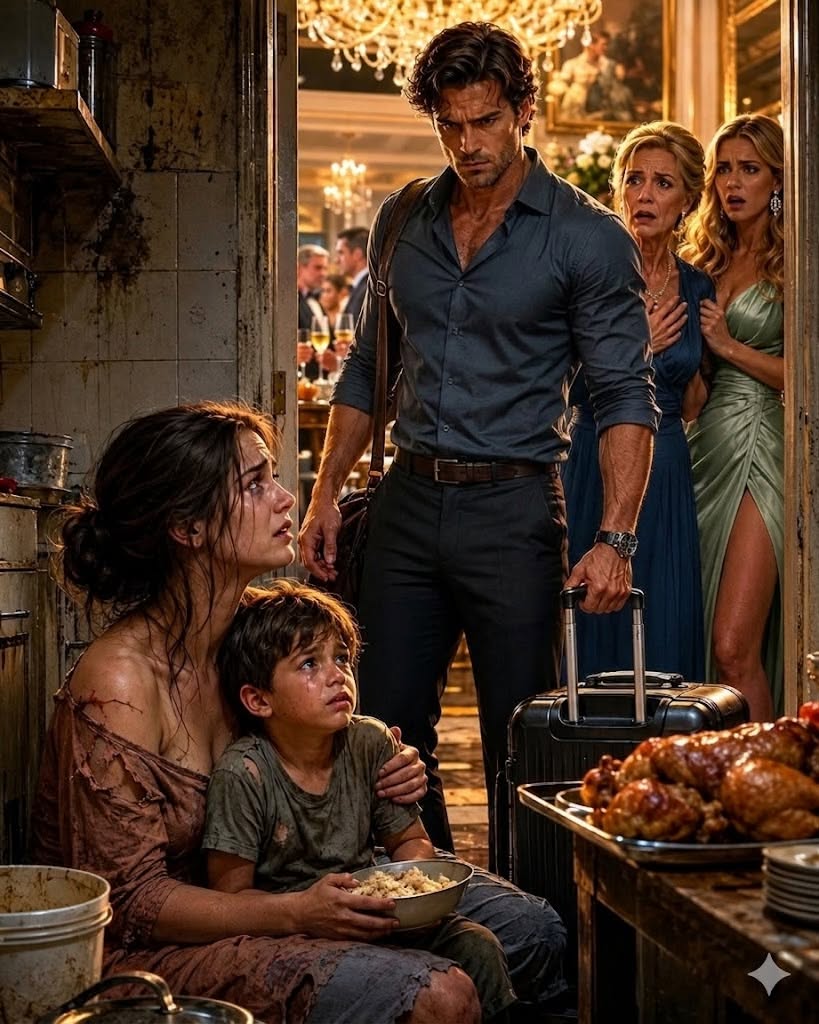
The same kitchen where Jamie had once been denied food.
Now the lights were soft. The counters were clean. The leftover party platters had been thrown away. A pot simmered on the stove, filling the air with ginger and honey.
She handed me a cup.
“You should sleep,” she said.
“So should you.”
She smiled faintly. “I think my body forgot how.”
We stood side by side while the sky outside turned silver.
“Are you all right?” I asked.
She looked at the service door.
For a moment, I thought she might cry.
Instead, she walked to it, opened it, and looked out at the dim little room beyond the kitchen—the plastic stool, the bulb, the stained wall, the corner where she had slept beside Jamie.
“I used to think this doorway was the whole world,” she said. “Inside was light. Outside was us.”
I stood beside her.
“What do you want done with it?”
She was quiet for a long time.
Then she said, “Not destroyed.”
I looked at her in surprise.
She touched the frame of the door. “I don’t want to pretend it didn’t happen. But I don’t want it to stay a place of shame either.”
“What should it become?”
Her eyes shifted toward the window, where the first morning light had begun to touch the neglected garden.
“A place where no one has to ask permission to eat.”
Three weeks later, the mansion began to change.
Not all at once. Healing never arrives like a marching band. It comes like water finding cracks, slowly softening what seemed impossible to move.
Mr. Henson handled the legal work. The trust Evelyn had left was real, though tangled in years of neglect and hidden documents. Gertrude had not been able to access it directly, but she had successfully delayed it, buried it, and frightened people away from pursuing it. Thomas, ashamed of his part, cooperated fully.
The monthly payments to Harbor Light had not been for services in recent years. They had been silence money. Thomas admitted it plainly, his voice low, his eyes fixed on the table.
“I told myself I was protecting Evelyn’s memory from scandal,” he said. “But the truth is, I was protecting my guilt.”
Prudence sat through every meeting.
At first, I did not know why. I thought perhaps she feared what would happen to her share of the trust, or what charges might come. But slowly, I understood.
She was listening because she had spent too many years not listening.
One afternoon, she came to Sarah in the garden.
I watched from the balcony, unseen.
Sarah was kneeling near the old service entrance, pulling weeds from a cracked flower bed. Jamie was nearby, digging with a child’s seriousness, his tongue caught between his teeth.
Prudence stood several feet away, holding a pair of gloves.
Sarah looked up but said nothing.
My sister shifted awkwardly.
“I can help,” she said.
Sarah’s hands stilled.
Jamie looked between them, uncertain.
Prudence swallowed. “I mean, not because I think helping fixes anything. It doesn’t. I just… I can pull weeds.”
Sarah studied her.
Then she pointed to a patch near the wall.
“Start there.”
Prudence nodded and knelt.
For nearly an hour, neither woman spoke.
Yet something important happened in that silence.
Not forgiveness.
Not friendship.
Something smaller and more honest.
A first thread.
Later, Jamie came upstairs with dirt on his cheeks and announced, “Aunt Prudence doesn’t know worms are helpers.”
Sarah laughed.
It was the first real laugh I had heard from her since coming home.
I held onto that sound like a gift.
Gertrude moved into the east wing while the legal proceedings unfolded. Mr. Henson advised a formal separation of residence and accounts. My mother objected, of course. She objected to everything—locks changed, staff dismissed, bank records reviewed, Sarah’s name restored on household decisions, Jamie enrolled properly in school.
But the house no longer bent around her displeasure.
One evening, I found her in the old sitting room surrounded by boxes.
She had been packing her clothes herself, refusing help. Expensive dresses lay folded beside framed photographs of parties, charity dinners, church events, all the proof of a life she had built for watching eyes.
She did not look up when I entered.
“Have you come to supervise?”
“No.”
“Then what?”
I held out one of my father’s letters.
“I read it.”
Her hands paused over a silk scarf.
“He loved you once,” I said.
She laughed under her breath. “That is supposed to comfort me?”
“No. It just seemed true.”
Her eyes remained down.
“He wrote that you were brave,” I continued. “Stubborn. Proud. He said you could walk into a room full of people who underestimated you and make them regret it.”
Her mouth trembled.
I stepped closer. “He also wrote that he was afraid you would rather burn the bridge than admit you needed help crossing it.”
She gripped the scarf tightly.
For a long time, she said nothing.
Then, in a voice barely above a whisper, she asked, “Did he say he hated me?”
“No.”
Her eyes filled, though no tears fell.
“I hated him enough for both of us,” she said.
The room was dim, lit by one lamp beside the window. Outside, Jamie’s laughter drifted from the garden where Sarah was pushing him on the swing we had installed that morning.
My mother closed her eyes at the sound.
“I hear him laugh now,” she said, “and I think of you. You laughed like that before your father left.”
“He didn’t leave.”
She opened her eyes.
For once, she did not argue.
“I know,” she said.
Those two words were so small, yet they seemed to take every bit of strength she had.
“I know.”
I sat across from her.
“Why did you do it to Jamie?”
She looked toward the window.
A tear finally slipped down her cheek.
“Because when I saw Sarah with him, I saw what I never had after your father died.”
“What?”
“Someone he trusted more than me.”
I shook my head slowly. “He was a child. Trust isn’t a throne.”
She wiped her face with sudden irritation, as if angry the tear had escaped.
“I don’t expect forgiveness.”
“I’m not offering it tonight.”
Her shoulders sagged.
“But I need the truth. All of it. Not because I want to punish you forever. Because my son deserves a family that doesn’t make him inherit lies.”
Gertrude looked at me then.
Really looked.
Not as a possession. Not as an ungrateful son. As a man.
“The papers for guardianship,” she said. “They were in the bottom drawer.”
I waited.
“I never filed them.”
“Why?”
She looked back toward the window.
“Because Jamie made me a card.”
My breath caught.
“What card?”
“For Grandparents’ Day. Sarah helped him. It was on cheap paper. He drew the house too big and himself too small.” Her voice cracked. “He wrote, ‘I hope Grandma smiles at me today.’”
She covered her mouth, fighting something inside herself.
“I put the papers away after that.”
The revelation did not erase anything.
But it changed the shape of the hurt.
Even in the middle of everything, Jamie had reached toward her.
And somewhere, buried beneath pride and fear and bitterness, something human had reached back—too weakly, too late, but real.
“Where is the card?” I asked.
She pointed to a small jewelry box.
I opened it.
There it was, folded carefully beneath pearls and brooches.
A crayon mansion. A tiny boy. The words written unevenly.
I hope Grandma smiles at me today.
I stood there for a long time, holding that fragile piece of paper.
Then I said, “You’re going to give this to Jamie someday. But not until you can tell him why you kept it.”
She nodded once.
It was the first time she had accepted a condition without fighting.
Months passed.
The service room became the first project Sarah truly claimed.
We cleaned it together.
Not servants. Not contractors.
Us.
I scrubbed the walls. Prudence painted the door. Mrs. Alvarez brought plants. Jamie decorated stepping stones with colored handprints. Thomas donated shelves, tables, and a commercial refrigerator. The cracked concrete floor was repaired, the single yellow bulb replaced with warm lights, and the sour smell that had once lived there disappeared beneath fresh paint, bread, and basil from the garden.
Sarah named it The Open Table.
At first, it was just a weekend pantry for families Mrs. Alvarez knew from church and the neighborhood. Then it grew. A retired teacher offered tutoring. A nurse volunteered health checkups. A local grocer donated produce. The mansion that had once hidden hunger behind its walls began quietly feeding people through the very door where Sarah and Jamie had once been told to wait.
The first Saturday it opened, Sarah stood nervously beside the entrance in a blue dress I had bought her—not expensive, not showy, just soft and bright.
Jamie tugged at her hand. “Mommy, what if nobody comes?”
Sarah looked at the tables of bread, fruit, soup, and school supplies.
“Then we’ll have a lot of soup,” she said.
He giggled.
But people came.
One mother with two children.
Then an older man.
Then a young couple.
Then families from streets we had driven past for years without noticing.
Sarah greeted each person with the same gentle sentence.
“Come in. Take what you need.”
I watched her say it again and again.
Each time, her voice grew steadier.
Prudence worked near the back, packing bags of groceries. She wore jeans, no jewelry, her hair tied back. When a little girl asked for extra apples, Prudence gave her three and winked.
Later, she found me by the garden wall.
“I’m going back to school,” she said.
“For what?”
“Social work.”
I looked at her.
She gave a nervous laugh. “I know. It sounds ridiculous.”
“No,” I said. “It sounds hard.”
Her smile faded into something grateful.
“I don’t expect Sarah to trust me.”
“She may not for a long time.”
“I know.”
“What made you decide?”
She looked through the open door at The Open Table, where Sarah was kneeling to tie a child’s shoe.
“Because I spent years learning how to look away,” Prudence said. “I want to spend the rest of my life learning how not to.”
That was the day I began to believe my sister might truly change.
Not because she cried.
Not because she apologized.
Because she chose a difficult road with no applause waiting at the end.
As for Thomas, his place in our lives came slowly.
At first, I met him only with lawyers. Then over coffee. Then, one afternoon, he brought a small wooden box to the house.
“This belonged to your father,” he said.
Inside was a compass, scratched and worn.
“He carried it when he worked road crews,” Thomas explained. “He said a man should always know which way home is, even when he’s lost.”
I turned the compass in my palm.
The needle trembled, then steadied.
Jamie climbed onto the chair beside me. “Is it treasure?”
Thomas smiled. “In a way.”
Jamie looked at him seriously. “Are you my grandpa?”
Thomas’s eyes widened.
I almost corrected him, but Thomas answered first.
“No,” he said softly. “I’m your great-uncle.”
Jamie considered this. “That’s a lot of words.”
“It is.”
“Can I call you Uncle Tom?”
Thomas’s face broke into the first unguarded smile I had seen from him.
“Yes,” he said. “I would like that very much.”
And just like that, another door opened.
The legal resolution came almost a year after the night I returned.
There was no dramatic courtroom scene. No shouting in front of strangers. Mr. Henson guided us through mediation, financial recovery, trust restoration, and formal agreements. Gertrude surrendered control of all accounts. A portion of misused funds was repaid through the sale of jewelry, club memberships, and investments she had made in her own name with money meant for Sarah and Jamie.
Prudence signed a statement admitting her role in blocking communication and misrepresenting Sarah’s condition. It cost her dearly, but she did it without excuse.
Gertrude avoided prison through cooperation, repayment, and Sarah’s request that the matter remain civil wherever possible.
When Mr. Henson asked Sarah privately why she had chosen that path, she answered in a way I never forgot.
“I don’t want Jamie’s story to become about punishment,” she said. “I want it to become about freedom.”
But freedom did not mean pretending.
Gertrude moved out of the mansion permanently and into a modest townhouse purchased with her own remaining funds. Contact with Jamie was limited and supervised at first. She was required to attend counseling if she wanted any relationship with him.
For months, she sent no letters.
Then, one afternoon, an envelope arrived addressed in her careful handwriting.
Not to me.
To Sarah.
Sarah stared at it for a long time before opening it.
I sat beside her, but she read it silently.
When she finished, tears stood in her eyes—not the broken kind, but the complicated kind.
“What does it say?” I asked.
She handed it to me.
It was not long.
Sarah,
I have written this letter many times and destroyed it because each version tried to make me look better than I was. I will not do that here.
I was cruel to you. I was cruel to Jamie. I used my fear as if it were proof that I had the right to control everyone. I told myself you were taking my son from me because it was easier than admitting I had made myself impossible to love closely.
You survived what I should have protected you from. I am ashamed that the danger was me.
I do not ask you to forgive me. I ask only that one day, when Jamie is old enough, you tell him his grandmother is learning how to tell the truth.
Gertrude.
Sarah folded the letter carefully.
“What do you want to do?” I asked.
She looked through the window at Jamie playing in the garden with Mrs. Alvarez’s grandson.
“I want to keep it,” she said. “Not as a key. As a record.”
Then she placed it in a drawer beside Jamie’s Grandparents’ Day card.
Two truths, side by side.
The wound.
And the beginning of repair.
Five years after my return, The Open Table had become something none of us could have imagined.
The back of the mansion was no longer hidden. The service entrance had been widened into a bright community hall with blue doors and wide windows. The garden had grown wild and beautiful, full of tomatoes, herbs, sunflowers, and the hand-painted stones Jamie refused to let anyone move.
Sarah directed the center.
She had taken classes in nonprofit management, learned grants and schedules and building codes, and discovered a strength that had nothing to do with surviving quietly. People listened when she spoke now. Not because she was loud, but because every word came from a place that had been tested.
Jamie was eleven, taller, stronger, with his father’s stubborn jaw and his mother’s gentle eyes. He loved science, pancakes, and asking questions adults were not always ready to answer.
One spring afternoon, the center hosted its largest event yet: a scholarship dinner for children of overseas workers, caregivers, and families separated by labor migration. I had funded the first scholarships in honor of my father and Evelyn. Prudence, now finishing her social work degree, helped design the family support program attached to it.
The dinner took place not in the front ballroom, but outside behind the house.
Exactly where everything had begun.
Long tables stretched beneath strings of warm lights. Children ran between chairs. Volunteers served food. Mrs. Alvarez supervised the kitchen like a general. Thomas sat near the garden wall, laughing as Jamie showed him how to operate a small telescope.
Prudence arrived with folders under one arm and dirt on her shoes.
“You’re late,” I said.
She smiled. “I was helping a family file school forms.”
“That excuse works on me now.”
“It better. I practiced it.”
She glanced toward Sarah, who was arranging name cards at the first table.
“Do you think she’ll ever really forgive me?” Prudence asked.
I followed her gaze.
“I don’t know.”
Prudence nodded, accepting the answer.
Then Sarah looked up and motioned her over.
Prudence froze.
“What does that mean?” she whispered.
“It means go.”
She went.
Sarah handed her a stack of cards and pointed toward the children’s table. Prudence listened closely, nodded, and got to work.
A small thing.
But sometimes grace arrives disguised as an errand.
Near sunset, a taxi stopped at the front gate.
I saw it from across the garden.
For a moment, I thought it was another guest. Then the back door opened, and my mother stepped out.
Gertrude was older now. Smaller. Her hair, once dyed perfectly dark, had gone silver at the roots. She wore a simple navy dress and carried a paper bag in both hands.
She stopped at the edge of the garden, uncertain.
No one rushed toward her.
No one turned away either.
Sarah saw her first.
For several seconds, my wife stood still.
Then she walked over.
I started to follow, but Sarah lifted one hand slightly.
Not stopping me harshly.
Just saying: let me.
I stayed where I was.
Gertrude and Sarah spoke too quietly for me to hear. My mother held out the paper bag. Sarah looked inside.
Then Sarah covered her mouth.
Jamie noticed and ran over.
“What is it?” he asked.
Gertrude knelt slowly, with effort.
From the bag, she took a framed drawing.
The crayon mansion.
The tiny boy.
I hope Grandma smiles at me today.
Jamie stared at it.
“I made that,” he said.
“Yes,” Gertrude replied.
Her voice trembled, but she did not look away.
“I kept it because it told the truth before I was ready to.”
Jamie looked confused. “What truth?”
Gertrude swallowed.
“That you were kind to me when I had not been kind to you.”
The garden grew quieter around them, though people pretended not to listen.
Jamie looked at Sarah.
Sarah’s eyes filled, but she nodded once.
Jamie turned back to Gertrude. “Are you still mean?”
A few nearby adults coughed into their hands.
Gertrude let out a sound that might have been a laugh and might have been a sob.
“I am trying not to be.”
Jamie considered this with great seriousness.
Then he said, “At school, Ms. Carter says trying counts, but only if you keep doing it.”
Gertrude bowed her head. “Ms. Carter is wise.”
Jamie looked at the framed drawing again. “You can put it inside.”
My mother’s eyes lifted.
“Inside?”
“In The Open Table,” Jamie said. “Not the mansion. The good inside.”
Sarah pressed a hand to her heart.
Gertrude looked at me across the garden.
There was no demand in her eyes now. No performance. No claim.
Only a question she had no right to ask but had finally learned not to force.
I nodded.
Together, we walked into The Open Table.
The room smelled of bread and lemon polish. Shelves were stocked. Children’s drawings covered one wall. Near the entrance hung photographs: Sarah and Jamie planting the first garden bed; Mrs. Alvarez carrying soup; Prudence painting the blue door; Thomas holding my father’s compass; me standing beside Sarah on opening day, both of us looking tired and hopeful.
Gertrude stood before the empty space near the doorway.
Jamie pointed. “There.”
My mother hung the drawing with careful hands.
When she stepped back, the little crayon house looked different in its frame. Not sadder. Not erased. Transformed by what surrounded it.
Sarah stood beside me.
“Do you remember what I said this room should be?” she whispered.
“A place where no one has to ask permission to eat.”
She slipped her hand into mine.
Outside, someone tapped a glass.
It was time for speeches.
I had prepared one, but when I stood before the crowd, the paper in my pocket suddenly felt unnecessary.
I looked at Sarah. At Jamie. At Prudence. At Thomas. At my mother standing quietly near the back wall. At Mrs. Alvarez pretending not to cry.
Then I looked at the families gathered beneath the lights.
“I went far away once,” I began, “because I believed love meant providing. I thought if I worked hard enough, sent enough money, built enough walls, my family would be safe.”
The garden settled.
“But love is not a wall. It is a door. It has to open both ways. It has to let truth in. It has to let voices be heard before silence becomes a prison.”
Sarah’s eyes shone.
I took out my father’s compass and held it up.
“My father carried this. I grew up believing he abandoned us. I learned later that he had spent the last days of his life trying to come home to his children.”
A soft murmur moved through the crowd.
“For years, I thought home was a place you could build with money. But home is not marble or chandeliers or gates. Home is where a child can ask for food without fear. Where a wife can speak and be believed. Where a sister can admit she was wrong and choose better. Where even painful truth can become a foundation if we are brave enough to stand on it.”
Jamie grinned at me from the front row.
I smiled back.
“So tonight, these scholarships are given in honor of Michael Mercer and Evelyn Vale, two people whose love was hidden but not destroyed. And in honor of Sarah, who taught me that survival can become service. And Jamie, who taught us that a small drawing can do what years of arguments could not.”
Jamie sat up straighter.
The crowd laughed warmly.
I looked toward my mother.
“And in honor of every person learning, however late, that love is not possession. It is responsibility.”
Gertrude closed her eyes.
When I finished, people rose to their feet.
Not all at once.
First Mrs. Alvarez.
Then Thomas.
Then Prudence.
Then the families, the children, the volunteers, the neighbors.
Finally, near the back, my mother stood too.
She did not clap loudly.
But she stood.
After dinner, when the sky had deepened into velvet and the first stars appeared, Jamie pulled me toward the garden.
“Daddy,” he said, “Uncle Tom says the telescope can see Saturn.”
“Then we better not keep Saturn waiting.”
Sarah joined us, carrying two cups of tea.
Prudence came with a blanket.
Thomas adjusted the telescope.
Mrs. Alvarez brought leftover cake wrapped in napkins.
And Gertrude remained near the doorway for a while, watching.
Then Jamie turned.
“Grandma,” he called, “you can look too.”
My mother froze.
Sarah’s hand tightened around mine.
No one moved.
Then Gertrude walked slowly across the grass.
Jamie stepped aside and showed her where to stand.
“Close one eye,” he instructed. “Not both. If you close both, you see nothing.”
Gertrude bent to the telescope.
A moment passed.
Then she whispered, “Oh.”
Just that.
Oh.
As if wonder had found a room inside her that bitterness had not completely locked.
Jamie smiled up at her.
“That’s Saturn,” he said proudly. “It has rings.”
Gertrude straightened and looked at him.
For once, she smiled before being asked.
A small smile.
Uncertain.
Real.
Later, when the guests had gone and the lights were being taken down, Sarah and I stood by the blue doors of The Open Table.
The mansion rose behind us, no longer a monument to sacrifice misunderstood, but a house slowly learning how to become useful.
Sarah leaned her head against my shoulder.
“Do you ever wish you had come home sooner?” she asked.
“Every day.”
She nodded.
Then she said, “I used to wish that too. But tonight, I thought about all the families who came here. All the children. All the food. All the scholarships. Maybe pain doesn’t become good just because something good grows from it. But maybe we can still choose what grows.”
I looked at the framed drawing inside the doorway.
The tiny boy.
The oversized house.
The hope written in crayon.
Then I looked at my son chasing fireflies across the grass, my sister laughing as she tried to catch one with him, Thomas holding the compass, Mrs. Alvarez packing leftovers, and my mother standing quietly beside Sarah—not forgiven fully, not restored easily, but present without ruling.
I took Sarah’s hand.
“We choose,” I said.
She smiled.
And for the first time since I had returned from Saudi Arabia, I did not feel like a man standing among ruins.
I felt like a man standing at the beginning of something built honestly.
Not from money.
Not from silence.
Not from fear.
From truth.
From courage.
From the stubborn, radiant grace of people who had every reason to close their hearts, and chose instead to open a door.
THE END