Part 2
For several seconds, nobody moved.
The music from inside the mansion kept playing as if the world had not just broken open in front of me. Laughter spilled through the walls. Glasses clinked. Somewhere in the bright front rooms, people were still eating the food I had paid for, drinking the wine I had never tasted, admiring furniture I had never sat on.
But in the dim service room behind the house, everything had gone silent.
Prudence stood frozen with the tray of roasted chicken in her hands. My mother stood behind her, one hand gripping the doorframe so tightly her knuckles turned pale.
Sarah stared at me as if she were afraid I was a dream.
Jamie blinked up from his plate, his thin little face uncertain, a grain of rice stuck to his chin.
Then he whispered, “Daddy?”
That one word nearly brought me to my knees.
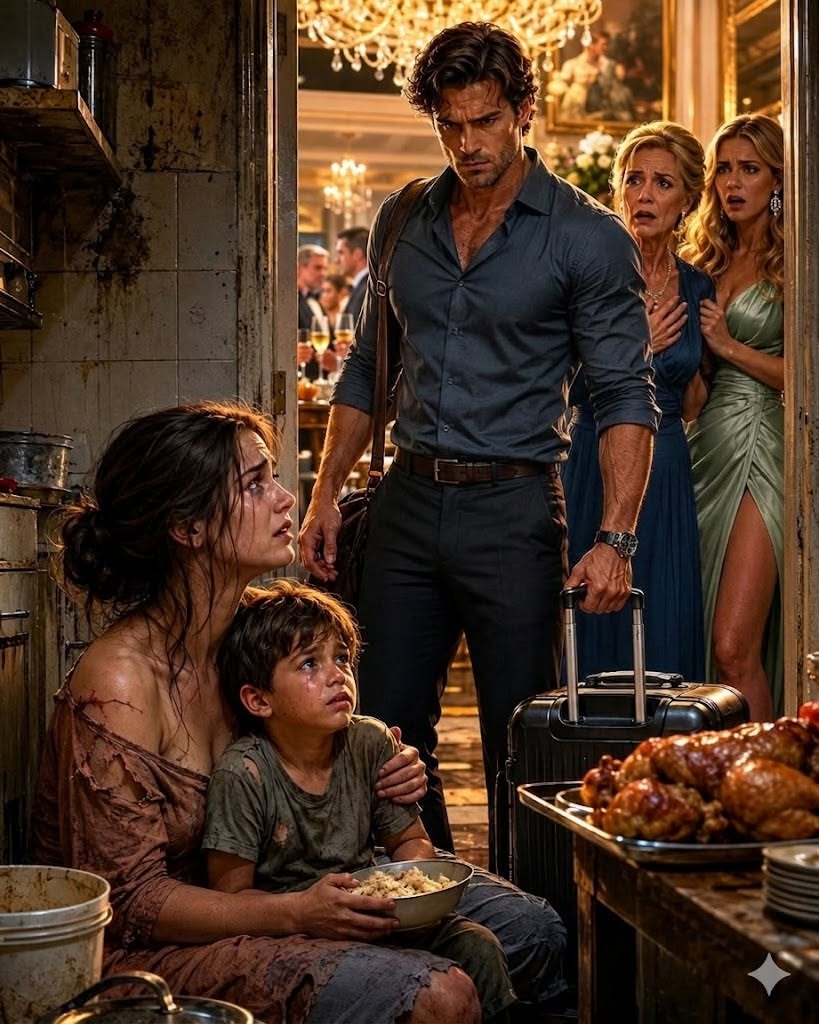
I crossed the room before I even knew I had moved. The gifts I had carried halfway across the world lay scattered behind me, chocolates rolling across the concrete, toy boxes dented, the gold bracelet still wrapped in velvet. None of it mattered.
I dropped beside my son and pulled him into my arms.
He felt too light.
Too small.
Five years ago, I had left behind a laughing toddler with round cheeks and restless hands. The child in my arms was six years old now, but his bones pressed through his shirt. He clung to me with a desperate strength that told me he had learned not to trust things that could be taken away.
“Daddy,” he said again, and then he started crying.
I held him tighter.
“I’m here,” I whispered. “I’m here, Jamie. I’m home.”
Sarah did not move.
She sat on that plastic stool with her hands folded in her lap, her eyes fixed on me, her face pale beneath the dim yellow bulb. It was not relief I saw first. It was fear.
Fear that this moment would somehow become her fault.
That realization hurt worse than the heat of Saudi ever had.
I reached for her with my free hand.
“Sarah.”
Her lips trembled. “You weren’t supposed to see this.”
I stared at her.
Those words told me more than any explanation could have.
Not “This isn’t what it looks like.”
Not “I can explain.”
But, “You weren’t supposed to see this.”
As if my return had exposed something that had been carefully hidden for years.
May you like


Behind me, Prudence found her voice.
“Daniel,” she said quickly. “Listen. You’re tired from traveling. This is a misunderstanding.”
I turned my head slowly.
The sound of my own name in her mouth felt strange, almost insulting after what I had just seen.
“A misunderstanding?”
She swallowed. Her eyes darted to my mother, then back to me.
“Yes. Sarah has been difficult. She refused help. Mother tried to—”
“Stop.”
The word came out quietly, but it landed hard enough to silence her.
My mother stepped forward then, gathering herself like an actress remembering her lines.
“Daniel, my son, thank God you’re home,” she said, forcing warmth into her voice. “We didn’t expect you. You should have called. Look at you, so thin. Come inside, wash up, eat something. We’ll discuss all this properly.”
I stared at her.
Five years of phone calls echoed in my head.
Sarah is resting.
Jamie is at school.
They’re at the mall.
She’s busy right now.
Every lie spoken in the same calm voice.
“Where did the money go?” I asked.
My mother’s face tightened.
“This is not the place.”
“It is exactly the place.”
Guests were laughing inside. Music boomed through polished halls. My wife and son sat beside spoiled rice beneath a servant’s bulb.
There could not have been a more perfect place.
“I sent you one thousand eight hundred dollars every month,” I said. “For five years.”
Prudence glanced down.
My mother lifted her chin. “And I used it for the family.”
I looked around the service room.
“At what point did Sarah and Jamie stop being family?”
Sarah flinched.
My mother noticed, then quickly softened her expression.
“Daniel, you don’t understand what things were like while you were gone. Sarah struggled. She was depressed. She didn’t manage the household. Bills came. Repairs were needed. Prudence helped me keep everything together.”
Prudence nodded eagerly. “Exactly. We protected the property. We kept the house respectable.”
I looked at my sister’s silk dress, her manicured nails, the diamond earrings sparkling beneath the kitchen light.
“Respectable,” I repeated.
Then Jamie shifted in my arms.
“Daddy,” he whispered, “can Mommy come too?”
I looked down at him. “Come where?”
“To the big rooms.”
The question was so innocent, so small, it crushed whatever control I had left.
I looked at Sarah.
Her eyes filled instantly, but she lowered her gaze, ashamed of tears she had no reason to hide.
I stood with Jamie in my arms.
“Sarah, get your things.”
My mother stiffened. “Daniel.”
I did not look at her.
“Sarah,” I said again, gently this time. “Pack whatever you need.”
She rose slowly, as if she expected someone to stop her. Her hands trembled as she gathered the pillow, the two outfits, the little cooking pot. That was all. Five years of my work, and my wife could carry her life in one pair of arms.
Prudence blocked the doorway.
“Don’t be dramatic,” she said, her voice shaking. “There are guests inside.”
I stepped toward her.
“Move.”
She did.
Not because I shouted. I didn’t.
She moved because for the first time in her life, she saw that I was no longer the brother who would forgive anything to keep peace in the family.
My mother followed us into the kitchen. The room was bright and spotless, smelling of roasted meat, butter, and expensive candles. Silver platters covered the counters. Caterers moved nervously along the edges, pretending not to hear.
The moment Sarah entered, one of the maids looked at her with open pity.
So people knew.
Maybe not everything.
But enough.
That made the betrayal deeper.
At the threshold to the main hall, the party noise grew louder. Men in suits and women in glittering dresses turned as we entered. Their smiles faded one by one.
I knew some of them. Old neighbors. Businessmen. Church acquaintances. People my mother had always been desperate to impress.
Gertrude moved quickly to my side, whispering through her smile.
“Daniel, please. Not in front of everyone.”
I stopped in the middle of the grand hall.
Above us hung the crystal chandelier I had sent extra money to install after my mother told me Sarah had dreamed of it.
Sarah had not even been allowed to stand beneath it.
Jamie tucked his face against my neck.
I looked around at the guests.
“My wife and son are tired,” I said. “The party is over.”
A confused murmur passed through the room.
My mother’s smile trembled.
“Daniel is emotional,” she announced, raising her voice. “He just returned from overseas. Please, everyone, enjoy yourselves. There’s no need to leave.”
I turned to her.
“Yes,” I said. “There is.”
Something in my tone settled the matter.
People began collecting purses and coats. A few offered awkward goodbyes. Some avoided my eyes. Others stared at Sarah, then at the grand staircase, the polished floors, the enormous vases filled with flowers, and I could almost see them beginning to understand.
My mother watched her audience disappear.
For her, that seemed to hurt more than anything.
Within twenty minutes, the mansion was quiet.
The caterers left. Prudence retreated to the living room, pale and furious. My mother stood by the staircase, her posture rigid.
Sarah waited near the front door with Jamie and their small bundle of belongings.
I could have taken them away that instant.
Part of me wanted to. I wanted to drive until the mansion vanished behind us and never look back.
But another part of me knew that running would leave too many shadows alive.
I needed answers.
And Sarah needed to see that the truth would no longer be buried under my mother’s voice.
“Sit down,” I said.
My mother blinked. “Excuse me?”
“In the dining room.”
She looked as if she wanted to refuse, but then her gaze moved to the windows. Beyond the glass, a few guests were still pulling out of the driveway. Reputation had always been her leash. She followed.
We sat at the long dining table.
I kept Jamie on my lap. Sarah sat beside me, close enough that her shoulder touched mine. That small contact felt like both a blessing and an apology.
Prudence entered last and sat opposite us, arms crossed.
My mother took the head of the table.
The same chair I had imagined sitting in when I came home.
“Start talking,” I said.
She folded her hands. “You are tired. You are upset. Your wife has clearly filled your head with—”
“She hasn’t said anything.”
My mother’s mouth closed.
“That’s what scares me most,” I continued. “I found them like this before Sarah had the chance to speak.”
Sarah whispered my name.
I looked at her.
“You don’t have to defend anyone tonight,” I said. “Not me. Not them. Not yourself.”
Her eyes filled again, but this time she did not lower them.
I turned back to my mother.
“Where did the money go?”
She sighed, the way she used to when I was a boy and had disappointed her by asking questions she didn’t want to answer.
“Into the house,” she said.
“This house was already paid for.”
“There are expenses you don’t understand. Taxes. Staff. Maintenance. Social obligations.”
“Social obligations?” I repeated.
Prudence leaned forward. “You wanted the family to have status. Don’t pretend you didn’t. You sent money because you wanted us to maintain the house properly.”
“I sent money for my wife and son.”
My sister’s eyes flashed. “And what about Mother? Was she supposed to live like a servant in her own son’s house?”
I stared at her.
“This was never her house.”
The words changed the room.
My mother’s face hardened.
For years, she had spoken of the mansion as if it had risen from her own sacrifice. In her stories, I was not a husband or father working abroad. I was an extension of her ambitions.
“My name is on the papers,” I said. “Sarah’s name is on the papers. Not yours.”
My mother’s voice dropped. “Be careful, Daniel.”
It was the tone she had used when I was twelve, when she caught me hiding coins to buy Sarah a birthday gift back when Sarah and I were only neighborhood children. That tone had once made me feel guilty for wanting anything she had not chosen for me.
But I was no longer twelve.
“No,” I said. “You be careful.”
Jamie shifted again. He was trying to stay awake, but his head kept nodding against my chest.
Sarah touched his hair. “He needs to sleep.”
The tenderness in her voice broke through the anger for a moment.
“You’re right,” I said.
I stood.
My mother rose too quickly. “Where are you taking him?”
“To his room.”
She looked at Prudence.
That tiny glance did not escape me.
“What?” I asked.
Sarah’s hand tightened around her bundle.
“Daniel,” she said quietly, “Jamie doesn’t have a room inside.”
The dining room seemed to breathe around us.
I looked at my mother.
“You told me his room had a race car bed.”
My mother said nothing.
“You sent pictures.”
Prudence looked away.
I remembered those pictures. Bright blue walls. Shelves of toys. A race car bed with red wheels. Jamie had been smiling in one of the photos, or so I thought. Now I wondered when that picture had been taken. Whether he had been allowed in that room only long enough to pose.
“Show me,” I said.
Nobody moved.
“Now.”
My mother’s lips pressed together. Then she led the way upstairs.
The second floor hallway smelled of roses and furniture polish. Family portraits lined the walls, but there were none of Sarah. None of Jamie. I had never noticed through video calls because my mother always chose the angles.
At the end of the hall, she opened a door.
The room was exactly like the pictures.
Blue walls. Race car bed. Toy shelves. Model airplanes hanging from the ceiling.
But everything was too clean.
Untouched.
A showroom pretending to be a childhood.
Jamie lifted his head from my shoulder.
His eyes widened.
“Daddy,” he whispered. “That’s the room Grandma shows people.”
I closed my eyes.
Sarah let out a small breath beside me, the kind people make when pain is too familiar to surprise them.
I turned to my mother. “He never slept here?”
She straightened. “He made messes. He broke things. I had to preserve—”
“He was a child.”
“He was undisciplined.”
Sarah spoke then, her voice soft but clear.
“He cried for you at night,” she said. “That was his great offense.”
My mother looked at her sharply.
Sarah took one step closer to me, but did not retreat.
“He cried because he missed his father. Gertrude said the sound disturbed the household. So we were moved downstairs. Then outside the kitchen. Then to the service room.”
“Moved,” I repeated, because the word was too gentle for what had happened.
Prudence muttered, “You always make yourself sound like a victim.”
Sarah looked at her.
For the first time since I had arrived, I saw something strong and steady rise in my wife’s face.
“I kept quiet because Daniel loved his mother,” she said. “I kept quiet because you told me he would believe you. I kept quiet because when Jamie got sick, you said you would stop paying for the doctor if I complained.”
My breath stopped.
Jamie got sick.
I looked at Sarah. “What sickness?”
Her strength faltered.
My mother snapped, “A cold. Children get colds.”
Sarah turned to me fully.
“It was pneumonia.”
The hallway blurred.
“When?”
“Two winters ago.”
I remembered that winter. I had been on a construction site outside Riyadh, sleeping four hours a night, saving extra because my mother said there had been storm damage to the roof.
Sarah continued, “I called you. Your number didn’t connect. I emailed. I sent messages. Then your mother told me you were too busy and angry that I kept disturbing you.”
My voice came out rough. “I never got anything.”
“I know that now.”
“How?”
Sarah’s eyes moved to Prudence.
My sister went pale.
I looked at her.
“What did you do?”
Prudence crossed her arms tighter. “Mother handled the accounts.”
“The phone,” Sarah whispered. “The one you sent me. Prudence took it after you left. She said international calls were expensive and she would arrange times for us to speak.”
I remembered the calls. Always short. Always with my mother present. Always excuses why Sarah couldn’t come to the phone.
Shopping.
Sleeping.
At the salon.
Busy.
Sarah had never been unavailable.
She had been blocked.
I looked at Prudence, and the little girl who once followed me around begging me to fix her bicycle vanished completely. In her place stood a woman I did not recognize.
“You kept my wife from me?”
Her mouth trembled. “I did what Mother said.”
It was the first honest sentence she had spoken all night.
My mother’s eyes flashed.
“Prudence.”
But it was too late.
Something had cracked between them.
I turned to Sarah. “Where did the doctor money come from?”
Her eyes dropped.
“Mrs. Alvarez.”
“The neighbor?”
Sarah nodded. “She helped. Quietly. She brought soup. Medicine. Sometimes food for Jamie. When your mother found out, she told the gate guards not to let her in anymore.”
Jamie’s arms tightened around my neck.
I kissed his hair, unable to speak for a moment.
Then I carried him into the race car room.
My mother started forward. “Daniel, don’t. He’ll dirty the blankets.”
I turned so sharply she stopped.
“He will sleep in his bed.”
Sarah pulled back the covers. Jamie looked uncertain, as if beds could be traps. I laid him down gently, removed his shoes, and tucked the blanket under his chin.
He grabbed my wrist.
“Will you still be here when I wake up?”
I sat on the edge of the bed.
“Yes.”
“Promise?”
“I promise.”
He studied my face with serious eyes far older than six.
Then he whispered, “Mommy said promises can get lost when people go far away.”
I looked at Sarah.
Her face crumpled.
I leaned down and kissed Jamie’s forehead.
“Then I’ll make this promise right here,” I said. “So it knows where to stay.”
His eyes closed slowly, exhaustion winning at last.
When he slept, I stood.
The hallway waited.
So did the truth.
I went downstairs with Sarah beside me. My mother and Prudence followed at a distance, no longer leading in their own kingdom.
In the dining room, I asked Sarah to tell me everything.
Not all at once. Not if it hurt too much. But enough.
She sat with both hands around a glass of water and spoke in a quiet voice that made the story worse, somehow, because she did not exaggerate. She simply laid five years on the table.
At first, after I left, Gertrude had been kind in front of neighbors. She told everyone Sarah was delicate, that she needed rest, that she was adjusting poorly to my absence. Then she began controlling the money. Small things first. Groceries chosen for the household but not for Sarah. Clothing purchases delayed. Jamie’s school enrollment “postponed” because he was “too attached” to his mother.
Then came the restrictions.
Sarah was told not to answer the house phone because international business calls might come through. Her own phone disappeared. Letters she wrote to me were never mailed. When she asked about the money, Gertrude said I had reduced the amount because work was uncertain.
“I believed her at first,” Sarah said. “Why wouldn’t I? She was your mother.”
I stared at the table.
That was the cruelest part.
My love for my mother had been used as a weapon against my wife.
Prudence sat silently, her eyes red now but dry. She looked smaller than she had at the party, stripped of perfume and applause.
“Why?” I asked her.
She lifted her head.
The question seemed to frighten her more than my anger.
“Because Mother said Sarah would take you away from us completely,” she said.
Sarah looked down.
I waited.
Prudence swallowed. “She said once you built this house and made enough money, you’d forget who raised you. That Sarah would convince you to leave us with nothing. Mother said we deserved security too.”
“So you starved a child for security?”
Prudence flinched.
“I didn’t know it was that bad.”
Sarah looked at her then.
“You walked past us every day.”
Prudence’s lips parted, but no defense came.
My mother stood abruptly.
“This is becoming theatrical.”
I almost laughed. Not from humor. From disbelief.
“Theatrical?”
“Yes,” she said. “You come home tired and emotional. Sarah tells her version. Prudence is frightened into saying things she doesn’t mean. But I kept this house standing. I protected your investment. I gave you a place to return to.”
I looked around the dining room.
The polished table. The imported curtains. The gold-framed mirror above the sideboard.
A place to return to.
But my family had been hidden behind it.
“I want the accounts,” I said.
My mother’s expression froze.
“What accounts?”
“Bank records. Transfers. Receipts. Everything.”
“That will take time.”
“You have until morning.”
She smiled then.
It was faint, bitter, and strangely calm.
“You think you can just come back and take control?”
“Yes.”
Her smile faded.
“Money changes men,” she said. “Before Saudi, you were a good son.”
Before Saudi, I had been obedient.
There is a difference.
I turned to Sarah. “Do you want to stay here tonight or leave?”
Her eyes widened slightly, as if no one had asked what she wanted in years.
She looked toward the ceiling, where Jamie slept.
“Jamie is so tired,” she said. “Moving him tonight might scare him.”
“Then we stay.”
My mother’s eyebrows lifted, almost triumphant.
I added, “Sarah and Jamie take the main bedroom. I’ll sleep by the door.”
The triumph vanished.
“That is my room,” my mother said.
“No,” I replied. “It is mine. It was always meant for my wife.”
Prudence looked at the table.
My mother stared at me as though she were seeing a stranger.
Maybe she was.
Because the man who had left five years ago would have begged for peace.
The man who returned had found out what peace had cost.
Sarah tried to protest when I led her upstairs, but I stopped gently at the bedroom door.
“Please,” I said. “Let me do one thing right tonight.”
The main bedroom was enormous, with a balcony overlooking the front lawn and a bed large enough to make the service room feel even more unforgivable. Sarah stood in the doorway, unable to step inside.
I understood.
Luxury can feel cruel when it has been withheld as punishment.
I opened the closet. Half of it was filled with my mother’s clothes. Expensive coats. Silk blouses. Shoes in neat rows. I closed it without comment.
“Tomorrow,” I said.
Sarah gave a tired nod.
I found one of the T-shirts I had stored before leaving and gave it to her to sleep in. She held it to her face for a moment.
“I used to keep one under my pillow,” she whispered. “Then it disappeared.”
I did not ask who took it.
We both knew.
After she showered, she came out looking smaller wrapped in a robe too large for her. Her hair was damp, her face scrubbed clean of the dust and exhaustion she had carried like a second skin. She looked older than when I had left, but not less beautiful. Never less.
She sat on the bed, hands folded.
“I should have fought harder,” she said.
“No.”
The word came fast.
She looked at me.
“I should have found a way to reach you.”
“Sarah, no.”
“I let Jamie suffer.”
I knelt in front of her.
“You kept him alive.”
Tears spilled down her cheeks.
“I hated you sometimes,” she whispered.
The honesty struck deep, but I deserved it.
“I know.”
“I thought you forgot us.”
“I know.”
“I thought maybe your mother was right. That once you were away, we became a burden.”
I took her hands carefully, afraid she might pull away.
“You were the reason I stayed alive over there.”
She closed her eyes.
“I talked to you in my head every night,” I said. “When the heat was so bad I couldn’t breathe. When my hands bled. When I wanted to quit. I told myself Sarah and Jamie are waiting. Sarah and Jamie are safe. Sarah and Jamie have everything.”
My voice broke.
“I built my strength on a lie.”
She leaned forward then and rested her forehead against mine.
For a long time, we stayed that way.
Not healed.
Not fixed.
But no longer separated by silence.
Later, after Sarah finally slept, I sat on the floor outside Jamie’s room with my back against the wall. The house was quiet now, but not peaceful. Old houses make sounds at night—pipes ticking, wood settling, wind pressing against glass. Every noise kept me awake.
Around two in the morning, footsteps approached.
Prudence appeared at the end of the hall.
She wore a plain sweater now, her makeup washed away. Without the party clothes, she looked younger. Almost like the sister I remembered.
Almost.
She stopped a few feet away.
“Is Jamie asleep?”
“Yes.”
She nodded.
“I never hated him,” she said.
I looked up at her.
“I know that doesn’t help,” she added quickly. “I just… I need you to know I didn’t hate him.”
“What did you feel when you saw him hungry?”
Her face crumpled.
“At first, I told myself Sarah was exaggerating. Then I told myself Mother had a plan. Then I stopped looking too closely.”
That answer was more honest than any apology.
She slid down the opposite wall and sat on the floor.
“I liked the parties,” she admitted. “I liked people thinking we were important. I liked not worrying about bills. Mother said you owed us because Dad left and she sacrificed everything for you.”
Our father had left when I was ten. My mother had never recovered from the humiliation of being abandoned. She raised us, yes, but she also made sure we never forgot the debt.
“She sacrificed,” I said. “But that didn’t give her ownership of my life.”
Prudence wiped her eyes.
“I know that now.”
“Do you?”
She reached into her pocket and pulled out a small flash drive.
I stared at it.
“What is that?”
“Copies,” she said. “Bank statements. Some emails. Receipts. I started saving them last year.”
“Why?”
Her hand shook.
“Because Mother scared me.”
The hallway seemed to grow colder.
“How?”
Prudence looked toward the stairs.
“She said if you came home and believed Sarah, everything would be ruined. She started moving money. Selling things. Meeting with a lawyer.”
“What lawyer?”
“I don’t know his name. But I heard them talking about guardianship.”
My stomach tightened.
“Guardianship of whom?”
She looked at Jamie’s door.
I stood slowly.
“No.”
Prudence’s voice dropped to a whisper. “She was trying to prove Sarah was unstable. That Sarah couldn’t care for Jamie. She said if the right papers were signed before you returned, you would have no choice but to accept it.”
My heart pounded.
“When?”
“I don’t know. Soon. Maybe this week.”
I took the flash drive.
“Why tell me now?”
Prudence’s face twisted with shame.
“Because tonight, when Jamie asked if his mother could come to the big rooms too, I realized I had become someone I would have hated as a child.”
For a moment, I said nothing.
Then I nodded once.
It was not forgiveness.
But it was a beginning.
“Go sleep,” I said.
She stood, hesitated, then walked away.
I stayed awake until dawn.
Morning came gray and quiet.
Jamie woke first. I heard the soft creak of his door, then saw his face peeking into the hallway.
When he saw me, relief spread across him so openly it nearly broke me again.
“You stayed,” he said.
“I promised.”
He ran into my arms.
For breakfast, I made pancakes.
Not because it solved anything, but because Jamie asked if pancakes were allowed in the big kitchen, and I wanted him to know that yes, they were. Sarah sat at the counter wrapped in my old sweater, watching us with a fragile smile.
Jamie poured too much syrup. I let him.
My mother entered halfway through breakfast wearing a cream robe and a cold expression.
She looked at Jamie at the counter.
Then at Sarah.
Then at me.
“I hope you’ve enjoyed your performance,” she said.
Jamie’s smile faded.
I set down the spatula.
“Not in front of him.”
She glanced at Jamie, then forced a thin smile.
“Sweetheart, go play in your room.”
Jamie looked at me for permission.
My mother noticed.
The look on her face told me she understood something had shifted permanently.
“It’s okay,” I told him. “Take your pancakes with you.”
Sarah walked him upstairs.
Once we were alone, my mother placed a folder on the counter.
“There,” she said. “Accounts.”
I opened it.
The top pages were neat, printed, organized. Too organized.
“Where are the originals?”
“These are sufficient.”
I looked at her.
“No, they’re not.”
Her mouth tightened. “You have been gone five years, Daniel. You don’t know what was required to maintain this family.”
“I know my son ate spoiled rice.”
She looked away.
Only for a second.
But enough.
“Did you try to take guardianship of Jamie?”
Her head snapped back.
So Prudence had told the truth.
My mother’s eyes narrowed. “Your wife is emotionally fragile.”
“She was isolated and deprived.”
“She is weak.”
“No,” I said. “She survived you.”
That one landed.
Her hand rose slightly, then dropped.
“I gave you everything,” she said, her voice trembling now with something real beneath the anger. “After your father left, I worked until my feet bled. I went without so you and Prudence could eat. I made you strong.”
“You did,” I said quietly. “And then you punished my wife and son for receiving the strength you gave me.”
Her face changed.
For a moment, I saw not a villain, not a monster, but a woman so terrified of being abandoned that she had tried to turn love into property.
It did not excuse anything.
But it made the tragedy clearer.
“I won’t let you erase me,” she whispered.
“I’m not erasing you.”
“You are choosing her.”
“I chose Sarah when I married her. I chose Jamie when he was born. That was never supposed to mean I stopped being your son.”
She laughed once, bitterly.
“That’s what men always say before they leave.”
There he was again.
My father.
A ghost sitting at every table.
“You needed help,” I said. “Not control.”
Her eyes hardened again, the vulnerability gone as quickly as it had appeared.
“You’ll regret this.”
I believed she meant it.
By noon, I had called a lawyer.
His name was Mr. Henson, an older man with a calm voice and no patience for drama. He arrived in a gray suit with a leather briefcase and listened as Sarah spoke. He did not interrupt. He did not react visibly when she described the service room, the missing phone, the blocked messages, the pneumonia.
When she finished, he looked at me.
“We need documentation,” he said. “Medical records, bank transfers, communications, any witnesses.”
“I have bank transfers from my side.”
“And we’ll subpoena the rest if needed.”
Sarah went pale at the word.
Mr. Henson softened. “This does not have to become public unless necessary. The first priority is safety, stability, and control of your assets.”
Control of your assets.
I thought of the house, the money, the accounts.
Then I looked at Jamie building a tower of toy blocks in the next room, blocks from the display shelves he had finally been allowed to open.
“No,” I said. “The first priority is them.”
Mr. Henson nodded. “Then we start there.”
By late afternoon, the first truths began to surface.
The $1,800 I sent monthly had gone into an account controlled jointly by my mother and Prudence. From there, some paid taxes and utilities. Some paid staff. But large amounts had gone elsewhere—boutiques, event planners, jewelry stores, private clubs, and withdrawals labeled only as “family management.”
One recurring payment stood out.
Five hundred dollars every month to a company called Harbor Light Consulting.
“Do you know them?” Mr. Henson asked.
I shook my head.
Sarah didn’t know either.
Prudence, when asked, became very still.
My mother refused to answer.
That was when I knew Harbor Light mattered.
Mr. Henson made calls. I gave him the flash drive Prudence had given me. She sat across the room, pale and silent, while my mother stared at her with open betrayal.
In the evening, Mrs. Alvarez came.
Sarah cried when she saw her.
The older woman was small, gray-haired, and fierce-eyed. She hugged Sarah, kissed Jamie’s forehead, and then turned to me.
“You finally came home,” she said.
The words were not accusing, but they hurt anyway.
“Yes,” I said. “Too late.”
She studied me.
“Late is not the same as never.”
Her testimony filled in what Sarah had been too ashamed to say. She had seen Sarah washing Jamie’s clothes by hand outside. She had slipped food through the back gate. She had heard Gertrude tell delivery men that Sarah was “help staff.” She had tried to call me once, using a number Sarah remembered, but it had been disconnected.
Disconnected.
I had never changed my number.
Someone had given her a fake one.
That evening, after Jamie fell asleep in his race car bed with three new toys tucked beside him, Sarah and I sat together on the balcony.
The air was cool. The mansion grounds stretched below us, beautiful and dark.
“I don’t know how to live here,” she said.
“Then we don’t have to.”
She looked at me.
“I built it for you.”
“I know.”
“I thought giving you this house would prove I could take care of you.”
Sarah’s eyes softened.
“I never needed a mansion, Daniel. I needed you to hear me.”
I nodded, throat tight.
“I’m hearing you now.”
She leaned against me slowly, as if relearning the shape of trust.
For a few minutes, we listened to the wind move through the trees.
Then she said, “There’s something else.”
I looked at her.
She stared down at her hands.
“Three months ago, a man came to the service entrance. I had never seen him before. He asked if Gertrude lived here. When I said yes, he looked surprised to see me.”
“What man?”
“I don’t know. He wore a brown coat. He had a scar near his eyebrow.”
My body went still.
“What did he want?”
“He said he needed to speak to her about Harbor Light.”
The name moved through the evening like a cold draft.
“What did my mother do?”
“She panicked,” Sarah said. “I had never seen her like that. She pulled him inside. They argued in the pantry. I couldn’t hear everything, but I heard your name.”
“My name?”
She nodded.
“And another name.”
I waited.
“Evelyn.”
I frowned.
“I don’t know an Evelyn.”
“I asked Gertrude later. She slapped me.”
Sarah said it quietly, almost without emotion.
But my hands curled around the balcony rail.
“She said if I cared about Jamie, I would forget what I heard.”
Below us, a car moved slowly along the driveway. For a moment I thought it was leaving, but then it stopped near the side entrance.
I stood.
Sarah followed my gaze.
“Are we expecting someone?”
“No.”
We went downstairs.
By the time I reached the hall, my mother was already there, standing near the front door in her coat.
Prudence hovered behind her.
Mr. Henson had gone for the evening. Mrs. Alvarez had returned home. The house felt too large, too quiet.
“Where are you going?” I asked.
My mother turned.
Her face was composed, but her eyes were bright.
“I need air.”
“With a suitcase?”
Beside her, half-hidden by the staircase, sat a small leather suitcase.
Prudence looked at me helplessly.
My mother lifted her chin.
“I am not a prisoner.”
“No,” I said. “But you are not leaving with documents, money, or anything that belongs to Sarah and Jamie.”
Her smile was cold.
“You think this is about money.”
The doorbell rang.
All of us froze.
A sound as ordinary as a doorbell should not have felt threatening.
I opened the door myself.
A man stood on the porch wearing a brown coat.
He was in his sixties, tall and thin, with silver hair and a scar near his eyebrow.
Sarah’s description.
His gaze moved past me to my mother.
“Gertrude,” he said. “We need to talk.”
My mother looked as if she might collapse.
I kept one hand on the door.
“Who are you?”
The man’s eyes returned to mine.
For a second, something like recognition crossed his face.
“My name is Thomas Vale,” he said. “I run Harbor Light Consulting.”
Prudence made a small sound behind me.
The man looked toward the staircase, where Sarah now stood halfway down, one hand on the rail.
Then his expression changed.
Not guilt.
Not surprise.
Grief.
“You must be Daniel,” he said quietly.
I felt the air shift.
“How do you know me?”
He reached into his coat and removed an old envelope, worn soft at the edges.
“Because twenty-nine years ago,” he said, “your mother asked me to disappear from your life.”
My mother whispered, “Thomas, don’t.”
But he kept looking at me.
“And because Evelyn wasn’t just a name you were never meant to hear,” he said. “She was your father’s first wife.”
The hallway seemed to tilt beneath my feet.
Thomas held out the envelope.
“Your father didn’t abandon you, Daniel. He died trying to get custody of you and your sister—and your mother has been paying me for years to keep the proof hidden.”
END OF PART 2 – LIKE, SHARE AND COMMENT “THE ENTIRE STORY” IF YOU WANT TO READ THE FULL STORY